

For as long as I can remember, I felt forced to pick a permanent psychological lane. Society conditioned me to believe I had to choose a side.
I thought I had to be a high-energy social butterfly or a hyper-isolated lone wolf. Growing up as a Millennial woman, I watched our culture glorify extreme personality tropes.
We constantly praised the hyper-visible “girlboss” or the completely detached introvert.
However, as I entered my late 20s, I realized I did not fit into either box.
Instead, I lived in a state of constant, exhausting psychological tug-of-war. For instance, I can effortlessly command a high-stakes corporate boardroom. I pitch ideas with absolute poise. AND I happily charm a dinner party until midnight.
Yet, right after, I experience a sudden, non-negotiable mental shutdown.
This burnout requires forty-eight hours of absolute, uninterrupted isolation. Consequently, I used trendy internet labels for years.
I called myself an “extroverted introvert” or a “social introvert” to explain my erratic social battery to my friends.
But as I dove deeper into studying behavioral psychology, I discovered a much more precise scientific term for my experience: the ambivert.
Far from being an awkward contradiction, sitting squarely in the middle of the personality spectrum is my ultimate asset. In our fast-paced, hybrid world, fluid adaptability outperforms extreme traits every single time.
The Science Of My Spectrum: Demolishing The Binary
The exhausting misconception that we must toggle strictly to one side of the social coin stems from a widespread misreading of history.
When Swiss psychiatrist Carl Jung pioneered the terms introversion and extraversion in his 1921 text Psychological Types, he never intended them to be absolute diagnoses.
In fact, in a quote I frequently revisit from Conversations with Carl Jung, Jung explicitly stated:
“There is no such thing as a pure extrovert or a pure introvert. Such a man would be in the lunatic asylum.”
Modern trait theory completely validates this view. Specifically, the scientifically backed Five-Factor Model (OCEAN) views extraversion as a continuous bell-curve distribution [Source: Paul Costa and Robert McCrae].
Furthermore, empirical research from the University of Minnesota proves that the vast majority of us do not inhabit the extreme poles of the spectrum.
We are ambiverts.
Ultimately, discovering this data freed me. It proved my shifting moods were a normal, dynamic human toolkit rather than a personal flaw.
How To Know If You Are An Extroverted Introvert?
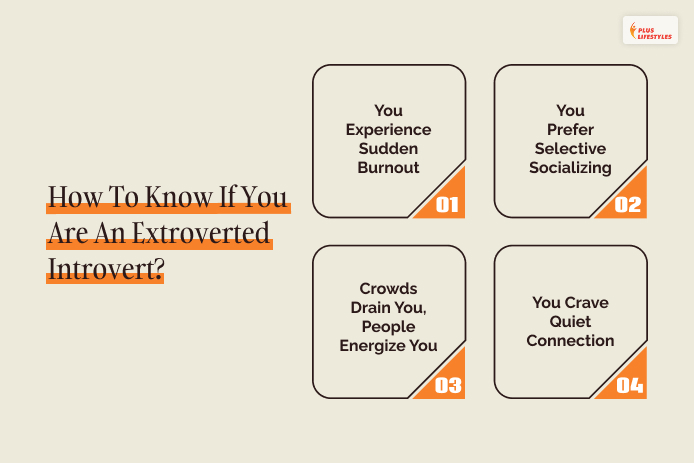
To figure out if you are an extroverted introvert, you must look closely at your behavioral patterns and your recovery needs.
For years, I confused my social skills with true extroversion, but tracking my energy changed everything.
Here is exactly how to know if you occupy this unique middle ground:
1. You Experience Sudden Burnout:
You command a room and charm a crowd effortlessly. However, your social battery hits an invisible wall, causing an immediate, non-negotiable need to escape.
2. You Prefer Selective Socializing:
Secondly, you enjoy meeting new people, yet you ruthlessly filter your inner circle. You trade superficial social breadth for high-quality, deep, one-on-one intimacy.
3. Crowds Drain You, People Energize You:
Large networking events or loud parties overstimulate your nervous system. Conversely, a deep, late-night conversation with a close friend completely fulfills your social needs.
4. You Crave Quiet Connection:
You love “parallel play” with your favorite people. For example, reading books or working on laptops in the same room satisfies your desire for companionship without draining your system.
| Note: Ultimately, if you love humanity but require absolute solitude to function, you are a true ambivert. |
Unpacking My Social Battery: How The Psyche Of An Extroverted Introvert Works
To understand why I move so fluidly through a crowd but burn out so abruptly, I examined the neurological science.
Crucially, the primary distinction between these traits is not a mere mood preference. It is a literal difference in our brain chemistry.
According to Hans Eysenck’s Cortical Arousal Theory, introverts possess a highly sensitive, naturally active reticular activating system (RAS).
Because my baseline mental alertness is already quite high, external stimuli easily push me past my optimal threshold.
For example, crowded networking events, loud music, and superficial small talk rapidly cause overstimulation.
Extroverts, on the other hand, have a lower baseline of cortical arousal. Therefore, they need heavy external stimulation just to feel mentally awake.
Furthermore, clinical reviews in the National Institutes of Health (NIH) literature show that extraversion correlates heavily with the brain’s dopamine reward system.
As analyzed by neurological experts at Henry Ford Health, an extrovert’s brain responds with an intense chemical rush during large social interactions.
As an ambivert, I feel a unique evolutionary push-pull dynamic.
My dopamine pathways trigger a craving for deep, vibrant human connection. This reaction fuels my empathy and expressiveness.
But because my baseline cortical arousal remains highly sensitive, I hit an invisible wall far faster than a pure extrovert.
My social battery does not slowly drain. Instead, it trips a psychological circuit breaker. One minute I am fine, and the next, I am entirely done.
The Ambivert Advantage In The Professional World
For generations, corporate folklore dictated that extreme extroverts made the finest leaders, negotiators, and creators.
Companies always assumed the loudest voice in the room was the most competent. However, groundbreaking organizational research has completely shattered this myth.
In a landmark study published in Psychological Science, Wharton professor Dr. Adam Grant tracked the revenue generation of professionals.
Grant discovered a clear, inverted-U-shaped relationship between extraversion and performance:
| Personality Position on Spectrum | Average Performance & Revenue |
| Extreme Introverts | Lower Tier ($120/hr standard) |
| Extreme Extroverts | Moderate Tier ($125/hr standard) |
| Ambiverts (The Middle) | Peak Performance ($155 to $208/hr) |
Remarkably, Grant’s data revealed that ambiverts outperformed extreme extroverts by 24% to 32%. Why do they win?
They succeed because of behavioral agility.
You see, extreme extroverts often suffer from a deficit of listening. They act overbearing and ignore subtle cues.
Meanwhile, extreme introverts act overly cautious. They miss opportunities to assertively close a deal or make a pitch.
I see this play out vividly in my own career. I win because I balance enthusiastic pitching with deep, active listening.
Additionally, I utilize enough extraversion to pitch ideas boldly. Simultaneously, I apply enough introversion to read the room, absorb feedback, and make sure the other person feels genuinely heard.
Why Extroverted Introverts Thrive In The Hybrid Work Era
Our current macroeconomic environment has inadvertently created the perfect habitat for women like me. Navigating the post-pandemic transition to hybrid corporate structures has completely altered how I measure my productivity.
In a traditional, 100% in-office environment, extreme extroverts thrived on constant visibility. They loved desk-side chats and spontaneous meetings. Conversely, a completely remote arrangement heavily favored the hyper-focused, solitary nature of the pure introvert.
But the hybrid workplace requires us to alternate rapidly between two opposite modes of operation:
- Asynchronous Deep Work: We spend days at home managing data, writing, or planning strategy in absolute isolation.
- Synchronous Collaboration: We head into a shared office for high-stakes, collaborative workshops, client pitches, and team events.
Consequently, I watch my pure extrovert colleagues struggle with the isolation of remote days. They experience drops in morale.
Meanwhile, my pure introvert friends find the sudden bursts of intense office collaboration physically destabilizing.
For me, however, this hybrid model offers a natural rhythm.
I happily utilize my deep-work days to completely recharge my internal battery. Then, I use my collaborative days to express my social capabilities.
How To Balance Love, Friendships, And Selective Socializing As An Ambivert?
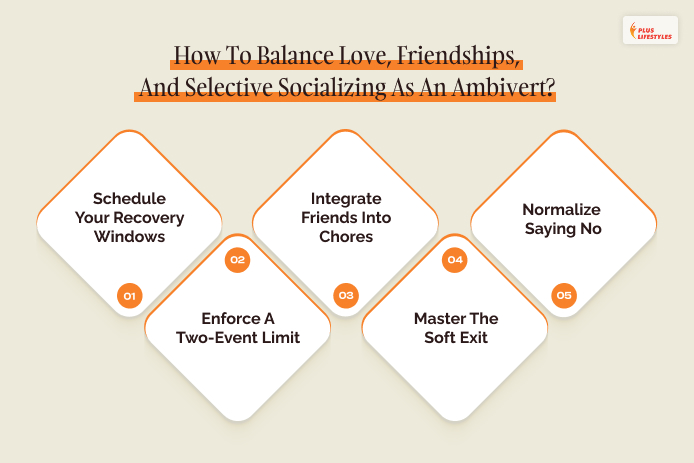
In my personal life, navigating my late 20s as an ambivert requires explicit, radically honest communication.
Relational studies in the Journal of Social and Personal Relationships show that extraverted traits excel at initiating contact with new people. However, introverted traits are heavily tied to cultivating deep, long-term intimacy.
Because of this dynamic, I apply a strict philosophy of high quality, low quantity to my inner circle. I interact effortlessly with a crowd of hundreds. Yet, I only trust a hand-picked few with my genuine vulnerability.
Friction used to occur when my romantic partners or friends mistook my sudden retreats for emotional withdrawal or passive-aggressive anger.
Therefore, I explicitly taught the people in my life a vital lesson. My request for solitude is not a rejection of them.
Rather, it is a necessary act of physiological maintenance. It allows me to return to the relationship fully present.
Here is the exact playbook I use to find my equilibrium in my late 20s:
1. Schedule Your Recovery Windows:
I treat alone time as a non-negotiable appointment. If I attend a high-energy group hangout on Saturday, I block out Sunday to recharge.
2. Enforce A Two-Event Limit:
As an extroverted introvert, I strictly cap my weekly social calendar at two events to prevent a social hangover.
3. Integrate Friends Into Chores:
I combine friendships with my daily routines. I turn grocery shopping, gym sessions, or coffee runs into quick opportunities to catch up.
4. Master The Soft Exit:
I give myself permission to leave early. I establish a graceful exit strategy in advance by declaring a firm departure time.
5. Normalize Saying No:
I decline invitations politely but firmly without over-explaining. Saying, “I need a quiet night in,” successfully preserves my peace.
My Tactical Wellness Framework As An Extroverted Introvert
To successfully capitalize on my ambivert advantage without succumbing to chronic exhaustion, I integrate three expert-backed behavioral boundaries into my life:
- The Pre-Emptive Exit Strategy: Before I enter any high-stimulus social event, I establish a firm departure time in my head. This boundary completely eliminates the anxiety of open-ended social commitments. It successfully protects my cortical arousal threshold.
- Micro-Rest Intervals: During long workshops or multi-hour weddings, I implement brief, 5-minute isolation breaks. I literally step away to a quiet corner or step outside just to let my nervous system reset.
- The Energy Audit: I track my weekly social commitments right alongside my sleep and workload metrics. I treat my social energy as a finite economic asset that requires deliberate budgeting.
Own The Fluidity Of An Extroverted Introvert
Ultimately, being an extroverted introvert is an evolutionary asset in a chaotic world. It gives us the rare ability to command a room when necessary.
Yet, we retain the capacity for quiet, independent reflection and deep analytical focus. By moving away from rigid, limiting labels and embracing the fluid science of the ambivert spectrum, I finally learned a major lesson.
I view my shifting social battery not as a structural flaw, but as my ultimate superpower.