



| Quick Answer The dominant movement in modern fashion is functional hybridity – the blurring of lines between athletic wear, loungewear, and formal corporate attire. Driven by a global shift toward comfort and sustainability, current trends prioritize modular, high-quality basics (like unstructured blazers, linen coordinates, and monochrome sets) that can be infinitely mixed. Rather than buying mass quantities of micro-trends, modern style relies on selective styling tokens. These include puffed sleeves, statement layers, and heavy fabric textures – to project effortless individuality. |
There is a very specific kind of exhaustion that hits you at 8:15 AM on a Tuesday morning.
You are standing in front of a wardrobe packed completely full of clothes. Yet you feel like you have absolutely nothing to wear.
The internet tells you the solution is simple. Buy a linen jumpsuit. Invest in a neutral blazer. Adopt a minimalist aesthetic. Build a capsule wardrobe and your life will suddenly look like a sunlit Pinterest board.
But as you stare at a pile of fast-fashion purchases that lost their shape after three washes, a quiet realization sets in.
Keeping up with style in current fashion trends has stopped being an expression of identity. Instead, it has turned into an expensive, fast-moving checklist.
And somewhere between the TikTok obsession with “Corporate Athleisure” and the stark reality of navigating a humid monsoon commute in India, I started wondering whether we are chasing trends we don’t even actually like.
The Psychology Of The Trend Cycle: Why Everything Feels Common
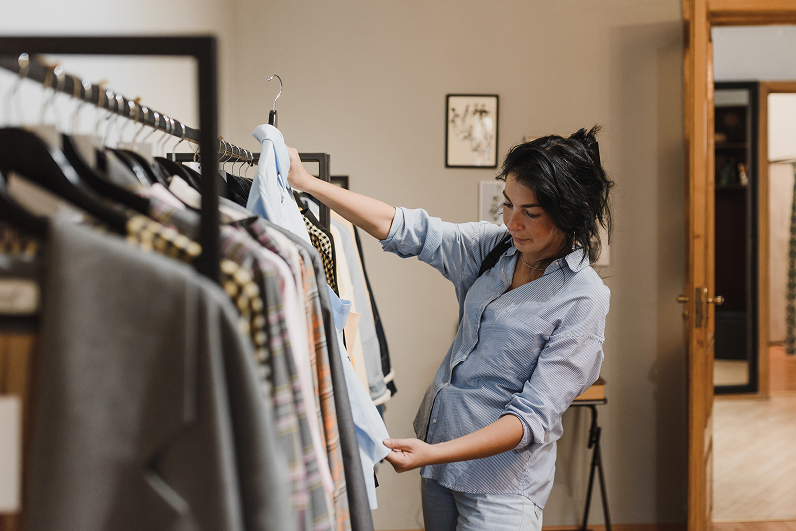
You have probably noticed how fast a trend spreads now. You see a celebrity wearing an oversized tracksuit at the airport. And within forty-eight hours, the exact duplicate is on an algorithm-driven shopping app, filling your feed.
The scientific explanation behind this is what cognitive psychologists call selective attention mixed with aggressive consumer algorithmic mapping.
Once a specific style token – like a puffed sleeve or a particular shade of olive green – enters your digital consciousness, your brain begins prioritizing it in your physical environment.
You aren’t seeing more of it because the world suddenly changed overnight. Your cognitive filter changed.
Stanford linguists and behavioral researchers have long noted that human beings use visual cues to establish tribe alignment. When structural systems change – like the massive global shift toward remote and hybrid work – our dress codes change with them.
That is why Athleisure and Loungewear subverted their way out of the gym and into executive boardrooms. It isn’t just a casual whim – it is a physical reaction to a changing lifestyle rhythm.
The Desi Reality Check: The Extra Clauses In The Wardrobe Checklist
Here is where the conversation gets interesting: building an “effortless” wardrobe in an Indian household comes with a few extra clauses that Western fashion ideas completely ignore.
The minimalist aesthetic looks beautiful online when it is styled in a temperature-controlled studio in London.
But the Western checklist doesn’t account for real life here. For instance, doesn’t really account for:
- A crowded metro ride during a Mumbai or Delhi downpour.
- The sudden, unannounced visit from extended family members who have very specific opinions on what looks “settled.”
Moreover, that’s not all. It doesn’t calculate the sheer amount of dust that ruins an all-white linen aesthetic within twenty minutes of stepping outside.
And it completely ignores the traditional festival calendar, where your minimalist neutral capsule wardrobe suddenly makes you look entirely out of place next to a sea of bright silk saris.
We are told to invest in high-quality materials like pure linen because it is a natural fabric made from flax fibers, offering a sustainable alternative to polyester.
That sounds incredible on paper.
But anyone who has actually worn a pure linen shirt to a corporate meeting knows the terrifying speed at which it wrinkles the moment you sit down in an auto or a desk chair. By 11:00 AM, your “effortless” style just looks messy.
The problem isn’t that Indian men and women don’t understand fashion trends. The problem is that we are trying to force imported, hyper-minimalist templates onto a highly colorful, high-context, and climate-challenging lifestyle.
The Ultimate Irony: The Great Cultural Style Swap
There is a profound, almost comical irony happening in global fashion right now, and it is time we named it out loud.
While Indian millennial and Gen Z shoppers are frantically emptying their wallets for flat, minimalist, Western-style monochrome coordinates, international runways are doing the exact opposite.
Foreign designers are looking at India and getting drunk on our vibrant colors, regional block prints, and intricate motifs. They are stripping away the minimalism and injecting traditional Indian design vernacular into their contemporary lines to make them look premium. [Source: First Resort]
Yet, walk into any high-end corporate office or modern cafe in Mumbai or Bangalore, and you will see a sea of beige, grey, and black.
We have allowed ourselves to believe that “smart casual” must mean boring. We have been conditioned to think that to look modern, professional, or corporate, we must bleach out our own visual history.
As a result, we are voluntarily choosing a muted palette. Meanwhile, the rest of the fashion world is raiding our heritage for inspiration.
The Great “Chandelier Earring” Disrespect
This cultural amnesia doesn’t stop at our clothes. It has deeply invaded our jewelry boxes.
A few months ago, the internet went into a frenzy because traditional Indian jhumkas suddenly started trending globally. The catch? Western fashion publications re-baptized them as “Chandelier Earrings.” [Source: Times of India]
It is utter nonsense.
A jhumka is not just a dangling piece of metal. It is a centuries-old structural art form deeply rooted in regional Indian identity. Re-labeling it to fit a Eurocentric vocabulary doesn’t make it modern – it makes it anonymous.
But the real tragedy isn’t that the West re-branded our jewelry. The tragedy is that many Indians didn’t care until a foreign label gave it a stamp of approval.
We hide our heavy, beautiful heritage silver and gold pieces in lockers, waiting for a wedding function, while happily paying premium prices for cheap, geometric Western jewelry that tarnishes within six months.
The “Desi Daftar”: Reclaiming Main Character Energy
Thankfully, the boring, monochrome Western checklist is starting to face a gorgeous, grassroots rebellion. Step into any Indian corporate office today, and you will notice a growing wave of women completely rewriting the rules of professional attire.
They are swapping stiff linen trousers for breezy, long block-printed kurtis paired with culottes, and trading structured Western suits for vibrant, lightweight chiffon and organza sarees.
You can thank Bollywood and our Instagram “For You” page for this corporate aesthetic shift.
The movement draws a straight line back to Shoojit Sircar’s Piku (2015), where Deepika Padukone’s character proved that an architect could command authority in casual, fluid cotton kurtas, wide-leg trousers, and minimal silver jewelry.
That blueprint laid dormant for a few years. But it was blown wide open by Alia Bhatt’s character, Rani Chatterjee, in Rocky Aur Rani Kii Prem Kahaani.
Playing a sharp, fast-talking television news presenter, Rani transformed the traditional saree from “wedding wear” into the ultimate daytime power-dressing uniform by opting for light, vibrant, color-blocked drapes that move effortlessly.
Direct Styling Blueprint: Moving from Commodity Trends to Execution
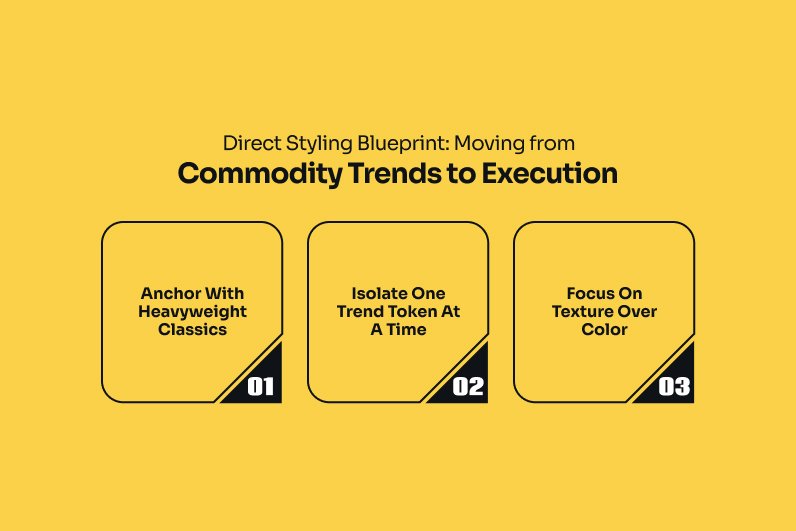
If you want to use current fashion trends without letting them consume your monthly budget, you have to separate collecting possibilities from actual execution.
Our shopping carts are full of saved items we will never wear because we are buying for a fantasy version of our lives. To break that loop, I would say use these three non-negotiable rules:
1. Anchor With Heavyweight Classics
Do not buy trend-first items. Invest your money into high-quality, structured anchors: sharp blazers, tailored trousers, and crisp white shirts. These are non-negotiable foundations.
When you pair an expensive, structured blazer over a basic, affordable fast-fashion bodysuit, the blazer visually pulls the entire outfit up, making it look luxury.
2. Isolate One Trend Token At A Time
If monochrome sets are trending, wear the set, but keep your footwear completely classic.
If puffed sleeves or dramatic statement zippers are popular, let that single detail do all the heavy lifting in your outfit.
When you combine streetwear layers, athleisure sneakers, and vintage accessories all at once, you stop looking stylish and start looking like an algorithm.
3. Focus On Texture Over Color
The easiest way to stand out in a crowd of commodity fashion is through fabric weight and detailing. Look at the buckles, the hardware of the zippers, and the density of the weave.
A heavy, well-textured rib-knit top will always look more premium than a thin, flat polyester blend, regardless of what brand name is printed on the tag.
The Verdict: The Red Car Principle Of Fashion
Ultimately, fashion trends are exactly like the Red Car Theory. If you spend all day looking for what you lack, the algorithm will continuously serve you proof that you are behind the trend cycle. It will make your current wardrobe feel obsolete every single month.
The clothing items aren’t actually new. The strategy is.
The life you want isn’t waiting at the bottom of a new shopping cart. Style isn’t about proving you checked every single box on a trend report. It is about choosing which pieces actually serve your daily physical movements, your climate, and your cultural context.
The trend cycle is only useful if you control the filter. Otherwise, you are just paying to wear someone else’s definition of adulthood.
Sources:
- The Prada Kolhapuri Collaboration (December 2025 – Early 2026)
- Istituto Marangoni’s Fashion Analysis (2026).
- Business of Fashion (BoF) Coverage of Dior in Mumbai.
- CNN Style’s report on Indian artisans.
- India’s World Fashion Archives.
- The New Indian Express: Chatpata couture: How Gen Z is spicing up Indian fashion
- Vogue Fashion Institute Data Report (2026)
- IDEA Worldwide’s Gen Z style reports
- First Resort 2026 Indian Fashion Spending Data Report
- Times of India: Ralph Lauren ‘jhumka’ earrings spark viral cultural appropriation debate after Paris Fashion Week show