



| Quick Answer A karmic relationship is a volatile, high-intensity connection driven by unresolved emotional wounds and trauma bonds rather than true compatibility. While spiritually described as a bond meant to resolve past-life karma, psychologically it acts as a relational mirror that forces individuals to face unhealed childhood patterns and boundary issues. |
I used to think that “the spark” was a green light. You know the one – that magnetic, almost electric pull toward someone that makes you feel like the universe has personally intervened to bring you together.
In my earlier writing, I might have called it destiny. But after years of researching relational patterns and living through a few “destinies” that nearly broke me, I’ve realized that intense familiarity often isn’t a sign of a soulmate. Usually, it’s a sign of a karmic loop.
In 2026, we are finally having a collective “vibe shift” regarding how we label our pain. We are moving away from the spiritual fluff that tells us we must suffer to grow.
As I’ve dug into the data and my own history, I’ve found that the term “karmic relationship” is often just a fancy, 12-syllable way of describing a trauma bond. It’s the “grey area” of the soul.
What Is A Karmic Relationship, Really?

When I told my friend that my partner and I decided to part ways after more than a decade of being together, the first thing he said was: I knew it was a karmic relationship!
And it took me weeks to understand what he meant. It took months to really see the signs myself – of something that no longer exists, yet lingers.
So, what is a karmic relationship?
If you look it up in a spiritual textbook, a karmic relationship is defined as a connection between two souls who have “unfinished business.” The idea is that you’ve met in a past life and you’re back to settle the score.
But when I look at this through a more grounded lens, I see a Relational Mirror. These relationships aren’t necessarily meant to last – they are meant to reflect back to us the parts of ourselves we haven’t healed yet.
It’s like a crash course in self-awareness, but the tuition is your peace of mind. In my experience, a karmic bond is characterized by an addiction to the “highs” and a devastating tolerance for the “lows.”
It’s high-intensity, low-security, and almost always temporary.
The 8 Signs You’re In A Karmic Relationship (And Not A Soulmate Bond)
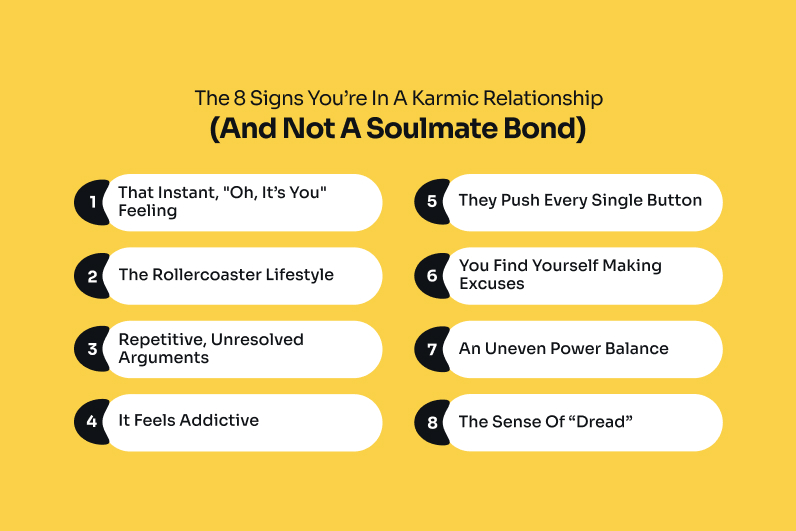
Based on my research and the hundreds of stories I’ve heard from readers, these are the hallmarks of a bond that is teaching you a lesson rather than building a life with you.
1. That Instant, “Oh, It’s You” Feeling
I’ve learned to be wary of “instant” chemistry. When you meet a karmic partner, it feels like you’ve known them for lifetimes within the first five minutes.
It’s an unexplained familiarity. While that feels romantic, it’s often just your nervous system recognizing a familiar pattern – usually one that mimics a struggle you had in childhood.
2. The Rollercoaster As A Lifestyle
If your relationship feels like a constant “Vibe Check” where you’re either on top of the world or crying in your car, it’s karmic. These connections thrive on drama.
I used to think the “make-up sex” and the grand apologies were proof of passion. Now, I see them for what they are: cortisol spikes.
3. You’re Having The Same Fight On Repeat
One of the most frustrating things about these bonds is the repetition.
You’ll have a breakthrough, a “Clear-Coding” conversation where you think everything is fixed, and then three weeks later, you’re back in the exact same argument.
It’s a loop that doesn’t resolve until the lesson is learned – and usually, the lesson is that you can’t change them.
4. It Feels Addictive
I’ve spoken to so many people who say they know the person is bad for them, but they physically cannot leave. It’s a chemical addiction.
The unpredictable nature of a karmic partner creates an intermittent reinforcement schedule in your brain – the same mechanism that makes gambling so addictive. You’re waiting for the “win” that rarely comes.
5. They Push Every Single Button
A soulmate supports you; a karmic partner activates you. They don’t just know your insecurities; they seem to have a map of them.
In my research, I’ve found that these partners act as “activators” for our deepest wounds. If you have an abandonment wound, they will be inconsistent. If you have a worthiness wound, they will be critical.
6. You Find Yourself Making Excuses
When I was in my own karmic loop, I became an expert at defending the indefensible.
I’d tell my friends, “You just don’t understand our connection,” or “He’s going through a lot right now.”
If you’re isolating yourself from your “inner circle” because you’re tired of them telling you the truth, that’s a massive red flag.
7. An Uneven Power Balance
These relationships are rarely a partnership of equals. Usually, one person is the “rescuer,” and the other is the “wounded project.”
I’ve realized that you can’t build a stable “We” when one person is constantly trying to “fix” the other. It’s exhausting, and it eventually leads to total burnout.
8. The Sense Of “Dread”
Even in the “good” moments, there’s an underlying sense of “when is the other shoe going to drop?”
You’re constantly scanning the horizon for the next storm. That lack of safety is the biggest differentiator between a karmic bond and a healthy relationship.
The Growth Trap In Karmic Relationship: Why “Staying For The Lesson” Is A Myth
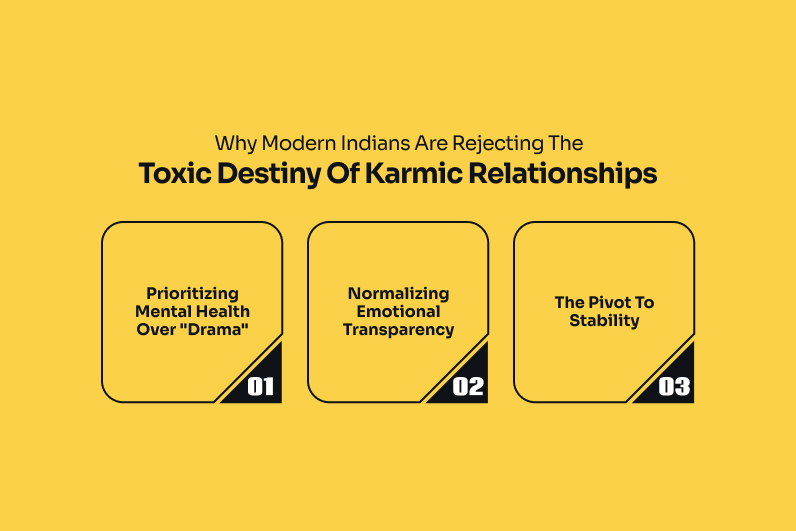
Here is where I have to be really honest with you: The biggest mistake I see (and have made) is staying in a particular situation because we think we haven’t “learned the lesson” yet. We’ve romanticized the struggle. We tell ourselves that the pain is just “clearing karma.”
But from what I’ve seen in my years, the lesson is usually learning how to leave. The universe isn’t testing your ability to endure pain – it’s testing your ability to choose yourself.
TBH, I would say “stability” is the new goal in 2026 – as it should. We are looking for partners who provide a “Safe Harbor,” not a stormy sea.
How To Break The Cycle (Without The Drama)
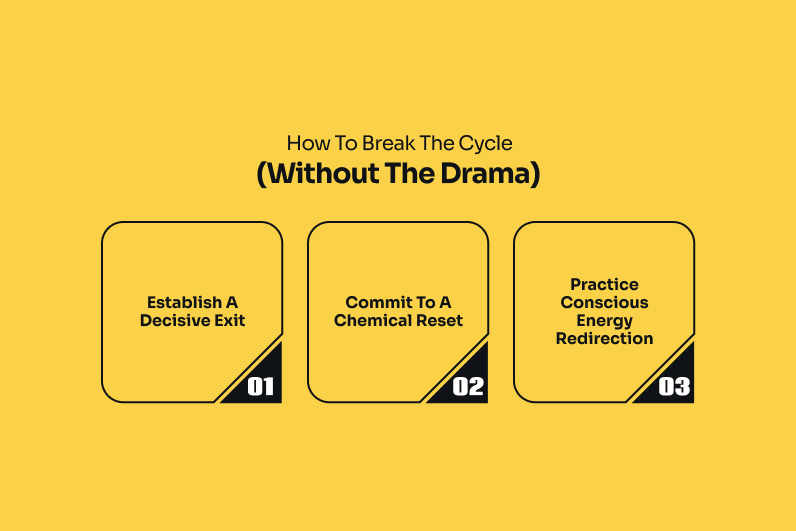
If you’ve realized you’re in a loop, the exit isn’t usually a grand cinematic moment. It’s a quiet, firm decision.
Here are a few steps that you can take:
- Decisive Exits: “Clear-coding” boundaries can prevent “closure talks” that often spike cortisol by 30%.
- Chemical Reset: No-contact allows dopamine to drop 50%, effectively detoxing brain addiction pathways.
- Energy Redirection: Mental “cord-cutting” stops rumination, which 40% of practitioners successfully reduce within 30 days.
I’m a huge advocate for “Clear-Coding” your exit. Don’t leave room for “maybe.” Don’t engage in a three-hour “closure” talk that just turns into another fight.
Closure is something you give yourself; it’s not something you negotiate with someone who doesn’t respect your boundaries.
In my experience, “No Contact” is the only way to break a karmic addiction. And I know it is extremely difficult. But you need to let the chemicals in your brain settle before you can see the situation for what it actually was.
I also suggest a “Mental Cord-Cutting.” Every time you find yourself obsessing over “what they meant” by a text, consciously redirect that energy back to yourself. What do you need today? What part of you was that person mirroring?
Does A Karmic Relationship Mean It WILL End?

This is the million-dollar question I get asked most often. If it’s “karmic,” is it automatically doomed?
The short, honest answer is: Usually, yes. But not because the universe is cruel. It’s because the very foundation of a karmic bond is growth through friction.
Karmic relationships are designed to be temporary “shortcuts” for soul evolution. Once the lesson is actually learned, the magnetic pull that kept you glued together often just evaporates.
And by “lessons” I mean:
- Learning to set a boundary.
- Discovering your own worth.
- Finally saying “no” to a toxic pattern.
However, there is a rare exception.
I’ve seen cases where both partners are equally committed to doing the heavy, messy “ego work” required to transform a karmic cycle into a healthy partnership.
But let’s be real: that takes two people doing the work at the exact same pace.
If you are the only one reading the books, going to therapy, and trying to “clear the energy,” you aren’t in a partnership – you’re in a one-sided project.
In my experience, trying to “force” a karmic relationship to be a lifelong soulmate bond is like trying to turn a hurricane into a light summer breeze. You can try, but you’ll likely just end up exhausted.
Most of the time, the “success” of a karmic relationship isn’t measured by how long it lasts, but by who you become once it’s over
You Deserve Safety, Not Just A Story
At the end of the day, a relationship should be a place where you can exhale, not a place where you’re constantly holding your breath.
I’ve stopped looking for the “destined” explosion and started looking for the “boring” consistency of someone who just does what they say they’re going to do.
Karmic relationships make for great stories and intense poetry, but they make for a miserable life. Once you learn that your worth isn’t tied to how much chaos you can survive, the karmic cycles stop. You stop being a “project” and start being a partner.
You’ve learned the lesson. You’ve seen the mirror. Now, it’s time to walk away and find the kind of love that doesn’t require a spiritual justification for why it hurts so much.
Stop romanticizing the struggle. You are worth a love that is certain.