
| Quick Answer Millennials – told that a degree, discipline, and career-ladder patience would guarantee stability – are burning out earlier, owning less relative to their parents’ generation, and facing a labor market being reshaped by AI faster than any generation before them. Hence, the Great Millennial Career Crisis. In India specifically, IT and BFSI millennials report some of the highest burnout rates in the world. But the data also shows something more hopeful than collapse: a generation actively building side incomes, redefining ambition, and treating flexibility as the new marker of success. This is a correction, not a retreat – and the numbers back that framing up in every direction, not just the grim ones. |
In 2024, a video of a florist quitting her corporate job went viral. And the phrase “Great Millennial Career Crisis” entered the cultural vocabulary.
What started as a single moment of catharsis has since become shorthand for something much larger: an entire generation quietly reassessing the deal it was sold.
Millennials – the largest and most educated generation in history – were told that a degree, discipline, and career-ladder patience would deliver stability, ownership, and identity.
It is almost like we were sold a dream.
Two years on from that viral moment, the 2026 data suggests the reassessment was not a mood. It was a correction, and it is still unfolding.
This case study pulls together the current burnout, wealth, employment, and labor-market data to test the original thesis: are millennials abandoning work, or redefining what work is supposed to give them back?
The Great Millennial Career Crisis

This year, I will turn 30. The last batch of millennials to turn 30. And the worst part is – I feel like a lost cause. I feel I have let down my parents and myself. Because let’s face it, most of us (including me, as I sit to write this case study while sipping my espresso) come from more or less a privileged background.
We went to a good school. We received an education. And we are earning a livelihood that a lot of people would die for.
However, sense of achievement – absolute zero.
When I first came across the video of Vienna Hintze (the then 29-year-old I spoke about earlier), I swear I could connect. [Source: CNBC] When the phrase “Great Millennial Career Crisis” showed up in comment sections and think-pieces alike, it struck a nerve.
Because it named something a lot of people had been feeling but hadn’t said out loud. That they did what they were told. Studied hard, took the internship, said yes to the extra project, moved cities for the promotion. Somewhere along the way, the promised payoff – security, ownership, a sense that the effort was going somewhere – stopped showing up on schedule.
If you’re a millennial woman in India reading this after a day of back-to-back calls that started before your commute even ended, none of this needs much explaining.
The specific exhaustion of being “on” from a 9 AM stand-up to a 10 PM client call because half your team sits in a different time zone. The mental math on a Mumbai or Bangalore flat’s price-to-income ratio, quietly abandoned mid-scroll.
The freelance work picked up on the side. Not as a passion project, but because the numbers on the primary salary stopped adding up around the second year, with inflation outpacing the appraisal.
Part One: The Burnout Baseline

Burnout is no longer a fringe complaint – it is the dominant condition of the modern workplace, and millennials sit near the top of nearly every measure of it.
Generational burnout data varies by methodology. But the pattern holds across sources: millennials sit near the top of nearly every measure.
Eagle Hill Consulting’s late-2025 survey puts millennial burnout at 58%, behind only Gen Z. And that’s not all!
Aflac’s 2025 report finds roughly two-thirds of millennials report moderate-to-high burnout. Deloitte’s 2026 Gen Z and Millennial Survey adds a telling detail: only 6% now say becoming a leader is their primary career goal, with burnout and poor work-life balance cited as the top reasons for stepping off the leadership track.
What’s driving it is structural, not personal.
Millennials and Gen Z hit peak burnout around age 25, compared with 42 for the average worker – a 17-year gap.
India’s numbers are more acute still. McKinsey Health Institute research places India at the top of a global burnout ranking, with 59% of Indian employees currently experiencing symptoms against a 20% global average.
Deloitte India’s 2025 data puts burnout among IT and BPO professionals at 75%. It is driven by 60 – 70 hour weeks, night shifts aligned to Western client time zones, and hiring that hasn’t kept pace with growth.
A Nasscom-Deloitte report found 68% of Indian IT professionals show at least two clinical burnout indicators:
- Emotional exhaustion.
- Depersonalization.
- Reduced sense of accomplishment.
The gendered layer deserves its own mention.
Research on Indian workplaces found 37% of female employees cite poor work-life balance as their top reason for wanting to quit, against 28% of male peers – the “double burden” of a full workday followed by unpaid domestic and caregiving labor, with almost no recovery window in between.
What Burnout Does To Your Body
It’s worth being precise about what burnout means physiologically. Because, honestly, the wellness conversation around it often stays at the level of vibes when there’s real biology underneath.
Chronic, unmanaged workplace stress keeps the HPA axis – the hormonal system governing stress response – switched on long after the actual trigger has passed. Cortisol, meant to spike briefly and fall, stays elevated instead.
A systematic review of prospective burnout studies links sustained elevation to a specific, documented list of physical outcomes:
- Higher cholesterol.
- Greater type 2 diabetes risk.
- Coronary heart disease.
- Disrupted sleep.
- Gastrointestinal issues.
- Chronic headaches.
- Weakened immune response.
And – in severe long-term cases – elevated mortality risk before age 45.
This isn’t wellness-industry language; it’s really not just me writing about it as a lifestyle writer. Rather, it’s what shows up consistently in peer-reviewed occupational health research.
That context matters given how normalized these symptoms have become. If you’ve finished a nine-hour workday and walked straight into grocery runs, cooking, or caregiving with zero recovery window, that’s not just a scheduling problem. It’s the mechanism above playing out in your actual nervous system.
Only about 1 in 10 employees in Indian corporates report having real access to professional mental health support, as per Mpower’s research. So this means most of this is happening without any structural safety net underneath it.
Part Two: The Generational Wealth Gap Behind The Burnout Crisis
Burnout does not happen in a vacuum. It happens inside a rigid economic structure that has made the traditional payoff for hard work – homeownership, savings, and generational security – measurably harder to reach than it was for previous generations.
The Core US Wealth Imbalance
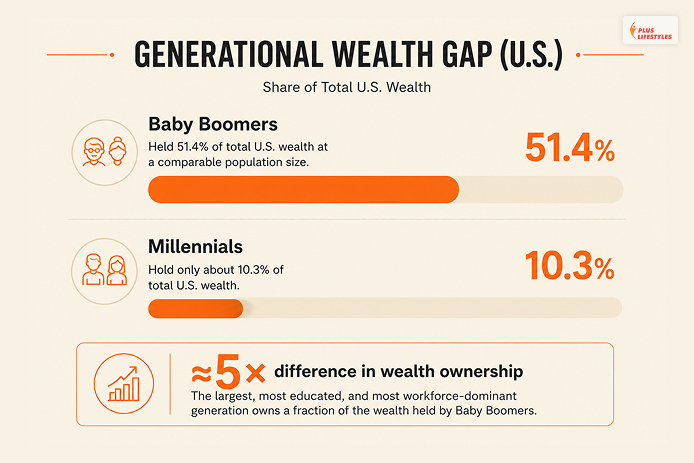
Millennials are currently the largest, most educated, and most workforce-dominant generation in US history. Yet, a massive disparity exists when looking at generational wealth distribution:
- Millennial Asset Share: Hold only about 10.3% of total US wealth.
- Baby Boomer Asset Share: Held 51.4% of total US wealth at a comparable population size.
This gap is the single most-cited statistic in generational wealth research. It explains exactly what the “burnout crisis” means in practice.
It is not just about daily job satisfaction. Rather, it is our fundamental question of whether career effort still translates into the milestones it once did.
The Real Estate Barrier
Housing data clearly illustrates the uphill climb for first-time buyers trying to enter the market:
- Record High Age: The median age of a first-time US homebuyer hit an all-time high of 40 in 2025. This is a massive leap from an average age of 31 a decade prior, and 29 in 1981.
- Shrinking Market Share: First-time buyers now make up just 21% of all home purchases, marking the lowest share on record.
- Boomer Dominance: Baby boomers account for 42% of purchases. They hold an estimated $19 trillion in home equity built over decades of appreciation that younger buyers missed out on.
The Compound Burden Of Debt
Student loans significantly delay wealth accumulation. The average 2023 graduate carried approximately $37,700 in student debt. Financial researchers estimate this specific monthly payment burden causes two major setbacks:
- Reduced Purchasing Power: Lowers a buyer’s home-purchasing power by $52,000 to $70,000.
- Delayed Timelines: Adds several years to the baseline down-payment savings timeline.
The Global Parallel: A Shift In India
While market structures differ, the underlying financial tension is strikingly universal. Anyone comparing current rental prices in major Indian metros to what their parents paid for an entire flat at the same age will find the pattern familiar.
According to Deloitte’s 2026 survey data:
- Top Concern: The cost of living has ranked as the number one financial concern for millennials and Gen Z for five consecutive years.
- Delayed Milestones: More than 50% of respondents state that intense financial pressure has forced them to delay marriage, higher education, or starting a family.
The Counter-Trend: Late-Stage Acceleration
A fair, data-driven analysis must acknowledge that millennials are not universally locked out of stability. Significant financial recovery occurred in the mid-2020s:
- Growth Spurt: US millennial wealth grew by 13% in 2024 alone.
- Crossing the Threshold: Millennial homeownership successfully crossed 52.4% for the first time in 2025.
- Net Worth Paradox: The Federal Reserve’s Survey of Consumer Finances highlights that millennials’ median net worth in their late 30s is actually higher than boomers’ median net worth was at the same age, adjusted for inflation.
We can attribute this sudden surge largely to rapid equity market gains and home price appreciation between 2020 and 2024.
Ultimately, the path to stability is simply much slower, later, and far more precarious than the one previous generations walked.
The divide is widening rapidly between buyers who have parental financial help or intergenerational wealth to draw on, and those who do not.
Part Three: The Job Itself Is Changing Underneath Them
The 2025 – 2026 labor market disruption marks a major structural shift, heavily defined by the rise of “AI washing.”
Labor economists interviewed by outlets like Built In and The Street describe companies attributing layoffs to AI-driven efficiency gains to please investors, masking the true culprits: overhiring, weak demand, or straightforward cost-cutting.
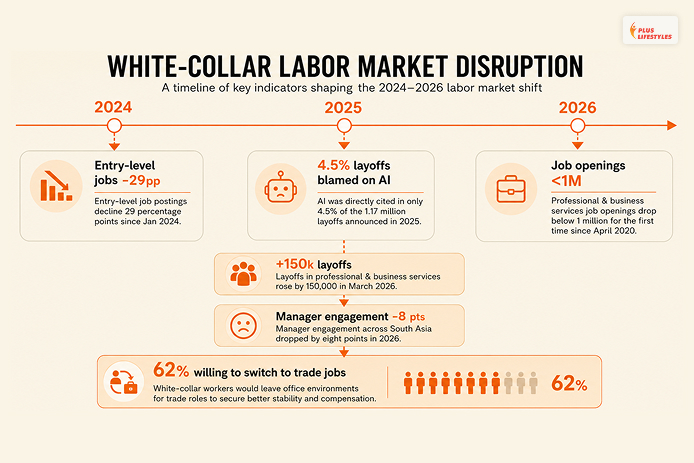
While AI dominates the public narrative, Challenger, Gray & Christmas data reveals it was directly cited in only 4.5% of the 1.17 million layoffs announced in 2025.
Even consulting giant McKinsey cut roughly 200 technology and support staff in late 2025, blaming AI-driven efficiency.
Regardless of the underlying causes, the impact on white-collar hiring is measurable, hitting entry-level positions the hardest. Entry-level job postings have plummeted 29 percentage points since January 2024.
Furthermore, KPMG’s analysis of January 2026 JOLTS data shows professional and business services job openings dropped below one million for the first time since April 2020, with layoffs rising by 150,000 in March 2026.
This crisis is global. In India, the contraction heavily impacts the IT and BFSI sectors, which are already carrying the heaviest burnout load.
Gallup’s 2026 data shows manager engagement across South Asia dropped by eight points in a single year, driven by hiring slowdowns and mid-level cuts in India’s IT sector. This leaves the most exhausted workers facing the highest job insecurity.
In response, workers are actively pivoting toward “white-collar trade jobs” – hands-on, skilled roles like data center infrastructure that offer corporate-adjacent pay with AI-resistant security.
A 2025 FlexJobs report found that 62% of white-collar workers would leave office environments for trade roles to secure better stability and compensation.
This surge in demand for infrastructure technicians proves the market crisis is triggering active labor reallocation, rather than just anxiety.
Part Four: The Response – Side Hustles And Portfolio Careers

The most telling data in this case study isn’t the burnout or the layoffs – it’s what millennials are doing about it. And the pattern is consistent: rather than opting out of ambition, they are diversifying it.
Roughly 44 – 50% of millennials now report having a side hustle, the second-highest rate of any generation after Gen Z, and millennial side hustlers earn more from that work than any other generation – averaging just over $1,100 a month, ahead of Gen Z, Gen X, and boomers.
Motivations have shifted meaningfully over the past five years: the share of side hustlers citing “making ends meet” as their primary reason jumped from roughly 12% in 2021 to over 27% in 2026, suggesting the side hustle economy has moved from a discretionary lifestyle trend to a load-bearing part of household budgeting for a meaningful share of this generation.
In the freelance and gig economy more broadly, millennials remain the dominant demographic – making up close to half of all gig workers in the US, per multiple 2026 industry surveys – and the majority describe the shift as intentional rather than forced.
Roughly 63% of freelancers say going independent was entirely their own choice, and voluntary freelancers report higher satisfaction than traditional employees across most measured dimensions, including work-life balance.
Industry analysts are increasingly using the term “portfolio career” or “side stacking” to describe what were once informal side gigs – treating a mix of freelance, fractional, and project-based income as a deliberate career architecture rather than a stopgap.
This is the clearest evidence for the “correction, not collapse” framing.
Millennials aren’t rejecting work. They are rejecting the specific bargain of single-employer, ladder-climbing loyalty in exchange for security that no longer reliably materializes – and they are building alternative structures, however imperfect, to replace it.
Response To The Crisis In India
My friend and I were discussing life at a cafe last Sunday. You know – aging parents, crumbling economy, this constant overwhelming feeling, and mental health that’s on life-support – the usual.
And there’s something that she said: We are millennials; we are different from every other generation. Because we can adapt the best. And we will surely get through!
Surely enough, this response shows up in India too, in a form many working women here will recognize immediately:
- Consulting on the side.
- Running a small content or design practice alongside a full-time role.
- Monetizing a skill on a niche platform.
- Building toward eventually going independent.
It’s rarely framed as reckless in the data – it’s framed as a hedge, a way of not putting an entire financial and professional identity into a single employer relationship that may or may not still exist, in its current shape, three years from now.
Correction Or Collapse? Reframing The Crisis

Putting these four data threads together – burnout, wealth, disrupted entry points, and the portfolio-career response – a clearer picture of the “Great Millennial Career Crisis” emerges than the framing usually allows for.
Either “millennials are struggling” or “millennials are thriving.”
It is not, on the evidence, a story of a generation giving up. Millennial wealth grew 13% in 2024. Homeownership is ticking up, even if later and harder-won than for prior generations.
Voluntary freelancers report higher satisfaction than traditional employees. Side hustle income is rising faster for millennials than any other cohort. These are not the markers of collapse. Rather, they are the markers of adaptation under real constraint.
But it is also not a manufactured panic.
The burnout numbers are too consistent across independent survey methodologies to dismiss. The wealth gap is a documented, multi-decade structural fact, not a generational complaint.
And the AI-driven disruption to white-collar entry points – whatever its true causal share – is changing the shape of the career ladder millennials spent their twenties and thirties climbing, in real time, while they are still on it.
The most useful way to describe what’s happening is a redefinition of the psychological contract of work. The old contract: sustained effort at a single employer converts predictably into promotion, home equity, and retirement security.
The emerging one, visible in the data, is closer to:
- Build multiple income streams.
- Treat any single employer relationship as provisional.
- Measure success by sustainability rather than title or tenure.
That’s not a crisis in the sense of an ending. It’s a renegotiation – uncomfortable, uneven, and still being written, but a renegotiation rather than a retreat.
A Realistic Framework
Data alone doesn’t lower cortisol.
Here’s a practical way to use what’s above. Audit your own burnout risk honestly:
- Are you sleeping through the night, or waking already tired?
- Is there a low hum of dread before opening the laptop, even on light days?
These are the early markers research links to sustained cortisol elevation – catching them here is easier than recovering from clinical burnout later.
Protect one non-negotiable boundary before adding anything else – not five new habits, one. A hard stop time for calls, a phone-free first hour after logging off.
Boundary erosion is one of the most consistently cited burnout drivers in Indian workplace research; a single reclaimed boundary does more than a wellness app opened twice.
If you’re building a side income, treat it as a hedge, not a second job – set hours for it the way you’d set hours for a client, since burnout risk rises when a side income becomes an unstructured extra shift.
And separate the financial conversation from the self-worth one: the wealth and housing data here is structural, decades of price-to-income divergence, not a personal failure to “adult” correctly. Naming that distinction out loud changes how the pressure sits in the body.
What The Data Suggests Comes Next
The convergence of burnout, wealth inequality, and AI disruption reveals that millennials are actively renegotiating their relationship with work, moving away from traditional corporate milestones toward a model defined by individual sustainability and diversified income.
From what I can see, this shift carries three major implications:
- Systemic Burnout Over Individual Resilience: Wellness perks and resilience messaging consistently miss the mark. The data points to structural pressures – such as sandwich-generation caregiving, AI-driven scope creep, and delayed homeownership – that cannot be fixed by corporate wellness programs.
- The Portfolio Career as the New Baseline: Side hustles and freelance portfolios are no longer optional trends; they are the primary lens of the millennial career. Rising independent income streams suggest this shift will deepen as AI lowers the barrier to independent work, forcing professionals to protect their own well-being by diversifying their revenue.
- A Nuanced View of Technological Disruption: The white-collar AI story remains highly contested. “AI washing” serves as a legitimate counterpoint to overheated narratives, meaning future outlooks must track investor-driven layoff data independently from actual entry-level hiring contractions.
The Great Millennial Career Crisis, on the evidence, is real – but it’s better understood as the visible, well-documented cost of a generation renegotiating its relationship with work than as a story of an entire cohort walking away from ambition altogether.
Sources:
- McKinsey Health Institute (2023)
- Eagle Hill Consulting (2025 Workforce Survey)
- Aflac WorkForces Report (2025)
- Deloitte Global 2026 Gen Z and Millennial Survey
- Gallup, State of the Global Workplace (2025 – 2026)
- Fortune/Principal Financial (2025)
- MHFA India (Dwivedi et al., 2026)
- Federal Reserve Distributional Financial Accounts (Q1 2025) and Survey of Consumer Finances (2022)
- Mpower Mental Health and Wellness Quotient Survey (2023)
- New America, “Framing the Millennial Wealth Gap” (2026)
- National Association of Realtors first-time buyer data (2025)
- Challenger, Gray & Christmas layoff tracking (2025 – 2026)
- KPMG JOLTS analysis (January 2026)
- Built In, “Did AI Take Your Job? The Truth About AI Washing” (2026)
- FlexJobs (2025)
- Bankrate/Hostinger/Podbase/Whop side hustle statistics (2026)
- MBO Partners/Upwork gig economy data (2026).