

| Quick Answer: Women’s cortisol doesn’t behave identically to men’s – acute stress spikes tend to be smaller, but sex hormones change how cortisol is measured and felt across the menstrual cycle. Reducing cortisol as a woman means accounting for that cycle, not just following generic stress-management advice built around a male baseline. |
Most advises on “how to reduce cortisol levels in women” that I have come across on the internet does one thing. They treat as if bodies are interchangeable.
They’re not, hormonally speaking.
Research shows women’s acute cortisol response to psychological stress is typically 1.5 to 2 times smaller than men’s – but that doesn’t mean women have it easier overall.
Estrogen raises cortisol-binding globulin, a protein that increases the total cortisol a blood test measures, without necessarily raising the active, biologically effective cortisol your body actually responds to.
Progesterone works differently – it has a calming effect and genuinely dampens cortisol’s impact. Which means when progesterone drops, cortisol’s effects become more noticeable, even if the raw amount produced hasn’t changed much.
The Cycle Connection Nobody Explains Well

That progesterone drop happens predictably twice: in the luteal phase (after ovulation, before your period) and more permanently during perimenopause.
A meta-analysis comparing cortisol across cycle phases found it tends to run higher in the follicular phase relative to luteal, though findings vary by study and measurement method. This is genuinely still being refined, not settled science.
What is consistent is the lived pattern a lot of women already recognize: heightened anxiety, worse sleep, or a shorter fuse in the days before their period, which lines up with progesterone’s drop leaving cortisol’s effects less buffered.
The Myth I Almost Believed
While researching this, I ran into something called the “pregnenolone steal” theory – the idea that under stress, your body diverts a shared hormone precursor away from progesterone production toward cortisol instead, essentially “stealing” it.
It’s a tidy explanation, and I nearly used it.
But current evidence doesn’t actually support it. Cortisol and progesterone are synthesized in separate zones of the adrenal gland with independent precursor supplies. So there’s no real steal happening.
The more likely explanation is that chronic stress disrupts ovulation and progesterone production through a separate pathway entirely. Worth knowing, because this theory shows up constantly in wellness content presented as settled fact.
Why This Matters More If You Have PCOS
There’s another reason cortisol deserves specific attention for Indian women: PCOS.
A nationwide ICMR task force study of nearly 9,824 women found the weighted prevalence in India runs between 7.2% and 19.6% depending on diagnostic criteria – among the highest reported globally.
Now known as PMOS, PCOS and cortisol regulation are closely linked. The same chronic stress response that keeps cortisol elevated can worsen insulin resistance and hormonal imbalance that PCOS already involves.
If you have PCOS, the cycle-related cortisol patterns described above are worth paying closer attention to, not less.
What This Looks Like Day To Day For Indian Working Women
None of this hormonal complexity exists in isolation from actual daily stress.
For a lot of us, that stress isn’t one big event. A full workday accumulates alongside a second, unpaid shift of household admin, family expectations, and a phone that never really clocks off.
For many of us, it also includes navigating joint-family dynamics and in-law expectations that come with their own, very specific pressure to always be “available” and accommodating. That’s something that rarely shows up in generic stress-management advice at all.
Add India’s heat and monsoon humidity disrupting sleep for large stretches of the year, plus the predictable spike every wedding and festival season brings.
And TBH it’s not surprising cortisol’s effects feel more pronounced here than the Western research alone would suggest – it’s not “just hormones,” and it’s not “just stress” either.
It’s all of it, compounding.
What Actually Helps: How To Reduce Cortisol Levels In Women?
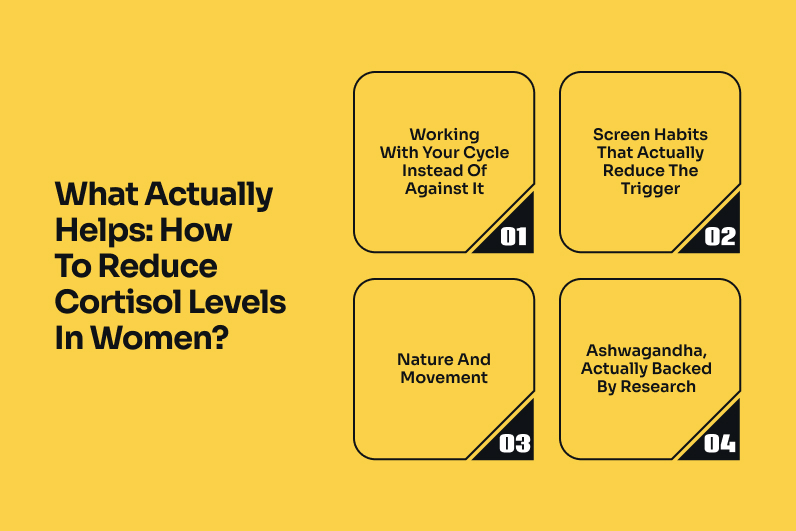
Personally, when I felt like I couldn’t really take it anymore, I went to my doctor. And asked directly: How to reduce cortisol levels in women? Is that really possible?
Here’s what she advised me to do:
Working With Your Cycle Instead Of Against It
Rather than applying the same stress-management routine every day of the month, it helps to expect the luteal phase to feel harder. It also helps to plan lighter around it where you can.
Which means? Yes, fewer high-stakes decisions scheduled for that window if you have any control over it. And more rest. Deliberate.
Screen Habits That Actually Reduce The Trigger
A large, often-missed piece of daily cortisol comes from constant small interruptions – every notification is a minor stress cue your body responds to.
Also, some of the tips on how to reduce screen time cut down on how often that response gets triggered in the first place. One example that I would like to give personally is batching notifications instead of reacting live.
Building longer, uninterrupted focus blocks – the same practice behind how to fix attention span – has a similar calming effect, since a mind that isn’t constantly switching also isn’t constantly signaling alarm.
Nature and Movement
Low-impact movement and actual time outdoors – a proper version of touch grass, not just a walk between meetings while checking your phone – both have reasonably consistent evidence behind them for lowering cortisol over time.
Ashwagandha, Actually Backed by Research
This is one place where Ayurveda and clinical research genuinely overlap.
A 2025 systematic review and meta-analysis of 15 randomized controlled trials (873 participants) found ashwagandha supplementation produced a statistically significant reduction in both cortisol and perceived stress. This occurred after 8 weeks. Doses were generally between 240 and 600 mg a day.
It’s one of the few things marketed under the “cortisol detox” umbrella that actually has trial data behind it, rather than being repackaged sleep-and-movement advice.
That said, it’s still worth checking with a doctor before starting it. Especially if you’re on thyroid medication or are pregnant, since it can interact with both.
Should You Actually Test?
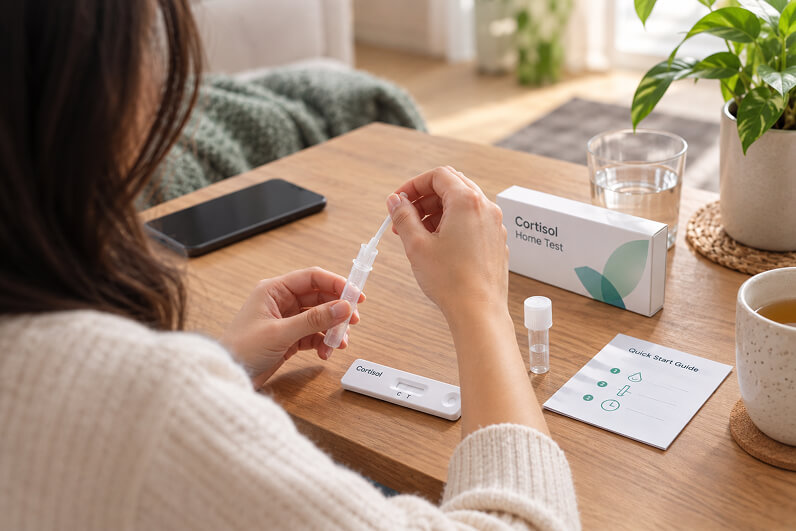
If you are unsure whether genuinely elevated cortisol causes your symptoms, you might just assume it from your feelings. A cortisol test at home is a reasonable way to get real data instead of guessing.
In India, services like Thyrocare and Healthians both offer NABL-certified at-home blood collection for cortisol testing. Reports are usually available within 24-48 hours. There is no need to take a half-day off work for a lab visit.
It’s worth knowing that a single test result is a snapshot. Cortisol naturally fluctuates across the day. It also fluctuates across your cycle. So, timing matters for interpreting it. A doctor is the right person to actually read the result against your symptoms.
When “Cortisol Detox” Language Gets In The Way
A lot of what’s marketed as a cortisol detox is really just this – sleep, movement, fewer interruptions – repackaged with a misleading word attached, since cortisol isn’t something you can literally detox out of your body.
The habits are legitimate. It’s worth being able to tell that apart from the supplements and diet plans sold under the same label.
The Digital Piece Of This Puzzle
A lot of the daily cortisol load for working women traces back to the same source: constant connectivity.
That same pattern shows up as digital burnout – exhaustion rest doesn’t fix – and sometimes as digital dementia, memory fog that overlaps with chronically elevated stress.
Once you notice how often your phone interrupts you, you tend to keep noticing it. That’s the red car theory in action, and it’s usually the first real sign something needs to change.
When Daily Habits Aren’t Enough

If cortisol-driven exhaustion persists despite consistent habits, a short digital detox – even a screen-free evening – can interrupt the pattern faster than smaller daily tweaks.
For something that’s been building for months, a proper digital detox retreat away from constant connectivity tends to reset the baseline in a way daily willpower rarely achieves alone.
What It Truly Means And How It Impacts You
For a lot of millennial women, elevated cortisol isn’t only about notifications and hormones. It’s also sitting quietly under something bigger, like the Great Millennial Career Crisis. This is a broader reckoning with whether the career path we were promised actually delivers.
Constant connectivity makes it easy to avoid that discomfort, which keeps the stress response running longer than it needs to.
If there’s one thing worth taking from this, it’s that “just relax” was never realistic advice. This is not because women are weaker at handling stress. It is because the hormonal picture is genuinely more complex.
Furthermore, the daily triggers are real.
Working with your cycle does more than any generic cortisol routine. Reducing digital noise also helps more. Knowing your actual numbers is equally effective. These generic routines are built for a body that isn’t quite yours.
| Disclaimer: This article is for general informational purposes and isn’t a substitute for professional medical advice. If you’re experiencing significant hormonal or cycle-related symptoms, please consult a doctor. |
Sources:
- “How to Lower Cortisol in Women Specifically,” Superpower
- “Higher Circulating Cortisol in the Follicular vs. Luteal Phase of the Menstrual Cycle: A Meta-Analysis,” PMC
- “How Stress Affects Your Period,” UPMC HealthBeat
- “Learn how to lower your cortisol,” OSF HealthCare
- “Prevalence, Phenotypes, and Comorbidities of Polycystic Ovary Syndrome Among Indian Women,” ICMR-PCOS Task Force Study, JAMA Network Open
- “Effects of Ashwagandha Supplements on Cortisol, Stress, and Anxiety Levels in Adults: A Systematic Review and Meta-Analysis,” BJPsych Open