

| Quick Answer The average person now focuses on a single screen for about 47 seconds. Then they switch to something else. This is down from 2.5 minutes in 2004. Attention span isn’t fixed. It is not permanently damaged. It is shaped by habit and environment. This means how to fix attention span is less about willpower. It is more about deliberately rebuilding a skill. Constant digital switching has worn that skill down. |
I want to start with the research, because the number surprised me too. Gloria Mark, a professor at UC Irvine and author of the book Attention Span, has been tracking this for over two decades.
In 2004, she found people spent an average of 2.5 minutes on a single screen before switching. By 2012, that had dropped to 75 seconds. Between 2016 and 2020, it had fallen further, to just 47 seconds.
That’s not a one-off study – it’s the same researcher, using the same method, watching the number shrink for twenty years straight.
Reading that made something click for me. I’d been vaguely aware I couldn’t sit through a full meeting or read for long without reaching for my phone. But seeing it as a documented, worsening trend rather than a personal failing changed how I approached fixing it.
Can You Really Fix Your Attention Span?

Attention span isn’t like height – it’s not fixed. It behaves more like a muscle that’s adapted to short, frequent use instead of longer, sustained effort.
That’s actually good news: if the drop happened through repeated habit, rebuilding it is also a matter of habit, just in the opposite direction.
Every piece I’ve found on how to fix attention span agrees on this basic point, even when the specific tips differ.
Why This Keeps Happening
Part of the answer is dopamine. Every switch – a new tab, a notification, a fresh scroll – gives your brain a small reward, and the brain learns to seek that reward more than it seeks sustained focus.
Once you start noticing this pattern in yourself, you tend to keep noticing it, which is basically the Red Car Theory in action: you’re not switching apps more than before, you’re just finally seeing how often you already were.
The Work Rhythm That Actually Has Data Behind It
One concrete method worth trying: DeskTime analyzed a large dataset of worker productivity and found the most productive people worked in cycles of roughly 52 minutes of focused work followed by about 17 minutes of real rest – not a scroll break, an actual rest.
I tried mimicking this loosely with a timer for two weeks, and the biggest change wasn’t during the focused blocks – it was that I stopped feeling guilty about the break, because I knew it was built into the structure rather than something I was “allowing” myself.
A Smaller Version That’s Easier To Start
If 52 minutes feels like a stretch on day one, starting with 25-minute blocks and working up is a reasonable entry point.
The specific number matters less than having a defined start and end, so your brain isn’t guessing how long it needs to hold focus for.
How To Fix Attention Span? Small Things That Really Work
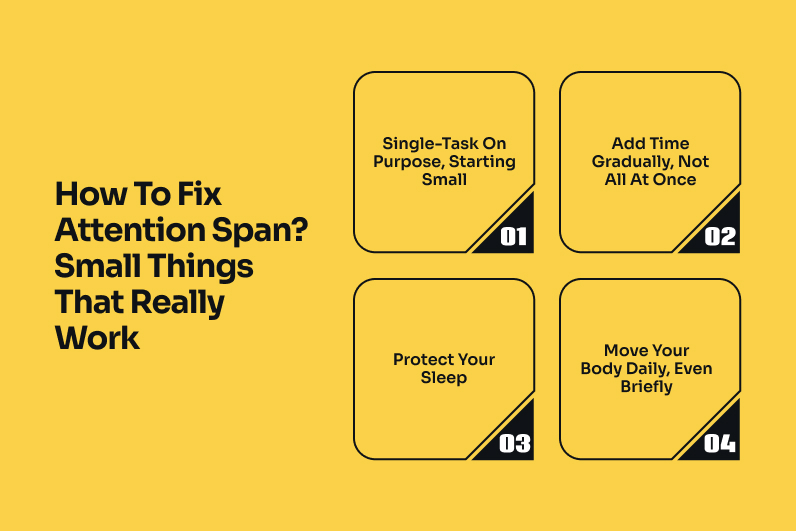
Data on why attention span dropped is useful, but it doesn’t fix anything on its own. Here’s the actual practice that helped rebuild mine, in the order I’d suggest trying it:
1. Single-Task On Purpose, Starting Small
Close every tab except the one you need. Put your phone in another room, not just face-down. Start with just 10 minutes of genuinely single-tasked work – no second screen, no switching – and treat it as a rep, not a test you can fail.
2. Add Time Gradually, Not All At Once
Once 10 minutes feels easy, move to 15, then 20, adding roughly 5 minutes every few days rather than jumping straight to a 52-minute block.
Attention rebuilds the way strength does – gradually, with the previous level fully comfortable before you add more.
3. Protect Your Sleep
This is the one I underrated the longest.
Sleep is when your brain consolidates the day’s information. And consistently poor sleep undoes focus gains faster than almost anything else on this list.
A regular sleep and wake time did more for my next day’s concentration than any single productivity trick.
To know more about how important sleep is for women, you can check out my previous blogs:
4. Move Your Body Daily, Even Briefly
At the cost of sounding extremely morbid, you need to exercise. Exercise is one of the more consistently evidence-backed ways to support attention – it doesn’t need to be intense. A 15-20 minute walk counts and is often the easiest one to actually stick to.
| Note: None of these fix attention span overnight. But together, they’re the difference between reading about the problem and actually doing something about it. |
What This Has To Do With Screen Time

Working on attention directly is one half of this.
The other half is upstream of it – how to fix attention span rarely sticks if your screen habits stay exactly the same in the hours you’re not deliberately “focusing.”
Simple, specific ways to reduce screen time – batching notifications, keeping your phone out of reach during focus blocks – do a lot of the groundwork that makes focused blocks possible in the first place.
The Bigger Pattern This Fits Into
A shrinking attention span rarely shows up alone.
For a lot of people, it travels alongside digital burnout. This is a kind of exhaustion that rest doesn’t fully fix. Sometimes it travels alongside memory lapses and brain fog. These symptoms get grouped under digital dementia.
I’d been treating my attention problem as separate from my constant tiredness for months. I then realized they were almost certainly connected.
The Body Side Of Attention
Attention and stress are more linked than most advice acknowledges.
Every interruption is a small stress cue. This includes a notification or a reflexive phone check. Your body responds to it the same way it would any minor threat. It responds with a brief spike in cortisol.
Constant interruptions mean that spike happens dozens of times a day. This keeps your nervous system from settling.
A cortisol detox, practically speaking, is just reducing how often those alerts happen – which circles right back to attention.
If you’re unsure whether stress hormones are part of what’s affecting your focus, a cortisol test at home is a reasonable way to check. It allows you to check rather than guess.
And it’s worth knowing that how to reduce cortisol levels in woman-specific terms isn’t the same as general stress advice.
When Daily Habits Aren’t Enough
Focus blocks and screen limits handle most of this for most people, most of the time.
But if you’ve tried the daily fixes and your attention still feels shot, a short, deliberate digital detox – even just a screen-free evening – can reset things faster than tweaking your routine further.
And if it’s been building for months, a proper digital detox retreat, away from screens entirely for a few days, tends to show people how much of their “permanently short” attention span was actually just constant, unbroken exposure.
The Small Grounding Habit That Helped Most
Something as simple as stepping outside for a few minutes between focus blocks – a low-effort version of touch grass – made a bigger difference to my next block of focus than I expected.
I now build it into my morning specifically, alongside a few other screen-light habits I picked up from working on my own morning routine, which turned out to be one of the more overlooked pieces of how to fix attention span for the rest of the day.
The Bigger Picture Of Fixing Attention Span
A shrinking attention span is easy to blame entirely on apps and algorithms, and they are a real part of it. But I think there’s also a quieter reason so many millennials are struggling to focus right now.
It is genuinely hard to concentrate on anything. Part of you is sitting with something like the Great Millennial Career Crisis in the background. A notification is always available to distract from actually feeling that.
The 47-second number is not a life sentence. It is a snapshot of a habit. Something that built up over years. This means it can be rebuilt too.
For me, how to fix attention span ended up being less about one big fix and more about a handful of small, repeatable structures: focus blocks with real breaks, fewer interruptions to react to, and a little outside time in between.
| Disclaimer: This article is for general informational purposes and isn’t a substitute for professional medical advice. If anything is affecting your daily life significantly, please speak with a doctor or mental health professional. |
Sources:
- Gloria Mark, “How to improve focus: Try these 5 tips to increase attention span,” USA TODAY
- “How to Increase Attention Span,” University of Rochester Medicine
- “32 Smart Ways You Can Increase Attention Span Right Now,” Science of People