






Quick answer: How to get your life together starts with one money habit, not a full reset. Track what you spend for 30 days. Then build an emergency fund of three to six months of expenses. Add one new habit at a time. In one study, habits took 66 days on average to feel automatic.
How to get your life together feels like a huge question.
It gets smaller when you start with money. So we asked 10 Gen Zs in India how on track their lives feel, and what they do when things slip. On average, the rate was about 6.
I think 5 or 6, because it’s quite difficult to manage both work and my daily routine,” said 26-year-old Anjali.
This was an honest answer. I could see how tired she was and how desperately she wanted some magical door to open – for a life that she really dreams of. She didn’t intend to hide it.
If there is one thing that most of us tend to (unintentionally) overlook, it is the fact that Generation Z is no longer children. The majority of them are young adults, trying their best to sustain their living. And while a few have a plan, others don’t.
So, how do you really get your life together?
Why Money Is The First Thing To Fix
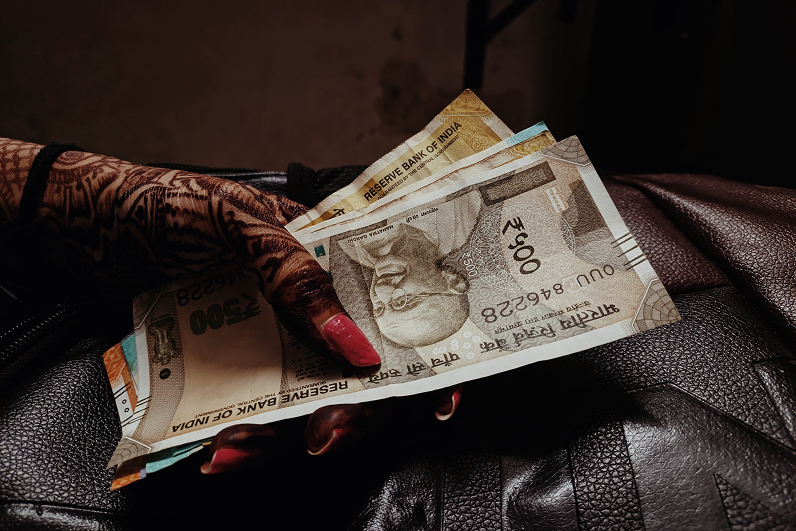
Most advice on getting your life together starts with vision boards and morning routines. Money rarely gets a mention. Yet your rent, your phone bill, and your EMIs decide how much room you have for everything else.
The gap is real.
The National Center for Financial Education (NCFE) surveyed 75,140 adults in 2019 and found 27% were financially literate.
A smaller 2022 survey in the RBI Bulletin found respondents aged 20 to 29 had the lowest financial literacy score of any group, at 59.8 out of 100. Their attitude score was the weakest part, at 41.6. That survey had only 584 respondents in Hyderabad.
Treat it as a signal, not a verdict.
Bhavna, 22, has an interesting thing to say about that first taste of financial independence:
“When my first paycheck hit, I felt like a queen – until I realized rent and groceries weren’t magically covered by the universe. Moving out made me realize ‘adulting’ is just staring at your bank app, calculating how many lattes you can buy. It went from ‘I’m rich’ to ‘Why does electricity cost this much?’ real quick.”
A private survey points the same way. Finnovate, a financial fitness platform, surveyed 1,727 people in 2024. Its 18-to-30 group had the lowest financial fitness scores, mostly because of poor planning.
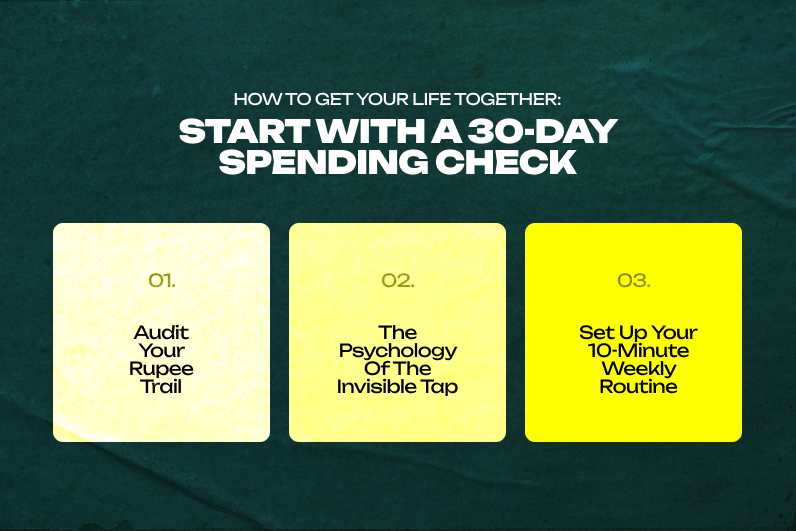
How To Get Your Life Together: Start With A 30-Day Spending Check
You cannot fix what you cannot see. So start by looking.
When asked, on a scale of 1 to 10, how much he would rate his life as being on track, 22-year-old Aditya said this:
“I would say I would give my life a solid 5 out of 10, especially because in my formative years I was fairly focused on developing my life in a different way altogether, and just last year I took a full pivot, a change in my life. So yeah, I would say it’s a 5 for now, and I hope to make it better as the days go by.”
Taking that pivot requires moving past the vague feeling of a “5 out of 10” and mapping out the actual numbers. Here are three very simple things that you can do:
1. Audit Your Rupee Trail
Firstly, one thing you could do is track your spending for 30 days. This can be easily done by looking at your UPI history, bank statements, or notes app. Then group them into three categories:
- Must-haves.
- Nice to have.
- Don’t notice you didn’t get.
The last category is what will surprise most people. It’s amazing how small amounts can build up. A ₹300 food delivery per week would amount to ₹15,600 over 52 weeks!
You may decide it’s worth it, which is totally fine, but the point of doing this is to decide.
2. The Psychology Of The Invisible Tap
Secondly, there’s this thing about money. Money now leaves your account in two taps. UPI handled 25.47 billion transactions worth ₹31.53 lakh crore in October 2026, according to NPCI data reported by IANS [Source: Free Press Journal].
A study by D. Soman in Marketing Letters found that the less visible a payment is, the more people consume (Soman, 2003). That study looked at payment methods like cards and cash, not UPI.
The logic still carries over.
A tap that does not feel like paying makes spending easier – especially when your budget is already stretched to its absolute limit.
Kuhelika, 20, was one of the most interesting young women I met during this interview. She rated her current situation a 3 out of 10.
“I am studying and working simultaneously, so things don’t go as planned. I am more into academia, but I have to work to sustain my academia. So yeah, 3. Hopefully, we will get back on track.”
When you are working just to fund your education, you cannot afford invisible leaks.
3. Set Up Your 10-Minute Weekly Routine
Finally, pick one day a week for a 10-minute check. Scroll your UPI history and circle anything you do not remember. That is your leak list.
25-year-old Asmita, who works in Bengaluru, says she is thorough with her finances:
“I maintain a daily income and expense tracker in my diary. It tracks the reason where the money was spent, income and the expenses of the day. The expense column accounts for all the money spent that day along with their payment method as credit cards usually come with a convenience fee, and the income column accounts for any money that was received in any form including refunds if any. It takes like 5 minutes to write everything and the closing balance of the day works as the opening balance of the next day. This helps me prevent overspending and maintain a weekly audit and be on top of any financial situation. Since I have a habit of journaling daily, this isn’t that difficult for me to maintain.”
Build The First Layer Of Safety: Your Emergency Fund

Amir, who is about to turn 24 this month, Bengaluru, said his wake-up call came when a minor emergency collided with his festival spending:
“I was treating my salary like play money. Last year, right after blowing my Diwali bonus on clothes, my bike broke down, needing a ₹12,000 repair. I had ₹800 left. Borrowing from my parents at 23 was deeply embarrassing. It hit me: an entry-level salary leaves zero room for error if you don’t plan ahead.”
Amir’s situation is exactly why financial planning requires a safety net before anything else.
An emergency fund is money you keep for sudden costs, like a job loss or a medical bill. NISM, the securities-market education institute, says most financial advisers suggest three to six months of household expenses.
After COVID-19, some raised that to six to twelve months. NISM adds that this money should be safe and easy to reach, not high-return.
Do the sum in rupees. If your essential costs are ₹20,000 a month, three months is ₹60,000 and six months is ₹1,20,000. That number can look huge. So start with one month, then build up. Even a small start helps.
If you can move ₹1,000 a month, you hold ₹12,000 in a year. That is not a full fund, but it can cover a phone repair or a ticket home without a loan. This is the honest answer to how to get your life together on a small salary: begin small, and begin now.
Many people are not there yet. In the Finnovate survey, about 40% lacked a sufficient emergency fund, and only 38% were debt-free (same Business Standard report).
Note: The article does not define "sufficient", and Finnovate is a private platform. Read these numbers as a rough picture.
Managing Your Loan
If you owe money, list every loan, EMI, and card due. Write the balance, the interest rate, and the due date for each. That list is your debt map.
Asmita provides a reliable roadmap for how she stays ahead of her own debt map each month:
“That falls under bills during the first week of the month. I clear all the EMIs and bills before the 5th of each month and put 50% of the remaining balance into savings. So the rest of my money is only for utilities. I set it up on the CRED app to get reminders of bills as well. So I don’t miss anything.”
That’s her way of doing so. But for you, it can be different. For decisions about repaying or investing, speak to a SEBI-registered investment adviser or another qualified professional.
Pick One Habit And Give It 66 Days
Changing too many money habits at once is overwhelming; start with just one.
To understand why, look at a 2010 study by Phillippa Lally in the European Journal of Social Psychology.
Tracking 82 students, researchers found it took 66 days on average for a new behavior to feel automatic, ranging from 18 to 254 days. While missing a single day didn’t hurt progress, repeatedly skipping days did.
Though not originally about finance, this logic applies perfectly. Choose one money habit and give it two months to take root. You could log daily spends, automate a ₹500 transfer on payday, or audit your UPI history every Sunday. Introduce a second habit only when the first becomes second nature.
Asmita rates herself a solid 7 by ditching rigid resolutions for flexible daily habits:
“On a scale of 1-10 I would rate myself a 7 when it comes to me having my life on track. I am not much of a planner so monthly or weekly plans don’t work for me, that’s why instead of making plans or resolutions, I have yearly goals which I ensure I achieve even without a set plan, and I follow through with them daily much like a daily To-Do list. Instead of have a New Year resolution like, “I will go to the gym daily,” like most people, I set a goal to lose weight. This gives me flexibility to choose the time and method. The only rule is I have to achieve the goals. Most of my goals that I set are already achieved while few of them are yet to be executed. But I’ll work them out slowly.”
So, in the end, getting your life together is a question of habits.
The Rest Of Your Life Comes After The First Win
Sleep, work, friendships, and health matter too.
In this article, I have put money first because you can measure it this week. When money feels steadier, pick one more area and keep it small.
- Fix one sleep time.
- Call one friend each week.
- Learn one skill.
Getting your life together is a long game, not one big weekend.
If you feel overwhelmed or low for weeks, talk to a doctor or a counselor. A budget cannot fix that.
“Honestly, my bank balance is the only thing that looks steady right now. Meanwhile, my sleep cycle is completely broken because of late-night log-offs at my tech job, and as a result, I barely have the energy to hit the gym anymore. I’m still trying to show up for my close friends, but most weekends I just end up doom-scrolling or sleeping for twelve hours straight simply to recover. I am trying to fix it, but ultimately, it feels like if I focus on my health, my social life slips, and conversely, if I go out, my routine goes out the window.”
This is what 24-year-old Kabir had to say.
A 30-Day Plan You Can Start Today
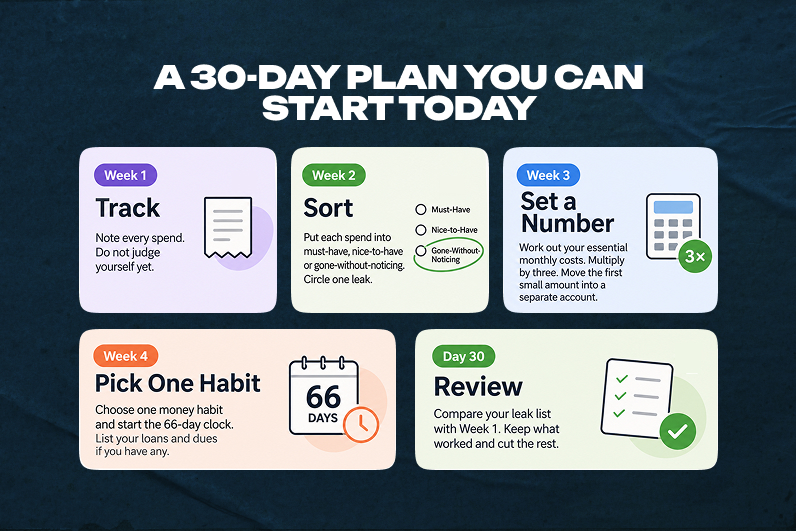
Here is a simple way to learn how to get your life together in 30 days. It is my suggestion, not a research finding. Adjust it to your own salary and your own city.
25-year-old Srinjoy from Kolkata was practical and hopeful about this slow process of building momentum:
“I’d like to rate it a 6, I think, because there had been a few plans that were supposed to be executed, but till now that’s not happening, and having to, you know, carry on with how it is as of now, and hopefully things work out in the future. And I’m…next time, when you ask me the rating can increase.“
To ensure your own rating increases the next time you audit your journey, you have to break down those stalled plans into weekly, bite-sized tasks.
Here is how you execute that shift over the next four weeks:
- Week 1, track: Note every spend. Do not judge yourself yet.
- Week 2, sort: Put each spend into must-have, nice-to-have or gone-without-noticing. Circle one leak.
- Week 3, set a number: Work out your essential monthly costs. Multiply by three. Move the first small amount into a separate account.
- Week 4, pick one habit: Choose one money habit and start the 66-day clock. List your loans and dues if you have any.
- Day 30, review: Compare your leak list with Week 1. Keep what worked and cut the rest.
The Takeaway
How to get your life together does not need a perfect plan or a big salary. It needs one number you can see, one habit you can repeat, and a little patience. Start with your spending this week.
Let the rest of your life follow.
26-year-old Charchika was rather candid and spot on with her answer when asked to rate how much her life is on track:
“I think maybe six or five. I don’t know, I’m not sure. Five or six. I mean, when I was a kid, I never thought I would be doing the work I’m doing right now. But yeah, it’s not like I’m complaining about it. It’s okay. I sometimes enjoy it, I sometimes don’t. But I still don’t have it figured out all – what I do, and what I might do in the future. I’m not entirely… I don’t have that figured out yet. And yeah, like, you don’t really know who you are – there’s a lot of self-discovery to do.”
Charchika’s rating reminds us that the “perfect 10” life sold on social media feed grids doesn’t exist in the real world. Getting your life back in order isn’t about crossing a static finish line where every single piece perfectly clicks into place overnight.
In the end, it is simply about mastering these small, predictable variables – like your daily UPI taps – so that, consequently, you gain the breathing room, the stability, and the grace to figure out everything else as you go.
Disclaimer: This article is general information and is not financial advice. For decisions about investments, loans, or tax, speak to a SEBI-registered investment adviser or another qualified professional.
Sources:
- National Center for Financial Education, NCFE Financial Literacy and Inclusion Survey 2019, executive summary
- Reserve Bank of India, Financial Literacy in India: Insights from a Field Survey, RBI Bulletin, 23 June 2023
- Business Standard, Only 38% Indians debt-free, 40% lack emergency fund: what a survey reveals, 26 July 2024
- NISM, Save for emergencies
- Soman, D. (2003). The effect of payment transparency on consumption: quasi-experiments from the field. Marketing Letters, 14, 173 to 183. Springer
- Free Press Journal (IANS), UPI transactions hit 25.47 billion in October, 2 November 2026
- Lally, P., van Jaarsveld, C., Potts, H. and Wardle, J. (2010). How are habits formed: modeling habit formation in the real world. European Journal of Social Psychology. Summary: BPS Research Digest