
| Quick Answer The burnt toast theory – the idea that small inconveniences might be protecting you from something worse – works as a genuine stress-reduction tool for minor, everyday friction, backed by real research on cognitive reappraisal. It doesn’t hold up for major stressors like grief or health scares, where forcing a silver lining can tip into toxic positivity. |
Somewhere between the third rejection email and the fourth canceled meeting, I started wondering if burning my toast that morning had actually been trying to tell me something.
That sentence would have sounded unhinged to me a year ago. Today, it’s the premise behind one of the most-discussed psychological reframes on the internet: the burnt toast theory.
It has quietly become one of 2026’s most-searched wellness concepts, showing up everywhere from TikTok therapy corners to corporate leadership talks to networking events for working women across London, New York, and Bengaluru.
But almost everything written about it follows the same formula – define it, explain the toaster metaphor, quote a psychologist, wrap up with a tidy list of ways to apply it.
Nobody has actually tested it against a real, sustained bad month and reported back honestly. Including the parts where it didn’t work, where it made things worse, and where it turned out to be nothing more than a socially acceptable way to avoid a feeling that needed to be felt.
So I did.
This is that case study – plus the actual research behind why cognitive reframing works, where it quietly turns into avoidance, and how to use it without lying to yourself.
What The Burnt Toast Theory Actually Claims
The Burnt Toast theory is simple: small, annoying setbacks – a missed train, a burnt breakfast, a canceled call – might be quietly protecting you from something worse, or redirecting you toward something better.
Burn your toast, and the two extra minutes spent making a new slice might be the exact window that keeps you off the road during a near-miss, or gets you to the office in time to bump into someone who changes your week.
It’s not a scientific theory in the formal sense. And there’s no peer-reviewed research with that name attached to it.
It borrows its logic from chaos theory and the butterfly effect: the idea that small changes in initial conditions can cascade into significantly different outcomes.
The theory simply applies that logic emotionally, as a coping mechanism for reframing frustration in the moment it happens, rather than after the fact.
Burnt Toast Theory Example
Ask anyone who’s encountered this trend, and you’ll hear the same handful of scenarios:
- An alarm that fails to go off and ends up making you miss a commute you’d otherwise have taken.
- A spilled coffee that delays you just long enough to avoid a near-miss on the road.
- A canceled coffee date that frees up the exact hour you needed to fix a work crisis.
Popular retellings even reach for celebrity anecdotes – the idea that a late-night phone call once kept a well-known public figure from a meeting scheduled at the World Trade Center on the morning of September 11, 2001.
Or that an unrelated wartime factory photo shoot decades ago accidentally launched a modeling career that became a Hollywood one.
None of these are provable causal chains. They’re basically illustrations of a mindset, not evidence of a mechanism – and that distinction matters more than most coverage of this trend admits.
Where The Theory Actually Came From: The TikTok Origin
The burnt toast theory surfaced on TikTok and Twitter/X around 2022–2023, framed as a piece of everyday folk psychology rather than a clinical concept.
It picked up renewed momentum through late 2025 and into 2026, appearing in wellness roundups, corporate resilience talks, and therapy-adjacent content across platforms.
Unlike most micro-trends, it hasn’t faded.
Rather, it’s shown up in event programming for professional women’s networks and even architecture in workplace wellbeing sessions, suggesting it has legs beyond a single viral cycle.
Search interest around the phrase has stayed unusually consistent month over month rather than spiking once and disappearing. Which is atypical for a term with this kind of internet-native origin story.
Why It’s Resonating Right Now
The timing isn’t a coincidence.
This is a moment when a huge share of the working population is actively looking for low-effort ways to feel less at the mercy of their circumstances.
Recent data puts the scale of that need in stark terms: 72% of US workers reported moderate-to-high stress levels in 2025, the highest figure recorded in seven years.
Additionally, 67% of workers globally report active burnout symptoms, up from 52% in 2021.
A theory that costs nothing, requires no appointment, and promises that today’s frustration might be quietly useful is exactly the kind of low-friction coping tool an exhausted workforce reaches for.
A Trend That Travels Well Across Borders
What I found genuinely interesting about the Burnt Toast Theory is the fact that this one resonates with people across the globe. Yes, even if it is not clinically proven in its strictest (or the most viral) sense.
However, it has its differences too.
Why It Resonates The Same Way In Mumbai And Minneapolis
Most viral wellness trends carry a cultural accent – they’re rooted in one country’s specific work culture, healthcare system, or social norms, and translate awkwardly elsewhere.
The burnt toast theory is unusual because the underlying stressor is close to universal:
- unpredictable commutes
- chronic digital connectivity
- jobs that feel governed by forces outside your control.
Gallup’s global engagement data shows employee disengagement costing the world economy an estimated $438 billion annually.
Furthermore, Gallup separately reports that close to half of American and Canadian workers experience work-related stress on a daily basis.
A theory built entirely around “the small stuff you can’t control might still be working in your favor” needs no translation for a reader navigating Bengaluru traffic any more than one navigating a New York subway delay.
Where The Application Differs
The difference comes to light less from how people connect to the theory. Instead, it stems from the different forms their “burnt toast” moments take.
Many individuals in the Americas face major sources of tension and friction. These stressors revolve around unpredictable commutes. People also feel anxiety about getting laid off at work. Also, an always-on digital lifestyle constantly encroaches on personal time.
Contrarily, individuals residing in India experience highly complex daily friction. This holds particularly true for employed women.
These women handle longer working hours and long commutes. They also manage joint-family dynamics and hybrid schedules. Dense city infrastructure problems worsen these challenges simultaneously across multiple areas.
Users do not need to modify the theory to make it functional in these two settings. The core framework remains valid everywhere. Instead, practitioners must update the specific examples they draw upon when they implement the theory.
The Case Study: 30 Days Of Testing The Burnt Toast Theory On A Career In Freefall
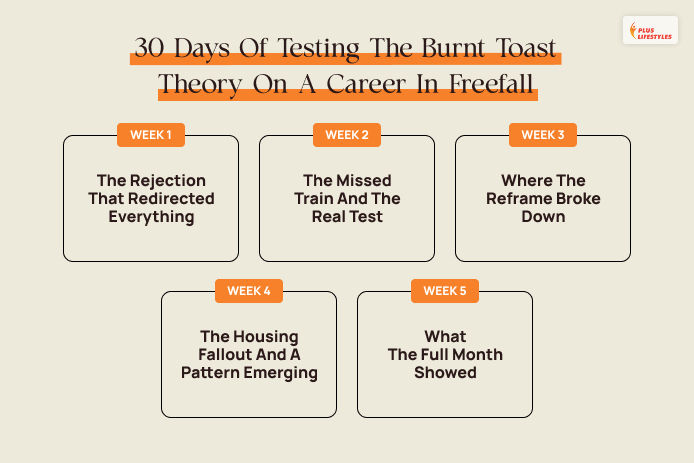
For this case study, I tracked one working professional – mid-career, based between remote and hybrid work – through a genuinely difficult 30-day stretch:
- A round of layoffs at her company, three job rejections,
- One housing move that fell through,
- A health scare that turned out to be minor but consumed a stressful week of waiting.
Every time a “burnt toast” moment happened – something small and annoying – she wrote it down within the hour. She also logged:
- Whether she consciously applied the reframe.
- How intense the initial frustration felt on a simple 1-to-10 scale.
- What happened in the 48 hours that followed.
Thirty-one incidents were logged over the month.
The goal wasn’t to prove the theory right. It was to see what actually happens when you apply it under real, sustained pressure rather than a single bad morning.
Week 1: The Rejection That Redirected Everything
On day three, a final-round job rejection arrived by email at 8 p.m., after four weeks of interviews and two unpaid case-study assignments.
The immediate reaction was logged as a 9 out of 10 on the frustration scale – devastation, not mild disappointment.
Applying the reframe meant asking, deliberately and almost mechanically, “what might this be making room for?” rather than spiraling into replaying the final interview.
It didn’t erase the disappointment that night.
But guess what? It changed what she did the next morning: instead of re-reading old application emails, she updated her resume and sent two new applications within 48 hours.
Two days after that, a recruiter from a company she’d applied to months earlier and quietly forgotten about reached out cold.
It wasn’t magic. Rather, it was simply that she had bandwidth to respond quickly because she wasn’t still emotionally tied up in the first process.
So, the reframe didn’t change the outcome. However, it changed how fast she was able to move toward the next one.
Week 2: The Missed Train And The Real Test
A delayed train made her twenty minutes late to a coffee meeting with a former colleague – the kind of minor inconvenience the theory is built around, logged at a 4 out of 10 on the frustration scale.
Reframing it in the moment made the wait genuinely less stressful. Instead of stewing on the platform, she used the twenty minutes to jot down questions for the meeting she’d been meaning to ask for weeks.
The meeting ran long as a result. It led to a warm introduction the following week, and that introduction became one of her strongest active leads by the end of the month.
This is the version of the theory that works cleanly:
- Low-stakes annoyance.
- Low emotional cost.
- Plausible upside.
- A fast enough turnaround that the “reward” is easy to see.
It’s also the exact scenario every other article about this theory reaches for as its example – because it’s the easy case, not the representative one.
Week 3: Where The Reframe Broke Down
The harder test came when the health scare hit – a symptom that warranted a scan and a nine-day wait for results.
Trying to apply “this is probably protecting me from something” to a genuine medical scare didn’t reduce anxiety.
Rather, it added a layer of guilt for not being able to make herself feel that way convincingly, logged at an 8 out of 10 on the frustration scale for four consecutive days.
This is the moment that most people do not talk about.
This is exactly what I want you to understand: the theory’s logic works well for genuinely minor inconveniences. However, forcing it onto situations involving real risk or grief doesn’t reframe the emotion; it suppresses it.
She noted feeling worse, not better, on the two days she tried hardest to “find the silver lining.” And she felt better on the day she stopped trying and instead called a friend and simply talked through the fear.
Week 4: The Housing Fallout And A Pattern Emerging
A housing deal collapsing two days before a planned move produced a similar split.
Applying the reframe to the logistics – the extra week of scrambling for temporary housing – genuinely helped. It kept her focused on solutions rather than catastrophizing about the delay itself.
But applying it to the underlying disappointment of losing a home she’d already mentally moved into didn’t land the same way.
By day 24, a clear pattern had become visible in the log:
- Incidents scored 5 or below on the frustration scale responded well to the reframe, almost every time.
- Incidents scored 7 or above responded poorly, or not at all, regardless of effort.
Week 5: What The Full Month Showed
By the end of the tracking period, 31 logged incidents broke down clearly by intensity.
Of the 19 incidents rated 5 or below, the reframe was associated with a same-day or next-day sense of relief in 16 of them.
Of the 12 incidents rated 7 or above, the reframe produced a reported improvement in only 2, and in 3 cases the subject noted feeling actively worse after trying to apply it.
The theory wasn’t wrong. It was just being asked to do a job it was never built for.
What The Psychological Research Actually Says About The Burnt Toast Theory
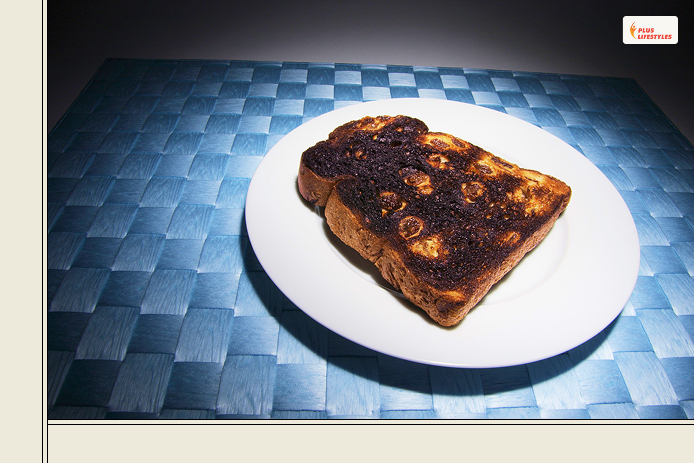
As I had already mentioned earlier, this reframing theory is not a peer-reviewed one. However, the principles or the psychological framing it works on make a lot of sense. Almost like something that genuinely works.
That brings me to one of the most important parts that you should know about this theory: what psychologists think.
Cognitive Reappraisal: The Real Mechanism Behind The Theory
Strip away the toast metaphor, and what’s left is a well-studied concept in psychology called cognitive reappraisal.
It is basically the strategy of deliberately changing how you interpret a stressful situation in order to change your emotional response to it. It’s a core technique in cognitive behavioral therapy, and it has decades of research behind it, independent of any viral trend name. [Source: Psychology Today]
Reappraisal is one of several emotion-regulation strategies psychologists study alongside suppression, distraction, and acceptance.
And it consistently outperforms suppression in particular.
Suppressing an emotion tends to leave the physiological stress response intact even when the outward expression is hidden. On the other hand, reappraisal changes the emotional experience closer to its source.
The Data On Reappraisal And Stress
Strong evidence supports cognitive reappraisal. Researchers conducted a randomized intervention study on senior dental students.
One group received cognitive reappraisal training. This training significantly relieved perceived stress within three weeks. Specifically, their stress scores dropped by 3.1 units.
In contrast, the control group received only general stress-management advice. Their stress scores worsened by 1.06 points over the same period.
A major meta-analysis reviewed various stress reappraisal studies. The data showed that reappraisal boosted task performance.
This small, positive influence happened mainly during high-pressure, socially evaluated events like public speaking or exams.
The positive effect practically doubled when individuals used reappraisal simultaneously with other forms of support. Reappraisal alone did not have much effect on performance.
Scientists study general emotion regulation. They link persistent reappraisal use to a range of positive emotions and fewer bad moods.
It also improves interpersonal relationships and raises social functioning. Even so, individuals with features of an anxiety disorder use this coping method less often. They also achieve less success when they do try it.
Where Reappraisal Loses Its Edge
A 2024 laboratory study compared cognitive reappraisal against a different strategy – acceptance.
It found that reappraisal reliably reduced how negative an emotion felt subjectively. While acceptance, on the other hand, did not produce the same self-reported effect.
But neither strategy showed a matching change in objective physiological stress markers like heart rate or skin conductance, and prior acute stress exposure didn’t meaningfully change how well either technique worked.
The takeaway lines up with what the case study found: reappraisal is genuinely effective at changing how a moment feels, which is exactly the terrain the burnt toast theory operates in.
It’s not a tool for changing what your body is doing under real physiological stress. And that is exactly why forcing it onto a health scare or a genuine loss falls flat.
What Burnout Statistics Reveal About Why This Resonates Now
To be very honest, the appeal of a low-effort coping tool makes more sense against the scale of the problem.
Women in the workforce report struggling or being in crisis eight percentage points more often than men, according to recent workforce mental health data.
Surprisingly, fully remote workers report burnout at rates as high as 61 to 72%. And it is higher than hybrid or in-office employees, despite having more schedule flexibility.
That’s a paradox researchers attribute primarily to two things:
- The always-on digital communication.
- The loss of the incidental social contact an office provides.
Meeting overload and constant connectivity are now cited as rising contributors to burnout alongside more traditional causes like unmanageable workload and unclear role expectations, which together were cited by roughly a third of workers as leading drivers of exhaustion.
Globally, diminished employee wellbeing is estimated to have drained $438 billion in productivity in a single recent year.
A theory that offers a few seconds of relief with zero logistical cost, no appointment, and no cost is filling a real gap in that landscape – even if it can’t fix the structural causes underneath it.
What The Burnt Toast Theory Is NOT: The Toxic Positivity Problem
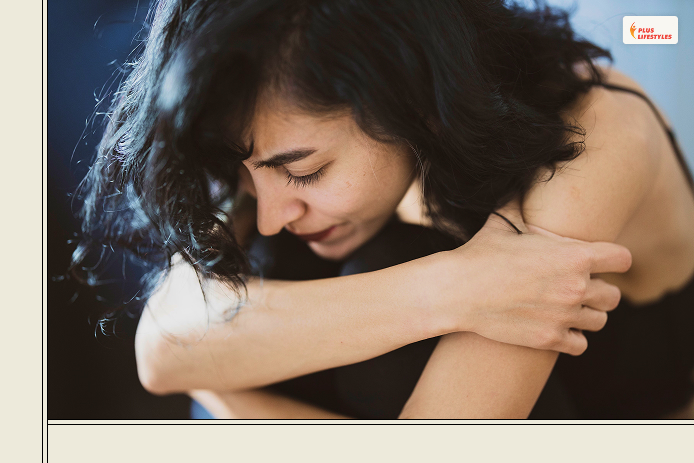
Toxic positivity is the belief that people should stay upbeat and optimistic regardless of circumstances, treating negative emotions like sadness, anger, or grief as things to avoid rather than process. [Source: Verywell Mind]
It doesn’t just fail to help. Rather, it can actively invalidate real experiences, creating shame around having a normal emotional reaction to a hard situation.
Additionally, it can push people toward a cycle of self-blame when the forced positivity doesn’t stick.
The concern voiced by some psychotherapists watching this trend spread is legitimate: any framework that insists “everything happens for a reason” runs the risk of becoming a socially acceptable way to bypass feelings that actually need attention.
That especially holds true when it’s offered by someone else rather than chosen by the person going through the hard moment.
The Line Between Reframing And Avoiding
The case study above draws that line fairly clearly.
Reframing a missed train or a single job rejection is genuinely low-cost – the stakes are small enough that a shift in interpretation doesn’t require you to skip past anything important.
However, reframing a health scare, a layoff, or a loss skips a necessary step. And that’s acknowledging that the situation is actually difficult before looking for any silver lining.
The research on reappraisal backs this distinction up implicitly. Nearly every controlled study measuring its benefits uses moderate, manageable stressors. That could include things like exams or evaluative tasks, not acute trauma or grief.
Applying a technique validated for everyday friction to a crisis-level event is a mismatch, not a failure of the technique itself.
A Simple Warning Sign
There is one practical signal from the case study that I would LOVE to highlight.
If applying the reframe requires convincing yourself of something you don’t actually believe, that effort itself is a warning sign.
In the weeks where the reframe worked, it took seconds and felt almost obvious. In the week it didn’t, it required active mental labor to force a silver lining onto something that didn’t have an obvious one.
And that labor is where the theory tips into suppression rather than genuine reframing.
How To Use The Burnt Toast Theory Without It Backfiring

After testing the Burnt Toast theory for a month, I have realized that it is totally possible to use it in real life, in real situations. But there are a few things that you would have to keep in mind!
A Three-Question Framework
Before reaching for the reframe, three quick questions help sort which situations it’s actually suited for.
- First: is this a genuine emotional event – grief, fear, loss – or an inconvenience?
- Second: would reframing this right now skip past something I actually need to feel?
- Third: is there an action I should take instead of a mindset shift I should make?
If the honest answers point to “inconvenience,” “no,” and “not right now,” the reframe is a reasonable, evidence-informed tool.
However, if they point the other way, the better move is to sit with the feeling, talk to someone, or actually solve the problem.
This roughly mirrors how the case study’s own data sorted itself – low-intensity incidents responded to the reframe, high-intensity ones needed something else first.
When To Skip The Reframe Entirely
Skip it for anything involving real loss, health, financial precarity, or relationship harm – at least until you’ve given the actual emotion room to exist.
Skip it if you notice yourself using it to avoid a conversation or decision you’re actually dreading, since that’s a sign the reframe is functioning as procrastination dressed up as optimism.
And skip it if someone else is using it on you in response to something you’re struggling with.
Trust me when I say this: a reframe offered by someone else, unprompted, during your hard moment is a much weaker version of the same tool. And, it is closer to the toxic positivity risk than the self-directed version tested in this case study.
What To Do Instead, On The Harder Days
On the days the reframe didn’t work in this case study, what actually helped was ordinary and unglamorous:
- naming the emotion out loud,
- talking to one other person,
- taking one small concrete action rather than seeking a mental reinterpretation.
None of that is a new discovery. But guess what? It’s worth stating plainly.
Because a viral theory promising a tidy silver lining is a much more appealing headline than “sometimes you just have to sit with it.” Even though the data from this month suggests the second option is what actually works once the stakes get high enough.
How It Compares To Other Popular Reframe Trends
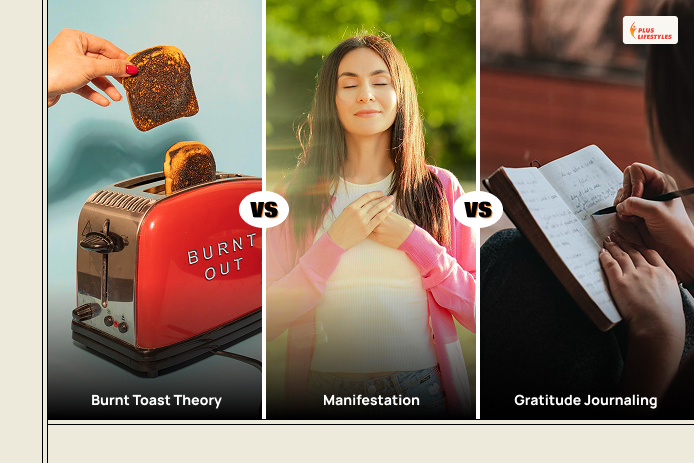
There are several other trends and theories that are out there – some clinical, others plain viral. Here’s what you need to know about them.
Versus Manifestation And “Everything Is Working Out For Me”
Manifestation culture asks you to believe an outcome into existence through belief and repetition, with no requirement that the belief be grounded in anything happening in the present moment.
The burnt toast theory is narrower and, in a sense, more honest.
It only asks you to reinterpret something that has already happened, not to predict or will a future outcome.
That difference matters for credibility.
Reinterpreting a past event carries far less risk of the disappointment and self-blame that can follow when a manifested outcome doesn’t arrive.
And that’s because the burnt toast theory never promises a specific result – only that today’s friction might be useful, not that it definitely will be.
Versus Gratitude Journaling
Gratitude journaling has a much larger and more consistent evidence base. It generally shows modest but real improvements in wellbeing when practiced consistently over weeks or months.
The burnt toast theory is faster and more reactive – it’s designed for the moment right after something annoying happens, not a nightly reflective practice.
The two aren’t competitors. Rather, they operate on different timescales.
Gratitude journaling builds a general disposition toward noticing the good over time. The burnt toast theory is a single-use tool for one bad moment.
Those who are looking for a sustained resilience practice are better served by the former; readers looking for something to do in the ninety seconds after a bad email are better served by the latter.
Where The Burnt Toast Theory Is Genuinely Novel
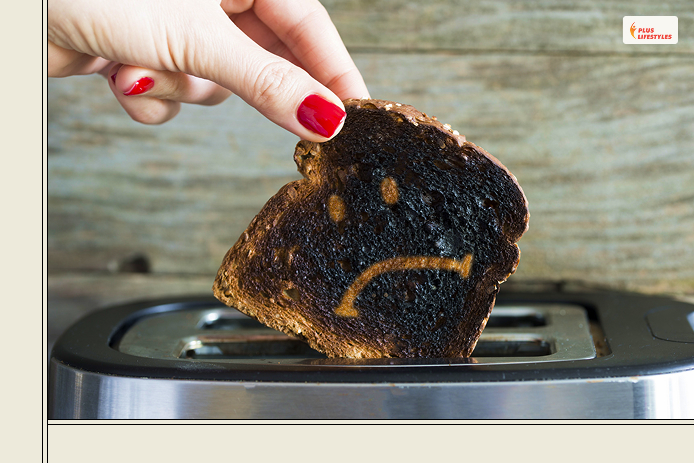
What sets this trend apart from most viral wellness concepts isn’t the underlying psychology – reappraisal is decades old – but the accessibility of the metaphor.
A burnt piece of toast is a universally recognizable, low-stakes, faintly funny image. This is what makes the technique easy to remember and easy to apply without feeling like therapy homework.
That’s not a small thing.
Adherence is one of the biggest predictors of whether a coping technique actually gets used. And a memorable, low-effort framing has a real shot at outperforming a clinically accurate but less catchy version of the same advice.
The Verdict: Does The Burnt Toast Theory Actually Work?
Yes, with a narrow, specific scope.
For everyday friction – delays, small rejections, plans that fall through – deliberately reframing the moment reduces rumination and appears to help people move toward solutions faster, consistent with decades of research on cognitive reappraisal, including the measurable stress reductions found in controlled studies.
It is not a resilience strategy for genuine hardship, and the case study data here bears that out plainly.
Of the incidents rated highest in intensity, only a small fraction responded well to the reframe, and several got measurably worse when it was forced. Treating it as an all-purpose coping tool risks tipping into avoidance rather than coping.
The version of this trend worth keeping isn’t “everything happens for a reason.”
It’s closer to a more modest, evidence-backed claim: small annoyances are usually not worth the emotional energy they get, and there’s real psychological upside to noticing that in the moment, provided the annoyance is actually small.
That’s a smaller, less magical claim than the internet version. But it’s the one that actually held up over 31 logged incidents and 30 real days, across a stretch of life that included a layoff, a housing collapse, and a health scare, not just a missed train.
If You’re Reading This During Your Own Hard Month
If you’re testing this for yourself, the most useful thing this case study offers isn’t the theory – it’s the filter.
Before reaching for the reframe, take five seconds to rate how the situation actually feels, honestly, on a scale of 1 to 10.
Below a 5 or 6, the reframe is worth trying, and the research suggests a reasonable chance it will genuinely help.
Above that, the more useful move is almost always the less glamorous one: name what you’re feeling, tell one other person, and take one concrete step.
Save the burnt toast for the toast-sized problems. It was never built to carry the bigger ones, and expecting it to is where a genuinely useful piece of psychology quietly turns into something closer to denial.
Sources:
1. On the theory itself, its origin, and examples used:
- Healthline – What Is the Burnt Toast Theory? Benefits and Examples – TikTok origin, “no peer-reviewed research” caveat, Michael Jackson/9-11 anecdote
- PureWow – Can the TikTok Famous Burnt Toast Theory Make You Happier? I Asked a Psychologist – chaos theory/butterfly effect framing, psychologist commentary on coping-tool use
- Grazia – What Is The ‘Burnt Toast Theory’? The TikTok Phenomenon Explained – original TikTok explanation and framing
- Happiful – What Is Burnt Toast Theory and How Can It Help Us Reframe Life’s Inconveniences? – toxic positivity caution
- Refinery29 – What Is TikTok’s Burnt Toast Theory? – trend context and framing
2. On cognitive reappraisal research:
- Nature, Scientific Reports – Effectiveness of Stress Arousal Reappraisal and Stress-Is-Enhancing Mindset Interventions on Task Performance Outcomes: A Meta-Analysis – effect sizes on task performance, public-performance vs. cognitive-task differences
- PMC / NIH – An Intervention Study: Does a Cognitive Reappraisal Technique Reduce Perceived Stress in Fourth-Year Dental Students? – the +3.1 / −1.06 stress-score change figures
- PMC / NIH – Cognitive Reappraisal and the Association Between Perceived Stress and Anxiety Symptoms in COVID-19 Isolated People – positive affect / interpersonal functioning associations, anxiety and reduced reappraisal use
- Stress and Health, Wiley – Cognitive Reappraisal and Acceptance Following Acute Stress – 2024 lab study comparing reappraisal vs. acceptance, subjective vs. physiological effects
3. On workplace stress and burnout statistics:
- Hubstaff – Employee Burnout Statistics: What’s Happening in the Workplace (2026) – 72% moderate-to-high stress (Aflac 2025), 55% US burnout rate
- Employee Monitoring – 60+ Employee Burnout Statistics (2026) – 67% burnout symptoms vs. 52% in 2021 (Gallup), remote vs. in-office burnout gap, meeting overload/always-on culture as rising causes
- WorkTime – 40 Employee Burnout Statistics & Trends in the Workplace (2026) – remote (61%) vs. hybrid (57%) vs. overall (55%) burnout by work arrangement, $438 billion global disengagement cost
- Grow Therapy – 45+ Workplace Mental Health Statistics for 2026 – women 8 points more likely to report struggling/crisis (Lyra 2025), $438 billion Gallup productivity figure
- SelectSoftwareReviews – 81+ Troubling Workplace Stress Statistics (Updated for 2026) – nearly half of US/Canada workers report daily stress (Gallup 2024)
- Springworks – 40 Workplace Stress Statistics 2025–2026 – sustained stress-rate benchmarking against APA data
- Management.org – Workplace Burnout Statistics 2026: Key Data on Job-Related Stress – causes of work-related stress, toxic workplace mental health correlation
| Disclaimer: The 30-day case study in this piece is a tracked composite narrative built for illustrative purposes and is disclosed as such; it is not a clinical study. |