



I used to buy products based on packaging. A pretty bottle, a promise of “glass skin,” an influencer’s glowing testimonial – sold.
My bathroom shelf looked like a skincare aisle, and my actual skin looked confused, congested, and constantly irritated.
The problem wasn’t effort.
I was trying hard. The problem was that I never actually learned how to build a skincare routine – I was just collecting products and hoping something would stick.
Once I understood the actual structure behind a good routine, everything changed. Not overnight, but steadily, predictably, in a way random product-buying never gave me.
Quick Answer
Building a skincare routine begins with determining your skin type. Then, you can apply your skincare products according to their consistency, beginning with the lightest ones first.
- Morning routine – cleanser, treatment serum, moisturizer, and sunscreen.
- Evening routine – cleanser, treatment, and moisturizer.
Dermatologists generally suggest a “less is more” approach consisting of three basic steps – cleansing, moisturizing, and sun protection. In this way, one can introduce targeted actives based on their particular skin concerns.
Things To Know Before You Build A Skincare Routine
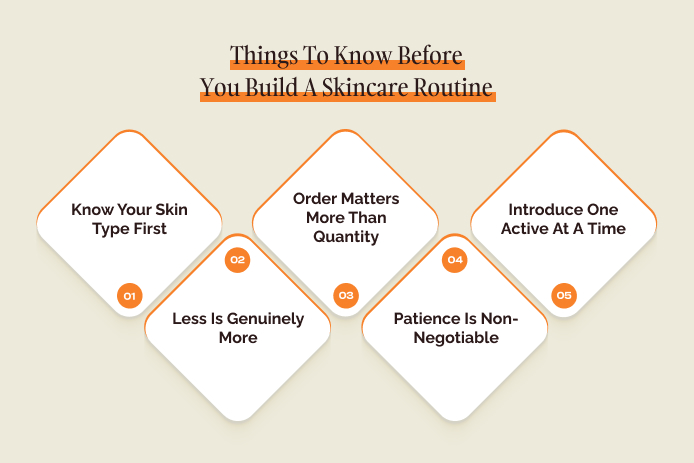
Before you buy a single product, there are a few things worth understanding. I skipped this step the first time around, and it cost me months of trial, error, and irritated skin.
Know Your Skin Type First
The order in which you apply your skin care products makes a difference to how effectively the products work. However, it would be almost pointless if, first and foremost, you are using products that contradict your skin type.
Being unaware of your skin type? Then clean your face gently without adding any products. After 30 minutes, evaluate the condition and appearance of your skin.
Less Is Genuinely More
A good skincare routine includes 3 essentials tailored to your skin type and treatment goals – it doesn’t need to be overwhelming or complicated, or expensive either. I wish someone had told me this before I owned eleven serums.
Order Matters More Than Quantity
When building a skin care routine, the general rule of thumb is to go from lightest to heaviest in consistency, gradually layering on heavier products as you go.
This is because the order you apply your products in matters – products need to penetrate the skin to be effective.
Patience Is Non-Negotiable
Many products take 6 to 12 weeks of regular use to show visible results, especially for acne and anti-aging goals. I quit products in week three for years, never giving them a fair chance.
Introduce One Active At A Time
Start with 1 active ingredient a few times per week for several weeks and increase as tolerated. Your skin barrier will thank you.
How To Build A Skincare Routine?
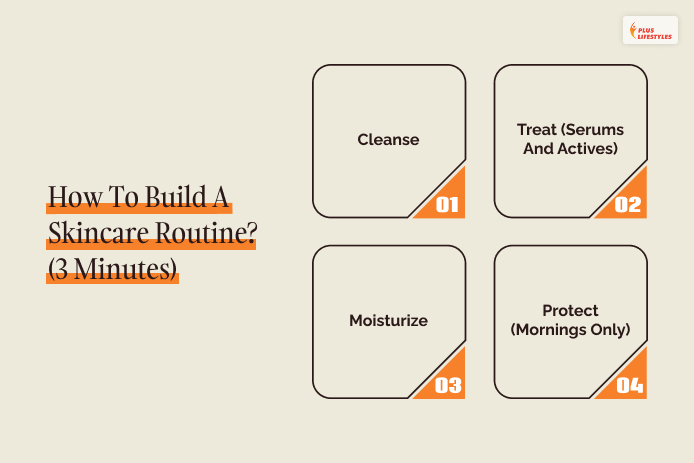
Here’s the actual framework. This is what I follow now, and it’s the same structure dermatologists consistently recommend.
Step 1: Cleanse
The first product you should use in your daily routine is a non-drying, fragrance-free facial cleanser.
Cleanse first, then layer products from thinnest to thickest.
This step removes the debris that accumulates overnight or throughout the day and primes your skin to actually absorb what comes next.
Step 2: Treat (Serums and Actives)
This is where you address specific concerns – hydration, brightening, acne, fine lines. Apply the most watery products first, finish with creams. This order keeps actives effective. [Source: North Carolina State University]
Niacinamide and hyaluronic acid work well in the morning. On the other hand, retinol is generally reserved for nighttime use, introduced gradually.
Step 3: Moisturize
Another must-have in your skincare kit is a non-comedogenic moisturizer – one that doesn’t clog pores.
Moisturizers for the face are the ones that hydrate your skin and lock in the moisture to keep it from getting dry, scruffy, or flaky.
Even oily skin needs this quite simply – without moisture, it overcompensates with extra oil, not less.
Step 4: Protect (Mornings Only)
You should always include broad-spectrum sunscreen with SPF 30 or higher in your skincare routine to shield your skin from the harmful effects of the sun.
Sunscreen is a must no matter the season.
Exposure to UV rays causes:
- Skin aging.
- Uneven pigmentation.
- Skin cancer.
Trust me when I say this – this is the step that I used to skip. But I don’t anymore!
That’s really the foundation of it all.
Once you grasp how to build a skincare routine through these four steps, all the other stuff is just a matter of fine-tuning to your skin’s precise requirements.
The Best Skincare Routine For Different Skin Types

Once your foundation is solid, the way you build a skincare routine should bend around your skin type – not the other way around.
Skincare Routine For Oily Skin
- Morning: Gel or foaming cleanser – niacinamide serum – lightweight, oil-free moisturizer – SPF 30+
- Night: Gel cleanser – salicylic acid or retinol (gradually introduced) – gel-cream moisturizer
For oily or acne-prone skin, a gel or foaming wash can get deep into pores and remove debris buildup. Resist the urge to skip moisturizer – it backfires.
Skincare Routine For Dry Skin
- Morning: Creamy cleanser – hyaluronic acid serum – rich moisturizer – SPF 30+
- Night: Creamy cleanser – nourishing serum or facial oil – ceramide-rich cream
Dry skin types usually prefer creamy cleansers, as these products should contain more oils. This helps in moisturizing the skin.
Use mild cleansing products and thick, creamy moisturizers containing elements such as ceramides that enhance the protective barrier and humectants, like hyaluronic acid and glycerin, that help bring moisture into the skin.
Skincare Routine For Combination Skin
- Morning: Gentle cleanser – niacinamide or hyaluronic acid serum – balanced, lightweight moisturizer – SPF 30+
- Night: Gentle cleanser – retinol 2 to 3 times weekly – medium-weight cream
Combination skin is the most challenging skin type to create a skincare routine for.
And that’s mainly because you are often trying to balance an oily T-zone and drier cheeks simultaneously.
As a result, formulas that are balanced and not too heavy are generally the best option for the entire face.
Skincare Routine For Sensitive Skin
- Morning: Fragrance-free cleanser – soothing, barrier-supporting serum – ceramide moisturizer – mineral SPF
- Night: Fragrance-free cleanser – gentle hydrating serum – ceramide moisturizer
According to the American Academy of Dermatology, patch testing and daily sunscreen significantly reduce irritation risk while you build a skincare routine.
So, always patch test new products on your jawline for 24-48 hours first.
What To Avoid In Your Skincare Routine Based On Your Skin Type?
Here are the absolute red flags that you MUST avoid when you are trying to build your skincare routine:
- Oily skin: Avoid heavy, occlusive creams and skipping moisturizer altogether – both can worsen oil production over time.
- Dry skin: Avoid foaming, sulfate-heavy cleansers and over-exfoliating, which strips the skin barrier further.
- Combination skin: Avoid applying the same heavy product across your entire face – your T-zone and cheeks often need different levels of richness.
- Sensitive skin: Avoid fragranced products, layering too many actives at once, and physical exfoliants with rough particles.
Note for Everyone: Too many products can lead to redness, irritation, and breakouts. Avoid popping pimples, blemishes, and whiteheads yourself – this can cause scarring, introduce bacteria, and push pus further under the skin.
Lifestyle Changes: What To Eat For The Perfect Skin?
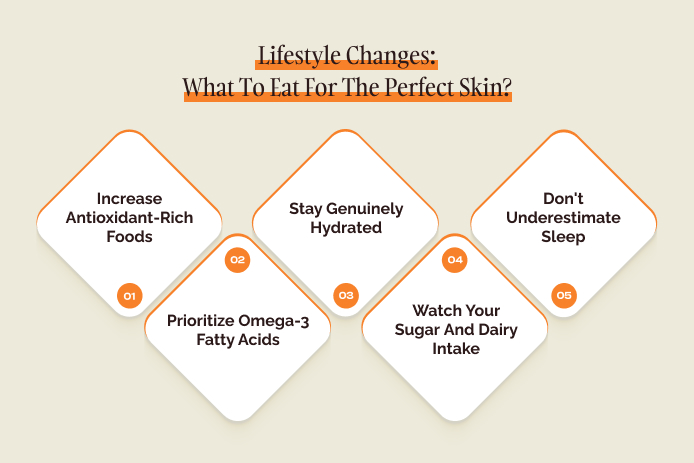
So, now you know how to build a skincare routine.
But guess what? Developing a skincare routine that only takes care of your skin externally will actually just take you halfway towards your goal. Your lifestyle strongly influences the behavior of your skin.
So, self-care is the BEST step (the foundational one) when it comes to building a skincare routine:
Increase Antioxidant-Rich Foods.
Besides being delicious, berries, leafy veggies, and brightly coloured vegetables help fight the stress caused by oxidation, which is one of the factors leading to premature skin aging.
Prioritize Omega-3 Fatty Acids.
These types of fats present in walnuts, flaxseeds, and oily fish not only contribute to your skin’s barrier but also to its moisture retention from within.
Stay Genuinely Hydrated.
Water is a natural ingredient to keep skin elastic. Besides this, it helps the body to get rid of toxins that otherwise might manifest on the skin as dullness or acne.
Watch Your Sugar And Dairy Intake.
For some people, high glycemic foods and dairy are linked to increased breakouts. This varies person to person, so pay attention to your own patterns.
Don’t Underestimate Sleep.
Finally, there’s sleep. Least talked about, but one of the most important ones. Your skin repairs itself overnight. Poor sleep shows up as dullness, under-eye puffiness, and slower healing. Try to get some deep sleep. Trust me – you will be able to see the difference!
No routine – however well-built – can fully compensate for a lifestyle that works against your skin. The two need to work together.