
| Quick Answer Digital dementia is a pattern of memory lapses, poor focus, and shrinking attention span linked to over-relying on smartphones and other devices for things our brains used to do on their own – remembering numbers, directions, even what we walked into a room for. It isn’t a formal medical diagnosis, but the symptoms are backed by real research, and they’re showing up earlier in life for people who grew up glued to a screen. The good news: most of it is reversible. |
German neuroscientist Manfred Spitzer coined the term back in 2012, describing how heavy reliance on digital devices – for navigation, memory, even basic recall – can lead to symptoms that mirror early cognitive decline: forgetfulness, poor concentration, and difficulty sustaining focus.
It’s not the same as clinical dementia, and most experts are clear it isn’t a diagnosable disease on its own.
But the underlying pattern – a brain that’s outsourced so much of its work that it’s forgetting how to do it unaided – is well documented.
What Is Digital Dementia?
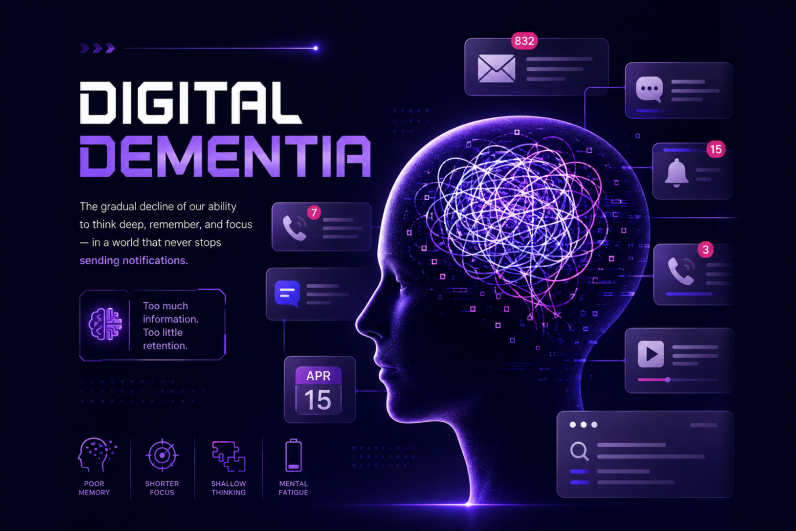
“Digital dementia” isn’t just a buzzword. It’s a real thing that happens when we let our gadgets do all the remembering for us.
Think about it: most of us don’t bother memorizing phone numbers, directions, or even trivia anymore. We just grab our phones and Google whatever we need. After a while, our brains get out of practice. Scientists call this the “Google Effect” or digital amnesia.
The brain simply stops working as hard to remember or figure things out, and that shows up in measurable ways. There’s even research tying heavy screen use to thinning in areas of the brain that handle memory and focus.
It gets worse with all the multitasking and endless notifications. Our attention spans scatter, and it’s tough for anything to truly sink in. The brain doesn’t get the chance to really process or store new information. [Source: National Institutes of Health]
Here’s the upside: this isn’t permanent brain damage – it’s more like a bad habit. Thanks to neuroplasticity, our brains are built to adapt. We can take back control.
Try navigating without your phone’s GPS once in a while, hold off on looking up answers and see if you can recall them yourself, and tuck the phone away before going to bed. Bit by bit, you can train your brain to do what it’s designed to do.
The Moment I Realized Something Was Off
I noticed it on a random Tuesday. I was standing in my kitchen, phone in hand, trying to remember why I’d walked in. Not a big deal on its own – except it had started happening at least twice a week.
I couldn’t hold a friend’s new number in my head long enough to save it. I’d reread the same WhatsApp message three times and still not absorb it. I’m turning 30 this year, and somewhere along the way, “just being busy” stopped explaining it.
What I didn’t expect was how closely it overlaps with something I already knew I was dealing with: digital burnout.
The constant notifications, the always-on Slack and email, the reflex to check my phone the second I feel a lull – none of that is separate from the memory fog.
It’s the same overstimulated nervous system showing up in two different ways: one as exhaustion, the other as forgetfulness.
Signs You Might Be Dealing With It Too
The symptoms, once I actually looked them up, were uncomfortably familiar:
- Trouble concentrating on one task for more than a few minutes
- Forgetting things almost as soon as I’ve been told them
- Reaching for my phone mid-conversation without meaning to
- Feeling like my brain is “full” even when I haven’t done anything mentally demanding
None of these are dramatic on their own. Together, over months, they add up to a noticeably shorter attention span than I had five years ago – and I’m not alone in that; most people I know describe some version of the same thing.
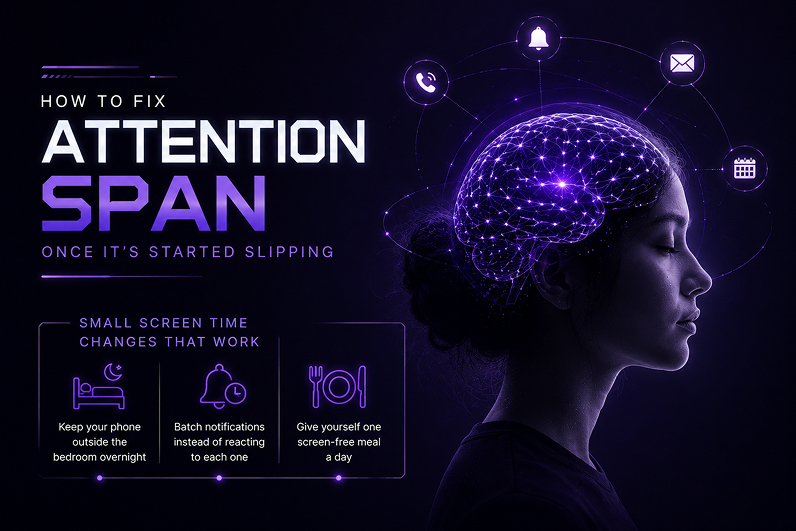
How To Fix Attention Span Once It’s Started Slipping
Can you really fix your attention span? Is digital dementia reversible?
The honest answer is: slowly, and with practice, the same way you’d rebuild any muscle you’d stopped using.
Deep focus isn’t something you get back through willpower alone – it comes from deliberately doing fewer things at once and giving your brain permission to be bored occasionally instead of reaching for a screen the second it is.
Why This Hits Working Women in India Especially
Our screen exposure isn’t just social media – it’s back-to-back Zoom calls, three different work chat apps, a family WhatsApp group that never sleeps, and a phone that’s simultaneously your alarm, your bank, and your only “me time” at the end of a long day.
India has one of the largest and fastest-growing bases of digital consumers in the world. And researchers have flagged that this scale of exposure – layered onto demanding work schedules – is still poorly studied in Indian adults specifically.
Yes. Even though the patterns of screen use here are genuinely different from the West.
We’re not overusing our phones for leisure alone. Rather, we’re doing it because our jobs, families, and social lives all now run through the same six-inch screen.
Small Screen Time Changes That Actually Work
None of this means throwing your phone away is the answer. But specific, small changes work far better than vague resolutions like “I’ll use my phone less” – here are a few how to reduce screen time tips that actually stuck for me:
- Keeping my phone outside the bedroom overnight
- Batching notifications instead of reacting to each one as it comes in
- Giving myself one screen-free meal a day
They sound almost too simple. But they’re the changes that stick, because they don’t ask you to overhaul your whole life at once.
The Cortisol Connection Nobody Talks About
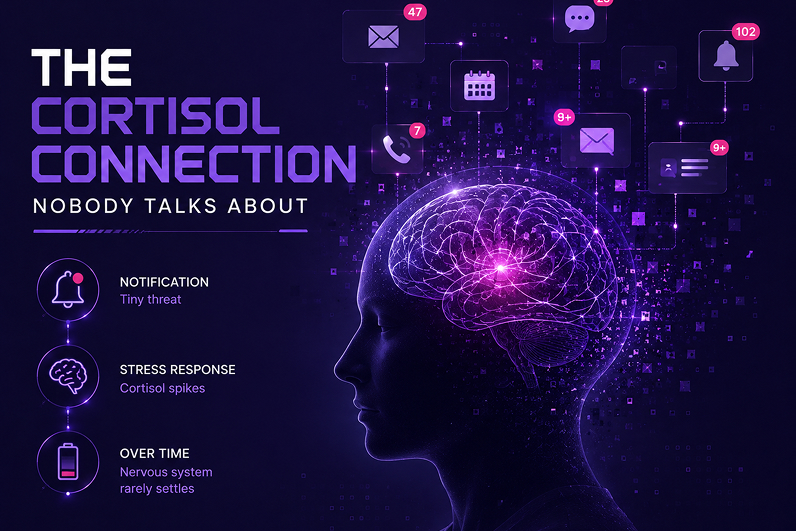
Here’s the part that surprised me most in researching this: digital dementia rarely shows up alone. It travels with stress.
Every time your phone pulls your attention away from what you’re doing – a notification, a reflexive check, an unread badge you can’t ignore – your body registers it as a tiny threat, and your stress hormones respond accordingly.
Think of it as the dark side of the burnt toast theory. That theory, as I mentioned in my previous blog, says minor daily delays happen for a protective reason.
But with our phones, the opposite occurs. Every ping is a false alarm – a “burnt toast” moment that didn’t actually save you from anything, but still spiked your cortisol anyway.
Over a full day of constant micro-interruptions, that adds up to a nervous system that’s rarely allowed to fully settle.
What A Cortisol Detox Actually Means
Cortisol is your body’s primary stress hormone, and while a little of it is normal and necessary, staying “switched on” all day – phone in hand, mind never fully at rest – keeps it elevated more often than it should be.
This is a big part of why a cortisol detox isn’t really about a strict diet or a supplement; it’s about reducing the number of times a day your nervous system gets startled into alert mode, which for most of us means reducing how often our phone interrupts us.
Should You Get A Cortisol Test At Home?
If you’re curious whether this is actually affecting you and not just “in your head,” a cortisol test at home is a reasonable first step before assuming the worst – it won’t diagnose digital dementia, but it can tell you whether chronic stress is part of what you’re feeling, which is worth knowing regardless.
How To Reduce Cortisol Levels As A Woman?
Learning how to reduce cortisol levels in woman-specific ways matters here too – women’s stress hormone patterns interact with the menstrual cycle, sleep, and even how we’re socialized to stay “on” for everyone else, which means generic stress advice aimed at a general audience often misses half the picture.
What Actually Helped Me Deal With Digital Dementia
Once I understood the connection, the fix stopped feeling like punishment and started feeling like maintenance.
A proper digital detox – even a modest one, like no screens for the first hour after waking up – made a real difference within a couple of weeks. I noticed I could hold a thought longer.
I stopped reaching for my phone out of reflex quite as often. Sometimes, the best advice really is just to “touch grass.”
If you want to go further than a daily reset, a short digital detox retreat is worth considering at least once – not as an extreme measure.
But as a way to feel, even briefly, what your baseline attention actually feels like without a screen pulling at it constantly. It’s genuinely disorienting the first day, and genuinely clarifying by the third.
I don’t think digital dementia means our generation is doomed to forget everything by 40. I think it means our brains are doing exactly what brains do – adapting to whatever we hand them the most work to do.
Mine had gotten very good at outsourcing memory to my phone, and not very good at anything else. Turning 30 was as good a reason as any to start handing some of that work back to myself.
| Disclaimer: This article is for general informational purposes and isn’t a substitute for professional medical advice. If memory loss or focus issues are affecting your daily life significantly, please speak with a doctor. |
Sources:
- Manwell et al., “Digital dementia in the internet generation,” Journal of Integrative Neuroscience
- “Understanding Digital Dementia and Cognitive Impact in the Current Era of the Internet: A Review,” PMC
- “Prevalence and Determinants of Excessive Screen Viewing Time in Children… India,” PMC