

| Quick Answer A digital detox retreat is a structured, usually multi-day stay – often in a nature-based or wellness-focused setting – where guests deliberately give up phones, laptops, and Wi-Fi for the duration of the trip. Unlike a regular vacation where you could put your phone away, a retreat removes the option entirely, with routines like yoga, meditation, and nature walks filling the space it leaves behind. |
A friend sent me a link to a digital detox retreat in Coorg and casually asked if I wanted to split a room.
My first reaction was skepticism – paying anywhere from ₹15,000 to ₹40,000 for something I could technically do at home for free felt like a scam dressed up in linen and essential oils.
But the more I sat with that thought, the more I realized I’d never actually managed to do “it” at home for free. Every attempt at a phone-free weekend ended by Sunday afternoon, usually because something “urgent” pulled me back in.
What Actually Happens Inside A Digital Detox Retreat?
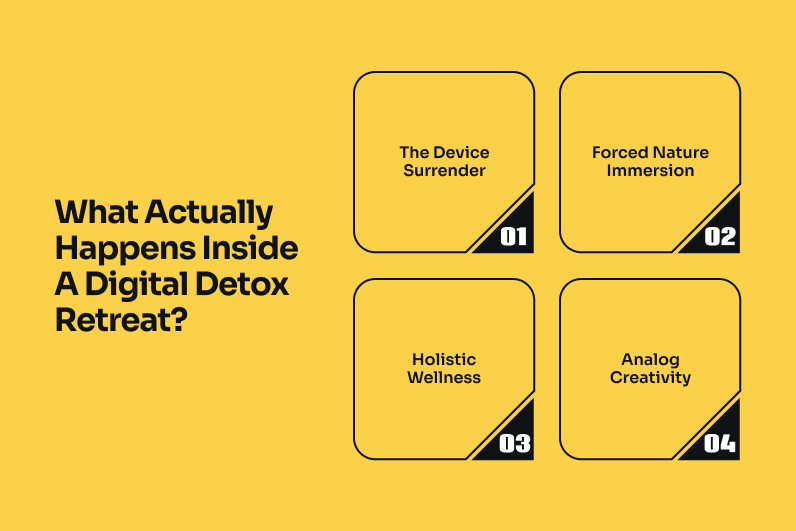
If you do decide to drop a massive chunk of money on a digital detox retreat, you need to understand that this isn’t just a regular hotel stay where the Wi-Fi is broken. It is a highly structured, intentional bubble designed to break your psychological habits.
If you pack your bags, here is exactly what the itinerary looks like when you strip away the screens:
The Device Surrender:
The very first thing you do at check-in is hand over your phone, laptop, and tablet like a misbehaving student. They are locked away securely in a safe or detox lockbox, entirely removing the “just checking once” temptation.
Forced Nature Immersion:
Your schedule is instantly filled with outdoor routines. You go from staring at a monitor to guided hikes, coastal tracking, silent forest bathing, and stargazing. It sounds a bit cliché, but it’s a massive shock to a nervous system used to concrete walls.
Holistic Wellness:
Instead of scrolling past an alarm, your days are anchored by daily yoga, breathwork sessions, sound healing, and traditional Ayurvedic treatments to actively quiet the internal chatter.
Analog Creativity:
To keep your hands from twitching for a screen, you are guided toward tactile, offline hobbies. You end up journaling, messing around with pottery, painting, or participating in communal cooking classes just to keep your brain occupied.
The Rise Of Digital Detox Retreats In India
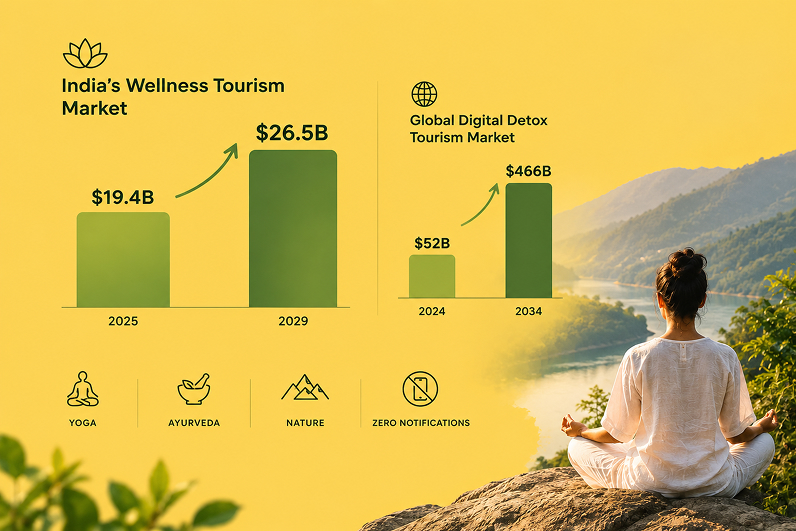
This isn’t a fringe idea anymore. India’s wellness tourism sector is valued at roughly $19.4 billion and is projected to grow to $26.5 billion by 2029, and more than 100 centers across the country now offer structured digital detox programs, up sharply from a handful just a few years ago.
In November 2025, the Indian Hotels Company – the group behind Taj Hotels – acquired a 51% stake in Atmantan Wellness Center, a clear signal that this has moved from a niche wellness trend to something big hospitality players are betting on.
From Fringe Idea To Serious Industry
Globally, the digital detox tourism market was valued at around $52 billion in 2024 and is projected to reach $466 billion by 2034. [Source: Akbar Travels]
Rishikesh, Coorg, Dharamshala, and parts of Goa and Rajasthan have become the country’s informal digital detox retreat circuit, each offering some version of the same core promise: yoga, Ayurveda, silence, and zero notifications.
What’s Actually Driving This
Part of it is straightforward burnout – the kind that’s now widely recognized as digital burnout, where constant connectivity leaves you exhausted even on light workdays.
But I think there’s something bigger underneath it too, tied to what’s being called the great millennial career crisis – an entire generation questioning whether the career path they were promised was ever going to deliver, and finding it almost impossible to sit with that question when a notification is always available to distract from it.
A retreat, in that light, isn’t really about the phone. It’s one of the few socially acceptable excuses to stop and actually think.
Why We Can’t Just Put The Phone Down At Home

I used to think willpower was the missing piece.
It isn’t.
There’s a concept called the red car theory – once you start noticing something, you notice it everywhere, whether that’s red cars on the road or how often your hand drifts toward your phone without your permission.
According to reports from the National Institutes of Health, at home, every surface reminds you your phone exists. A retreat works specifically because the option is removed entirely, so there’s nothing left to notice. [Source: PubMed Central]
What You Actually Get That A Weekend Off Doesn’t
A regular day off still has your phone in your pocket, and most of us end up doing a milder version of a digital detox rather than the real thing – checking “just once,” which turns into an hour.
A retreat forces the kind that actually sticks, at least for its duration. It also actively builds in habits that a weekend at home rarely delivers:
- First, it forces you into structured time outdoors. It is basically a more elegant way to touch grass.
- Second, it carves out massive, uninterrupted stretches of time. These quiet blocks allow your brain to rest. Because of this, people quickly notice real improvements in both their focus and memory.
This break actively lifts that heavy mental fog. It is the exact same cognitive slowdown that experts call digital dementia when screen addiction builds up over time.
Digital Detox Retreats In India
You don’t have to fly across the world to find a place that will confiscate your devices. India has built a serious, high-end circuit of dedicated wellness spaces specifically tailored to handle digital burnout.
If you are looking to book a spot, these are three major regional destinations that do it best:
| Location | The Environment Vibe | What You’ll Actually Do |
| Kshemavana (Near Bengaluru) | High-end holistic health center focused on a full cellular reset. | Intensive naturopathy protocols, structured yoga, and quiet meditative therapies. |
| Veda5 (Rishikesh) | Deep Himalayan serenity right on the banks of the Ganga. | Traditional Ayurveda treatments, structured meditation, and clean, mindful living. |
| Aranya Mauna (Mussoorie) | Total forest solitude hidden high up in the mountain ranges. | Strict silent retreats, long nature walks, and dedicated deep breathing work. |
If none of these three match your calendar or budget, you can easily check out a much wider selection of regional options using the BookRetreats India Directory to compare available dates and specific wellness packages.
Do You Actually Need One, Or Just A Weekend Off?

Here is my honest take after looking into this properly. You probably don’t need a retreat. At least, not if you haven’t tried cutting back at home first.
Simple, repeatable habits solve a good chunk of this for free. Try keeping your phone away during meals. Batch your notifications instead of leaving them live. Charge your device outside the bedroom entirely. These tips are absolutely worth testing before you spend a single rupee on a retreat.
A retreat only earns its cost under two conditions.
- First, you’ve tried the small stuff at home, and it just won’t stick.
- Second, you are dealing with a barrier that feels much bigger than a bad habit.
Maybe your attention span is so fractured you are constantly looking up how to fix it. Or maybe you are dealing with chronic, wired-but-tired exhaustion.
If you are at the point where you are considering an at-home cortisol test to check your stress hormones, that is when a retreat makes sense.
To be clear, a getaway won’t replace a real medical cortisol detox plan or professional advice. But as a forced reset, it is a genuinely useful starting point.
And for what it’s worth, women need to know that stress isn’t generic. Learning how to lower cortisol levels as a woman looks different. You can’t just follow standard advice, because monthly hormonal cycles heavily factor into your body’s stress response too.
What Changed My Mind
I ended up going to Coorg. Three days, no phone, a lot of unstructured time I didn’t know what to do with for the first six hours. By day two I’d read more pages of an actual book than I had in the previous two months combined.
It didn’t fix my job, my inbox, or my career questions – nothing three days away realistically could. But it gave me a clear-enough head to actually look at those things instead of scrolling past them, which was worth more than I expected going in.
A digital detox retreat isn’t magic, and it’s not the only way to reset your relationship with your phone. But if you’ve genuinely tried the free version and it hasn’t worked, paying for a setting where the choice is made for you might be less indulgent than it first sounds.