

| Quick Answer You can’t actually “detox” cortisol – it’s not a toxin. It’s a hormone your body produces on purpose, and there’s no clinical evidence that any specific detox program removes it. What people usually mean by cortisol detox is supporting a healthy cortisol rhythm through sleep, movement, and stress reduction. The habits genuinely work; the word “detox” is just misleading marketing attached to them. |
I want to get this out of the way early, because I went into researching this expecting to find a clean routine to hand you.
And instead, I found a lot of overhyped wellness talks. I saw creators pushing everything from positive affirmations to unproven detox diets. This content quietly overstates what is actually known by science.
So this is the honest version. One that you really need to know!
What Cortisol Is (And Isn’t)
Cortisol is produced by your adrenal glands as part of a feedback loop called the HPA axis – your hypothalamus, pituitary gland, and adrenal glands signaling back and forth. It’s not inherently bad.
It’s what gets you out of bed, helps regulate blood sugar, and sharpens your response when something demands attention.
ColumbiaDoctors state that healthy cortisol follows a curve: it peaks in the morning, then gradually declines through the day, dropping lowest at night so your body can wind down.
Simple?
Problems show up when that curve gets disrupted – when cortisol stays elevated into the evening instead of tapering off, which is what most “high cortisol” complaints are actually describing.
Why “Cortisol Detox” Is The Wrong Word
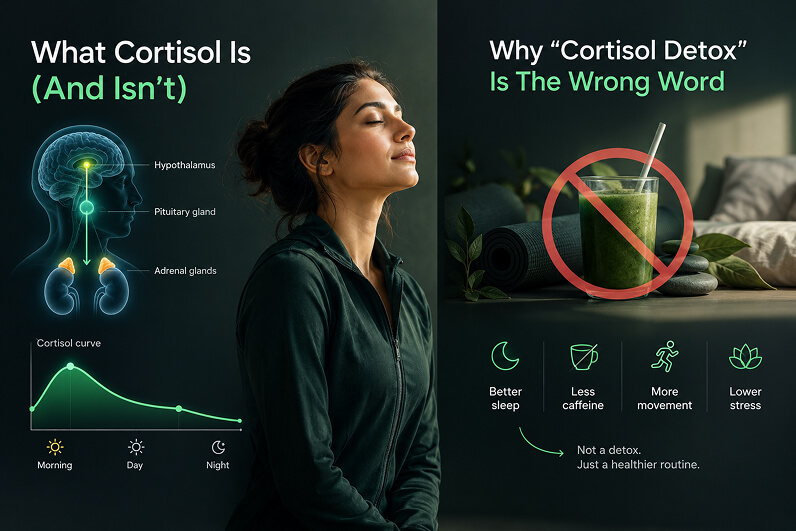
Endocrinologists have pushed back on this term directly.
A cortisol detox, medically, isn’t a recognized treatment – it’s a repackaged version of ordinary stress management:
- Better sleep.
- Less caffeine.
- More movement.
- Lower overall stress load.
None of that removes cortisol from your body the way a detox implies.
What it actually does is reduce how often your HPA axis gets triggered in the first place, so there’s simply less cortisol being produced to begin with.
Small distinction, but it matters for how you approach it – this isn’t a weekend cleanse. Rather, it’s an ongoing pattern.
Cortisol Detox: Where This Trend Actually Came From
It’s worth knowing this isn’t a brand-new idea – it’s an old wellness concept that recently went viral.
The term traces back to 2001, when naturopath James Wilson published Adrenal Fatigue: The 21st Century Stress Syndrome. Here, he argues that chronic stress “wears out” the adrenal glands.
Adrenal fatigue was never a recognized medical diagnosis. But the idea stuck around in wellness circles for two decades.
Then, in 2022, Google searches for “high cortisol” spiked sharply – likely tied to pandemic-era research linking COVID-related stress to elevated cortisol in healthcare workers and the general public.
By 2023, it had fully broken into social media, with TikTok creators coining terms like “cortisol face” and “cortisol belly” and pushing detox diets and supplements as the fix. [Source: Yahoo, 2 Minute Medicine]
The hashtag #cortisoldetox has since racked up close to 800 million views.
It’s become common enough that clinicians now report patients requesting cortisol testing based on what they’ve seen on social media. Even though that test is really only useful for diagnosing rare conditions like Cushing’s syndrome. [Source: Healthgrades]
So the timing makes sense – a genuinely stressful few years, an old wellness concept, and a platform built for oversimplified before-and-after claims.
None of that makes the underlying science any different, but it explains why you’re seeing this everywhere right now.
What The Research Actually Shows Helps
If you are planning to go on what the internet calls “a cortisol diet,” here’s what research says really helps:
Sleep And The Cortisol Curve
Sleep and cortisol share the same regulatory pathway, which is part of why poor sleep and elevated evening cortisol tend to show up together.
A consistent sleep and wake time – even on weekends – helps keep that morning-high, evening-low curve intact, which is more useful than any single “relaxation technique” on its own.
Movement And Nature
Exercise has reasonably consistent evidence behind it for lowering cortisol over time, and time spent in actual nature – not just outdoors near traffic – shows a similar effect.
A walk in a park does more for this than the same walk on a busy street, which is part of why I’ve started treating my balcony as more than just a spot to leave laundry – a proper little green corner out there has become a five-minute reset I didn’t expect to matter this much.
Diet’s Role (Without The Hype)
Diet’s effect on cortisol is real but modest. And a lot of “cortisol detox diet” content overstates it.
What the evidence actually supports is fairly unglamorous: less ultra-processed food, less excess caffeine, more whole foods.
Nothing in a “Cortisol Detox Diet” does something a generally balanced diet doesn’t already do.
Checking Where You Actually Stand

Before assuming your exhaustion or irritability is cortisol-related, it’s worth getting an actual read rather than guessing from symptoms alone, since symptoms overlap with a dozen other things.
A cortisol test at home is a reasonable starting point for that – it won’t replace a doctor’s interpretation, but it gives you real data instead of a hunch.
Why This Hits Working Women A Little Differently
Cortisol doesn’t operate in isolation – it interacts with the menstrual cycle, and stress hormone patterns can shift noticeably across it.
This is part of why how to reduce cortisol levels in woman-specific terms genuinely differs from generic advice aimed at a general audience.
And it is important that you understand this. A routine that works fine for a male colleague might land differently depending on where you are in your cycle.
Where Cortisol Detox Fits Into The Bigger Screen-Time Picture
A big, often-missed driver of elevated cortisol for people like us isn’t a single big stressor – it’s dozens of small ones. Every notification, every reflexive phone check, registers as a tiny threat cue, and your body responds accordingly.
String enough of those together across a day and your cortisol rarely gets the chance to taper off the way it’s supposed to.
This is the same underlying pattern behind digital burnout – exhaustion that rest alone doesn’t fix – and it overlaps with digital dementia too, since a body that’s rarely calm also struggles to hold focus and memory well.
Once you start noticing how often your phone interrupts you, you tend to keep noticing it – that’s the Red Car theory again, and it applies here just as much as it did to screen time.
Cortisol Detox Tips: Practical Habits That Actually Lower Cortisol

Given all that, the most useful lever most of us have isn’t diet – it’s reducing how often we get interrupted in the first place.
Certain tips on how to reduce screen time – batching notifications, phone out of the bedroom overnight – do double duty here. It lowers both screen time and the stress spikes that come with it. I have spoken about it at length in my previous blog. Do check that out!
Building in sustained, uninterrupted focus blocks (part of how to fix attention span work) has a similar effect, since a mind that isn’t constantly switching also isn’t constantly triggering that stress response.
And something as small as stepping outside – to Touch Grass – genuinely helps, for the same nature-exposure reason mentioned earlier.
When Daily Habits Aren’t Enough

Cortisol-driven exhaustion might be building for a while.
This can happen despite daily habits. A short digital detox can interrupt the pattern. This could be a screen-free evening or two. It works faster than incremental tweaks.
The exhaustion and burnout might be chronic rather than occasional.
A proper digital detox retreat can help. This means staying away from notifications entirely for a few days. It tends to reset the baseline. Daily willpower rarely manages this on its own.
So, Do You Really Need A Cortisol Detox?
None of this exists in a vacuum.
A lot of us are running elevated stress not just from notifications but from something bigger sitting underneath – what’s being called the Great Millennial Career Crisis, a quiet, ongoing reckoning with whether the career path we were promised actually delivers.
Constant connectivity makes it easy to avoid sitting with that discomfort, which paradoxically keeps stress levels higher, not lower.
If there’s one thing I’d want a reader to take from this, it’s that you’re not missing some secret detox protocol.
The actual levers are boring and repeatable. They are already available to you. These include sleep, movement, and fewer interruptions. They also include knowing your real numbers instead of guessing.
If your symptoms feel more severe than everyday stress, that’s worth taking to a doctor. Do not try to fix them with a wellness routine.
Severe symptoms include significant weight changes or unusual bruising. They also include anything that feels beyond “just tired.”
Disclaimer: This article is for general informational purposes and isn’t a substitute for professional medical advice. If you’re concerned about your cortisol levels or hormonal health, please consult a doctor.
Sources:
- “Cortisol Detox: What Science Says,” ColumbiaDoctors Endocrinology
- “Do Cortisol Detox Diets Work? Here’s the Science”
- “How to lower cortisol levels and naturally reduce stress hormones,” Calm
- “Cortisol and Sleep,” Healthline