






Quick Answer (tl;dr):
Making friends in a new city does not always start with joining something. Start with the people already near you: the PG neighbor, the team, the school friend who moved too. Help when you can and keep showing up. About 50 hours together moves an acquaintance to a casual friend, according to a University of Kansas study.
I am currently sitting at my work desk, listening to Iktara from Wake Up Sid, wondering exactly how Konkona cracked the code to make friends in a new city.
Aisha had moved to Mumbai from Kolkata with dreams. And she had her own ways. How she made friends in the new city was not an intentional path that she had chosen. And I think, if not for Sid, she would’ve bored herself to death with her boss. Thank god she finally realized that he wasn’t worth the effort.
Looking back, I can pin point a few things that she did to make friends in a completely new city:
- Attending the college farewell.
- Trusting Sid, even though he was a complete opposite.
- Connecting through her workplace and building professional rapport.
I know it was a movie. But that path was still possible back then. Times have changed.
Now ask a Gen Z how to make friends in a new city. Ask my sister, who moved to Bangalore in November 2024. Her answer is not a plan. It is a shrug with a story:
“Making new friends in BLR happened by accident to be honest.”
She did not join a club. She is an introvert who likes a small circle. And she still ended up with people. This is how.
Loneliness In Indian Metros Is Common, Not A Personal Failure

If you feel a new city is lonely, you are certainly not alone. Around 60% of those living in big cities, including Mumbai and Delhi, say they are lonely, according to a Red Lab report, 2025.
“Despite being the most connected generation, Gen Z is reportedly the loneliest. High screen time, peer exclusion, and declining in-person interactions are leaving millions of teens and young adults isolated.”
Furthermore, 43% of Indian urban youth claim to be lonely. However, the report gives no information about how many people were surveyed or how, so this should be treated as indicative rather than definitive.
Exchange 4 Media identifies four reasons. Firstly, many people are so work-focused that they lack time to socialize. Secondly, electronic communication is increasingly used, and this is seen to replace more meaningful connection. Thirdly, cities themselves fail to provide sufficient communal areas and therefore cause a sense of urban loneliness. And finally, in some areas of India there is still a cultural norm to maintain different genders within separate friend groups.
None of those is a flaw in you.
Friends Often Start With Distance, Not Choice
While much guidance on how to make friends in a new city urges people to ‘go out and socialize ’, a classic study into housing identified a more fundamental cause.
Leon Festinger, Stanley Schachter and Kurt Back (Chapter 12 Social Design and Emergent Behavior) undertook research into the friendships of students who had recently moved into new married student housing at MIT. They discovered most people’s friends were also housed within the building.
Neighbors next door were the most likely friends. Furthermore, those residing on the ground floor around stairwells were over 2.5 times more likely to be friends with those on upper floors. [Source: Minnesota State University Moorhead, Environmental Psychology].
Psychologists call this “propinquity.” According to the study, they were “describing ways that the physical environment was encouraging or discouraging interaction among individuals.” Basically, it is the idea that you bump into people, you talk, and you drift into friendship.
That study is more than 70 years old, American, and about married couples in one housing complex. I read it through a textbook summary, not the original. Still, it explains something in my sister’s story that a motivational post never will.
Shared Stress Is A Shortcut, With A Catch
Asmita has a view on where friendships form fastest: “In a tensed meeting room. When everyone is stressed you make great friends.” Research gives that line some support.
In a 2014 paper in Psychological Science, Brock Bastian, Jolanda Jetten and Laura Ferris randomly allocated people to two groups. One group was asked to undertake a physically unpleasant activity, e.g., submerging a hand in cold water. The other group was allocated a non-painful activity. Those people in the more unpleasant group felt they had formed stronger connections and were more cooperative in a subsequent game.
As reported by the Association for Psychological Science, psychological scientist and lead researcher Brock Bastian said, “The findings shed light on why camaraderie may develop between soldiers or others who share difficult and painful experiences.”
However, there are significant caveats. Those researched were university students and the connection was temporary. Furthermore, while the research analyzed people’s response to physical pain, it did not analyze reactions to office-related strain. Thus, although Asmita’s comment is a human parallel to the research, it is not evidence per se.
Why Team Dinners Work And Desk Hours May Not
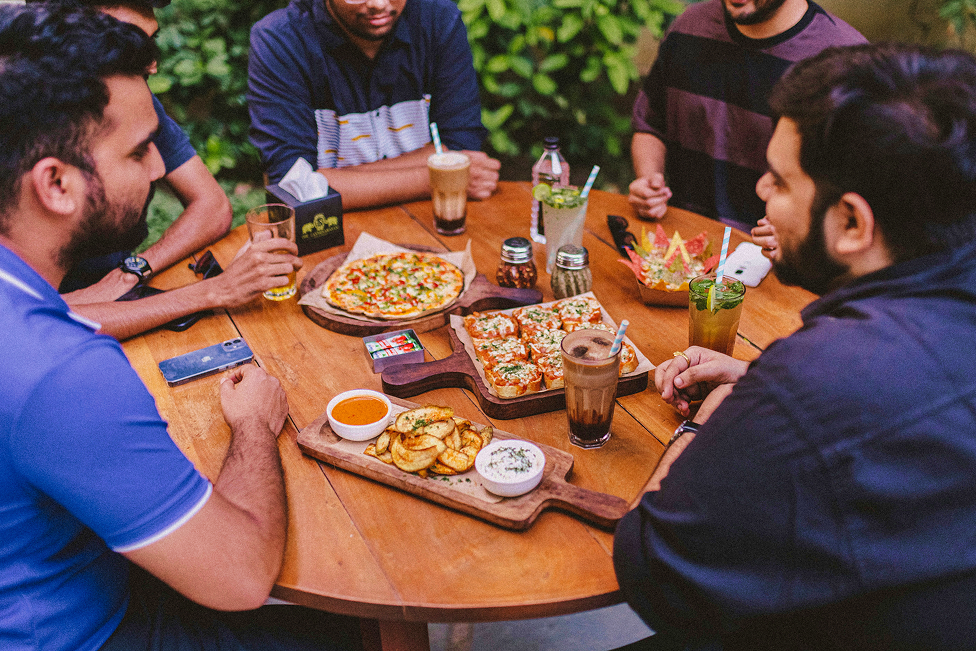
Jeffrey Hall, Associate Professor of Communication Studies at the University of Kansas, studied 355 adults who had moved in the previous six months. [Source: Journal of Social and Personal Relationships].
Hall found that it generally requires around 50 hours of togetherness to transition from acquaintance to casual friendship. Becoming friends in this way requires around 90 hours and more than 200 hours for close friendship.
The detail people skip is the type of time.
The KU report says hanging out and joking around count toward friendship. “This means time spent hanging out, joking around, playing video games and the like. Hours spent working together just don’t count as much,” reports KU News.
That may be why Asmita points to team dinners, not just deadlines. In my reading, shared stress opens the door, and the dinner walks you through it. That is my interpretation of Hall’s finding.
They Like You More Than You Think
Introverts often fear the first conversation more than the second. Psychologists Erica Boothby, Gus Cooney, Margaret Clark, and Gillian Sandstrom ran five studies, published in Psychological Science in 2018.
Those in the research said that after conversing with a stranger for 5 minutes, they thought they were liked more than they believed the other person liked them.
The authors call it the “liking gap.” According to Yale News, the authors mentioned that “it can hinder our ability to develop new relationships.” It held in longer conversations and real settings, and lasted months among roommates, reports the Association for Psychological Science.
The awkward feeling after you leave is not a verdict.
Small Contacts Still Count
You do not need a best friend on day one. Gillian Sandstrom and Elizabeth Dunn found, in a 2014 paper in Personality and Social Psychology Bulletin, that people with more weak-tie interactions reported a greater sense of belonging.
According to the Harvard blog summary of the study in relation to interactions during the pandemic, “peripheral social interactions” are extremely important when it comes to well-being.
“The researchers found that participants who had, on average, more weak tie interactions than others reported greater feelings of belonging. Furthermore, they also found that participants reported greater feelings of belonging on days when they interacted with more weak ties than usual.”
So, in simple words – a nod to a neighbor counts.
What The Standard Playbook Tells You To Do

If you consult several ‘how to make friends in a new city’ resources, you will find that there is an apparent emphasis on proactivity and structure.
First, you are told to start before you even pack. Bumble encourages you to utilize current connections to help form new ones. Initially, it is advised to favor breadth of contacts – particularly linking with other people new to the area who also share your interest in forming new friendships.
Upon arrival, The Art of Manliness promotes localization and shrinking your geography. This would include:
- Meeting those in your local area.
- Limiting shopping/spending habits to this vicinity.
- Setting firm dates for socializing.
Domestic hospitality can also be used to further encourage mutual interaction.
But these are not the only things. Skip The Small Talk discusses the mindset required to form friendships. Becoming known as a ‘regular’ at a local café, quiz night or course is seen as a means of increasing your visibility.
However, as connection does not occur instantaneously, there will always be some delay between actions and outcomes. Facing the discomfort of being in new places by yourself, this resource suggests that rather than fretting about how you are perceived, you should adopt a more inquisitive approach.
Through brief but sincere revelations about yourself – but without divulging excessive information – you can begin to form numerous light-level relationships instead of solely relying on one person for all social interaction.
All three resources emphasized that friendships need to be nurtured. Regular attendance, supplemented by gentle secondary approaches, are suggested along with the creation of continual interaction, which is no longer automatically offered in adulthood.
How To Make Friends In A New City: Asmita’s Story In Bangalore
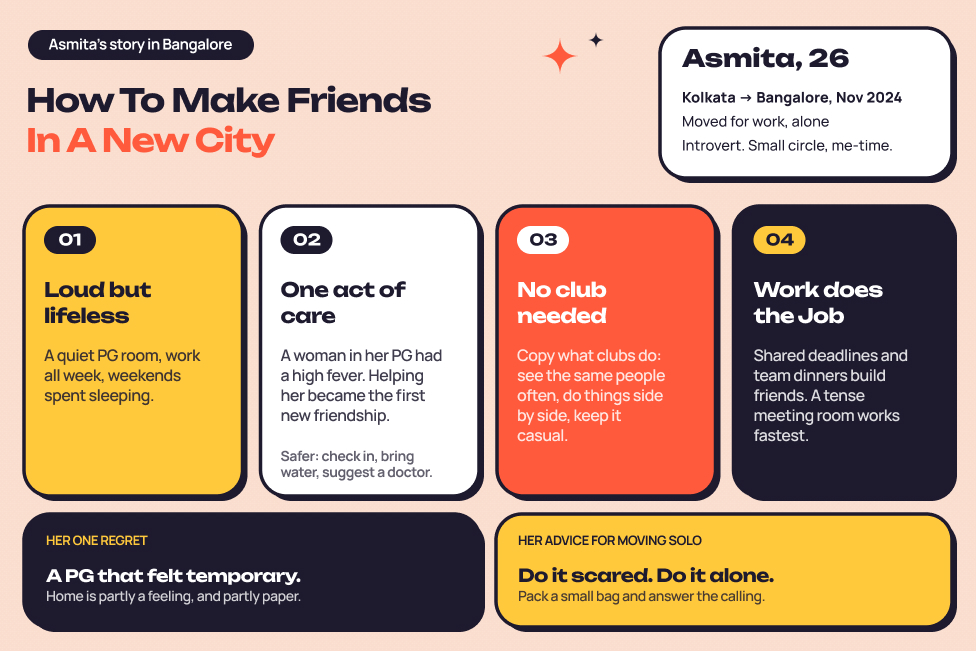
The internet’s standard playbook for making friends in a new city reads like a second job. Suggestions include running in groups, attending pottery classes, and engaging in small talk at social functions. And then agreeing to every weekend event.
For an introvert, however, this is neither inspiring nor energizing.
Generally, genuine adult friendships aren’t initiated through an invitation or networking function. Rather, they tend to be influenced by serendipity, common strain, and even unintentional minor conflict.
Asmita’s move from Kolkata to Bangalore proves that you do not need to reinvent your personality to find your people – you just have to pay attention to the spaces you already inhabit.
The Case File
| Detail | What happened |
| Who | Asmita, 26 |
| Moved | To Bangalore, November 2024, for work |
| From | Kolkata |
| Home | A private room in a PG, “almost similar to a 1RK” |
| Already in the city | A few school friends who had also moved |
| Personality | Introvert; likes a small circle and some me-time |
| Hobby club | None. She avoids classes and gyms she may not stick to. |
| First new friend | Another woman in her PG, after Asmita gave her meds for a high fever |
| Easiest place to bond | A tense meeting room |
| Biggest regret | Choosing a PG over an apartment |
The First Month: Loud But Lifeless
Asmita moved in November. She set herself a finish line.
“I moved to Bangalore in November so I kept telling myself that I just have to survive a month and a half, then I’ll go back home for the holidays. I got a private room in the PG almost similar to a 1RK so everything felt too quiet all of a sudden. The city is loud but lifeless and it was very clear from the first week itself. I had a few friends from school who also shifted to this city so I met up with them. The weekdays went by working and I slept through the weekends waiting to go back home. That’s pretty much how the first month went”
Look at what the housing study would predict. A private room gives you space. It also gives you fewer accidental meetings. That is my reading of the research, not a finding about PGs.
The Fever
Then something small happened.
“I just happened to bump into another woman in the PG who had a high fever and I gave her meds. That’s how it started.”
Notice the shape. It was not a plan. It was proximity, plus one act of care.
A word of caution for readers: sharing medicine is not always safe. A high fever deserves a doctor. Checking in, bringing water, and helping someone reach a pharmacist or doctor is the safer way to help.
No Club, No Gym, No Pottery
I asked her about hobby clubs. She gave me an honest no.
“Hobby club not so much. Occasionally I’ve thought about joining gym, sometimes pottery classes sound fun too but I’m not a person who sticks to those so I avoid such things.”
This is a particularly pertinent answer as it goes against current trends. Indeed, brands are already exploiting organized socializing. A 2026 report by District by Zomato entitled ‘Touching Grass’ identified that 83% of Indian Gen-Z prefer guided group fitness sessions [Source: Business Today]. Almost all guidance on creating new friendships emphasizes exactly this sort of club.
As previously highlighted by Hall, time is integral to friendship creation. Fitness classes are a good source of this. But so too are work and PG areas. Asmita skipped the paid memberships and collected hers at work and in the PG.
Don’t Want To Join A Club? Do These Instead
While the advice to “be brave, go out, and say yes” is admirable in principle, it isn’t particularly helpful. Clubs are preferable to one-off social occasions as they are based on 4 basic principles. Fortunately, these can all be applied to everyday life at no cost:
- See the same people often: As I have mentioned above, friendships require time to develop. Weekly classes ensure regular contact with the same people. Similarly, an office floor and PG corridor also enable frequent interaction with the same individuals.
- Do things side by side: People strengthen links when they chat and laugh while collaborating. An office team lunch or shared deadlines are equally effective as a gym.
- Let the task break the ice: Having something to concentrate on greatly reduces the discomfort of initially meeting someone. Moreover, as previously noted, people tend to like you more than you think. Similar to hobbies, a challenging project or even a shared house issue will often provide ample discussion topics.
- Keep things casual at first: You need not strive to identify a best friend by Sunday. Informal friendships can naturally develop simply from a corridor greeting.
The Office, And The Rule She Keeps
Work turned out to be the easy part. When I asked her if she has been able to make friends at her workplace, this is what she said:
“Yes absolutely. Although I maintain a clear boundary and only make friends with ex-employees because the ones in office are colleagues, when you spend half of your entire day at work, interactions with others become inevitable. If you’re in a team especially, responsibilities and reliance are often the main factors which lead to friendships. Then there are bonding activities like team dinners and stuff that just enforces it as well.”
Her rule is interesting. She continues to treat her current colleagues as colleagues and reserves her friendship group for ex-employees. Although this is her decision, it is by no means the only viable option. Notice what she says about the mechanism: shared responsibility, reliance, and team dinners.
The Tense Meeting Room
I asked where she thought friendship was impossible, but it turned out to be easy.
“In a tensed meeting room. When everyone is stressed you make great friends.”
A Small Circle, On Purpose
She did not try the neighborhood either, and she does not apologize for it.
“Other than that one accidental friend that I made by sharing medicine, I did not try making friends. I like my circle small and I love some me-time.”
Her belief, from before she tried anything:
“I already have some of my schoolmates so I don’t need to care about making new friends. They are plenty to annoy me.”
That belief was half right. Old friends in the same city are a real anchor.
The Regret: A PG That Felt Temporary
Her one regret is not about people.
“Probably getting an apartment would’ve been better than getting a PG in the first go. I always feel like this is a temporary accommodation and that kind of takes away the whole sense of relaxation.”
Interestingly, legally, the majority of PG residents are in fact licensees, not tenants. Consequently, their rights largely depend on the license they sign, according to an Outlook India, June 2026 explainer.
Home is partly a feeling, and partly paper.
Her Advice
Her advice to the next person who moves alone is short.
“Moving away is important for growth so do it. Do it scared. Do it alone. Pack a small bag and answer the calling. You never know what happens next but it always happens for the best.”
A Plan For How To Make Friends In A New City If You Hate “Putting Yourself Out There”
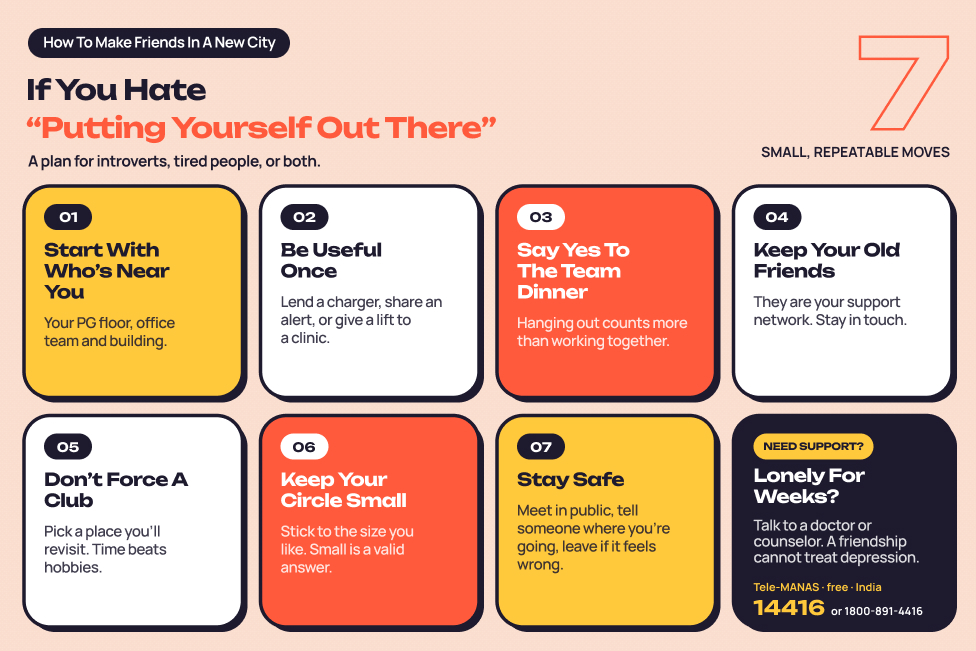
Use this if you are introverted, tired, or both. It shows how to make friends in a new city with small, repeatable moves. It borrows from the research above and from Asmita’s story.
1. Identify those in your vicinity: Start with who is near you. As shown by the housing research, neighbors are most likely to become friends. These include your PG floor, office team, and building.
2. Be useful once: Perform a kind act. Asmita’s friendship was initiated by an act of kindness. While you do not need to perform highly significant gestures, offering somebody your charger, an alert, or transport to a clinic can all be of assistance
3. Say yes to the team dinner: Hall’s work suggests hanging out counts more than working together.
4. Keep your old friends: Continue to associate with your existing friends. Asmita connected with her school friends in Bangalore. They provided a strong support network.
5. Do not force a club: If you will not stick to one, skip it. Select an environment in which you are likely to revisit. Again, time is more significant than hobbies.
6. Keep your circle the size you like: Stick to your preferred group size. Small is a valid answer if that’s what makes you comfortable.
7. Stay safe: When it comes to making friends in a new city, safety should be your top priority. Socialize in public and always inform someone of your destination. Leave if a plan feels wrong.
If the loneliness lasts for weeks, or comes with low mood or hopelessness, talk to a doctor or counselor. In India, Tele-MANAS offers free support at 14416 or 1800-891-4416.
A friendship cannot treat depression.
The Takeaway
Aisha got a Sid. Asmita got a fever, a team and a PG. Neither planned it. Both got their friends the same way: they were near people long enough for something to start.
That is the quiet lesson about how to make friends in a new city. You do not have to be brave on schedule. You have to be present, be kind once, and let the hours add up.
Sources:
- KU News, How to make friends? Study reveals how many hours it takes, 6 March 2018 (Hall, Journal of Social and Personal Relationships)
- Association for Psychological Science, You probably made a better first impression than you think, 10 September 2018 (Boothby, Cooney, Clark and Sandstrom)
- Association for Psychological Science, Shared pain brings people together (Bastian, Jetten and Ferris, Psychological Science, 2014)
- Harvard blog on social connection, Sandstrom and Dunn on weak ties (Personality and Social Psychology Bulletin 40(5), 2014)
- Minnesota State University Moorhead, Environmental psychology text, chapter 14 (summary of Festinger, Schachter and Back, 1950)
- exchange4media, Nearly 60% of residents in Indian metros report feeling lonely: Red Lab, 5 August 2025
- Outlook India, PG rules in India explained, 26 June 2026
- Tele-MANAS, Ministry of Health and Family Welfare