
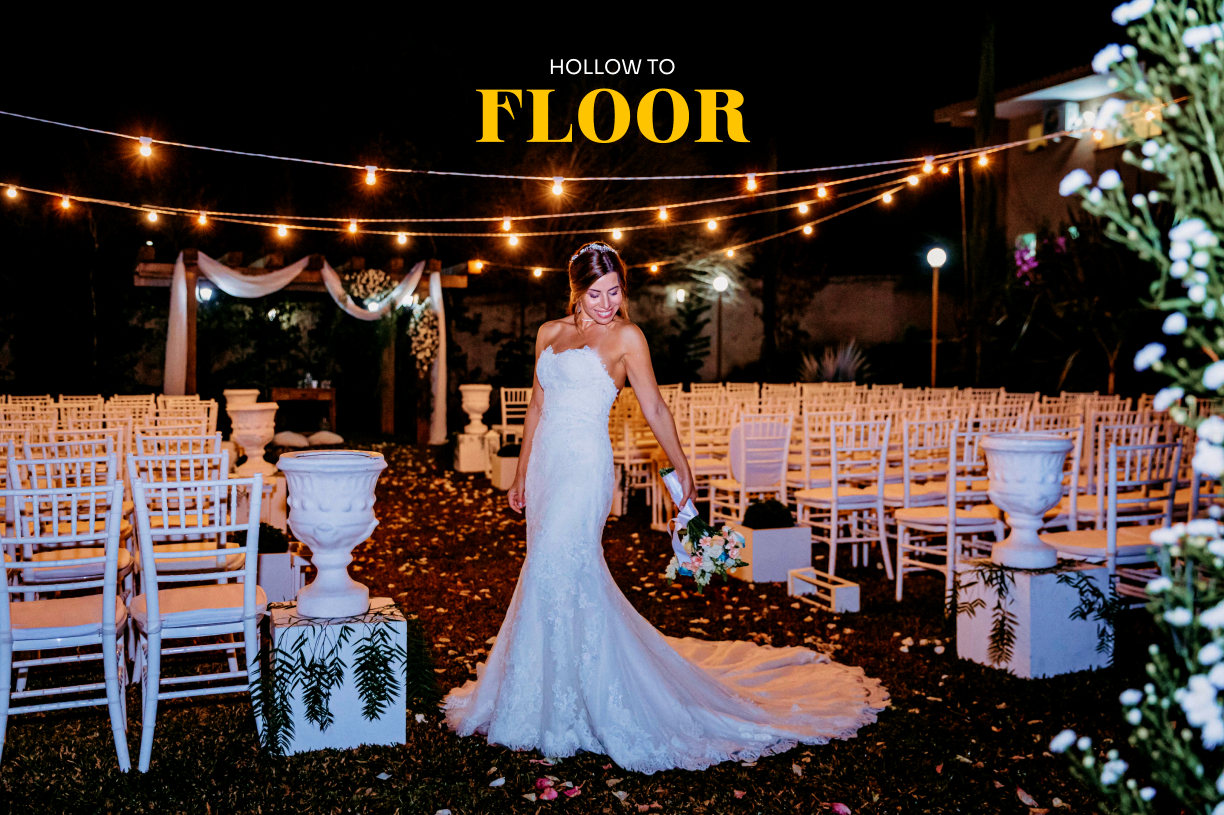
| Quick Answer A hollow to floor measurement is taken from the center of the collarbone (the hollow space at the base of the neck) straight down to the floor, usually while standing straight with bare feet or in event shoes to ensure a custom-fit dress length. |
Today I am going to talk about something that I learned about recently: Hollow to Floor measurement.
Let’s be real: buying a wedding or bridesmaid dress is a massive thrill until you hit the “Custom Measurements” section of the website.
Suddenly, you’re faced with terms like Hollow to Floor, and if you’re like most people, your first thought is probably, “My hollow what?”
Don’t panic.
You don’t need a fashion degree or a background in architecture to get this right. Whether you’re ordering a custom gown online or working with a high-end designer, this one number is the “North Star” for your dress length.
It is the secret to a dress that fits perfectly – no tripping hazards or awkward high-water hemlines included.
So, if you want to know about how to get your hollow to floor measurement right for your dream dress, keep reading!
What Is A Hollow To Floor Measurement?

In the world of bridal and formal fashion, the Hollow to Floor measurement is a vertical line from the base of your neck straight down to the floor.
If you touch the base of your throat, you’ll feel a small, bony indentation right between your collarbones. That’s your hollow.
Designers use this as the starting point because, unlike your shoulders (which can be sloped, broad, or narrow), the hollow is a stable, consistent landmark on every human body.
So, by measuring from there to the floor, the designer gets a “true height” of your torso and legs combined.
Hollow To Floor Measurement vs. Hollow To Hem Measurement: What’s The Difference?

This is where most people get tripped up. You’ll often see these terms used interchangeably, but there is a subtle, crucial difference:
- Hollow to Floor: This is your actual body measurement, usually taken while you are barefoot. It represents the distance from your neck to the ground.
- Hollow to Hem: This refers to the length of the actual dress. To get this number, a designer takes your “Hollow to Floor” and then adds your heel height plus a little wiggle room (usually about an inch), depending on the style of the dress.
If a website asks for your “Hollow to Floor,” they usually want your barefoot stats. If they ask for “Hollow to Hem,” they are asking how long you want the fabric to be from top to bottom.
Is There A Hollow To Floor Measurement In Indian Weddingwear?
The short answer is no, not natively – but global e-commerce is forcing a shift.
If you look closely at standard Indian sizing charts from top domestic multi-designer platforms like Aza Fashions or Lashkaraa, you will see that “hollow to floor” is completely absent.
Instead, traditional Indian wear operates on modular, two-piece metrics: blouse length, bust, and a dedicated waist-to-floor “lehenga length”.
The gap shrinks when NRI brides enter the picture. For global custom orders, online retailers like House of Panchhi or Mohi Fashion have actually had to adapt Western bridal standards.
They explicitly request hollow-to-floor data – ranging from roughly 130 to 155 cm (51 to 61 inches) based on height – specifically for one-piece silhouettes like Anarkalis, fusion gowns, or to calculate a seamless dupatta drape over head-to-toe weddingwear profiles.
Importance Of Hollow To Floor Measurement
You might be thinking, “Can’t I just give them my height?”
Unfortunately, no.
You see, two women can both be 5’6”. But one might have a long torso and short legs, while the other is all legs.
Standard dress sizes are usually built for a 5’7″ or 5’8″ model. So, if you don’t provide a hollow-to-floor measurement, the designer just guesses. And, quite obviously, things might go the way you had planned!
Here is why precision matters:
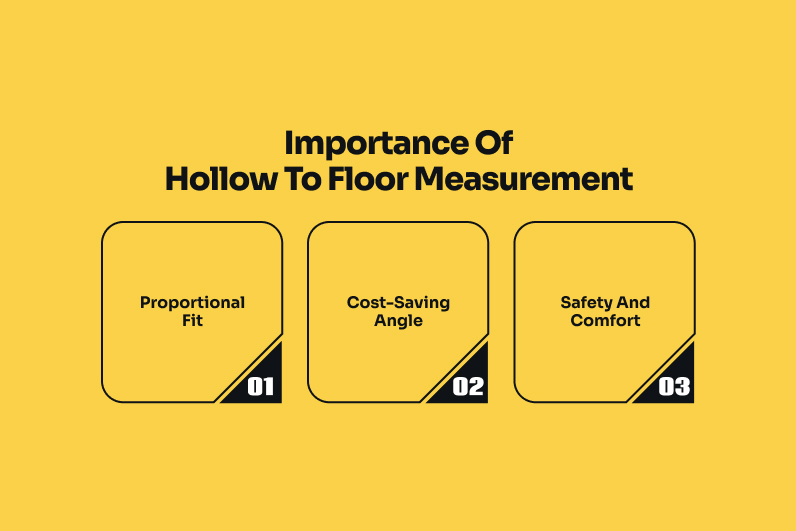
1. The Proportional Fit
Firstly, a dress isn’t just a tube of fabric. It has break points – which include the:
- Waistline.
- Hip curve.
- Knee-break (especially in Mermaid styles).
So, if the length is wrong, the waist of the dress might sit on your ribs. Or maybe the flare of a trumpet gown might start at your mid-thigh instead of your knees.
This measurement helps the designer place those curves in the right spots.
2. The Cost-Saving Angle
Secondly, having the right hollow to floor measurement can make a hell lot of difference when it comes to the cost!
You see, wedding dress alterations are notoriously expensive. Hemming a gown can easily cost between ₹150 and ₹500 in your local tailoring shop. And yes, when it comes to the premium ones, the boutique rates can range from ₹600 to ₹2,500+. [Source: Aidavo]
This happens especially with the ones with:
- Multiple layers of lace.
- Horsehair braid.
- Intricate beading.
Therefore, by getting the hollow to floor measurement right during the ordering phase, you can often skip the hem appointment entirely. And this is something that saves you enough money for those reception sneakers you’ve been eyeing.
3. Safety And Comfort
Finally, comes comfort – and even safety. There is a very fine line between a dramatic sweep and a tripping hazard.
A dress that is even half an inch too long can get caught under your heels as you walk down the aisle.
A precise hollow to floor measurement ensures the gown grazes the floor perfectly – like in a fairytale.
Hollow To Floor Measurement: How To Measure Without The Stress?
Let’s get the most important rule out of the way: You cannot do this one alone.
If you try to bend over to see where the tape measure hits the floor, you’ve already ruined the measurement.
Bending even slightly shortens the distance. Grab a friend, your mom, or a bridesmaid, and follow this play-by-play.
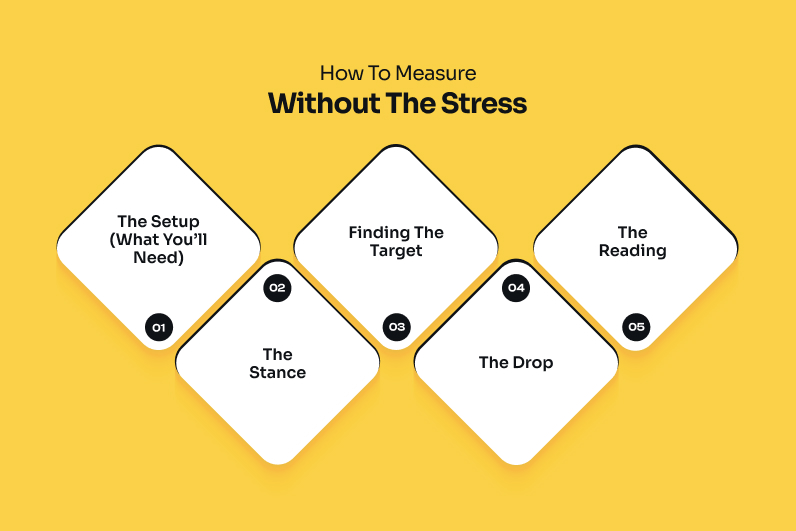
Step 1: The Setup (What You’ll Need)
Firstly, get your setup right. Some of the things that you will need to get the process of hollow to floor measurement right are as follows:
- A Soft Measuring Tape: Do not use a metal construction tape measure. They don’t curve with the body and will give you a jagged, inaccurate number.
- A Hard Floor: Measure on wood, tile, or laminate. Thick carpets can sink your heels and shave half an inch off your height.
- The Right Undergarments: Wear the bra and shapewear you plan to wear on the wedding day. A push-up bra can actually change the starting point of the tape measure!
Step 2: The Stance
Stand straight with your feet together (or no more than 2 inches apart). Relax your shoulders – don’t puff your chest out unnaturally. Look straight ahead at a point on the wall.
Step 3: Finding The Target
Locate your “hollow.” Again, it’s that little dip at the base of your throat. Have your friend hold the “zero” end of the tape measure right in the center of that dip.
Step 4: The Drop
Your friend should let the tape measure fall straight down your front.
One thing that you should keep in mind is that the tape should go over the fullest part of your bust and then drop straight to the floor.
It should not be pulled tight against your stomach – it should hang naturally, just like the fabric of a dress would.
Step 5: The Reading
The number that is kissing the floor is your measurement. Write it down to the nearest quarter-inch. Don’t round up to the nearest whole number unless the website specifically tells you to.
Pro-Tips For Different Dress Silhouettes
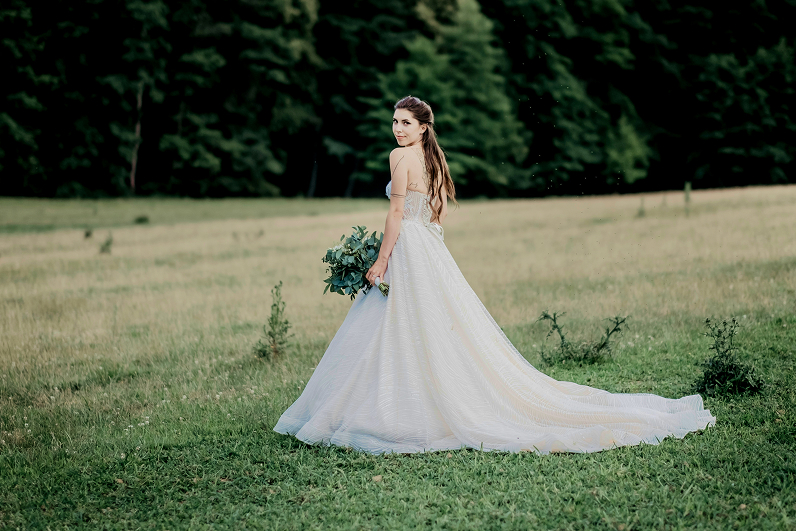
The style of your dress actually changes how you should think about your length.
The Ball Gown “Hoop” Factor:
If you are wearing a massive ball gown with a petticoat or a hoop skirt underneath, the fabric has to travel “out” before it goes down.
In this case, you might want to add an extra half-inch to your measurement so the volume doesn’t pull the hemline up too high.
The Mermaid/Trumpet Flare:
These dresses are all about the knee-break. If you are petite, this measurement is your best friend because it ensures the wow factor of the flare happens at your actual knees, not your shins.
The Change-Of-Shoes Plan:
Are you wearing 4-inch stilettos for the ceremony but switching to flat Keds for the party?
This is a common trap.
If you measure for 4-inch heels, you will trip on your dress during the reception. Many brides choose a middle ground heel height for their measurements to accommodate both.
Common Mistakes That Could Ruin Your Dress
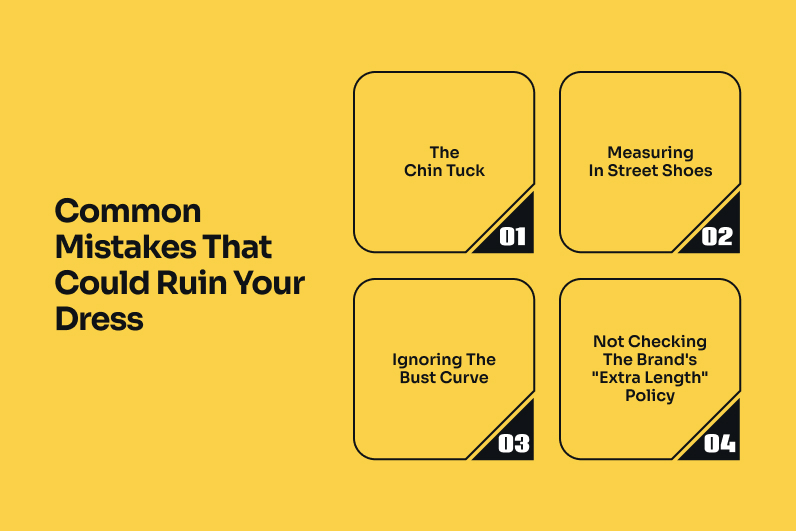
Even with a helper, it’s easy to make a mistake. Watch out for these and avoid them at all costs when taking the hollow to floor measurement:
The Chin Tuck:
Firstly, as your friend measures, you will be tempted to look down to see the number. I have seen this happen multiple times.
Don’t.
Tucking your chin actually shortens your torso measurement by up to 1.5 inches. So, keep your eyes on the horizon.
Measuring In Street Shoes:
Unless you are wearing your exact wedding shoes, measure barefoot. Similar heels are often off by a quarter-inch, which is enough to cause a “trip” factor.
The “Suck It In” Move: Many brides instinctively suck in their stomach or hold their breath. This changes your posture and the way the tape hangs. Just breathe normally.
Ignoring The Bust Curve:
If you have a larger bust, the tape measure must go over the curve. If you pull the tape down the side of your body or between your breasts, the dress will end up being too short once it has to stretch over your chest.
Not Checking The Brand’s “Extra Length” Policy:
Finally, some brands offer “Extra Length” in 3-inch or 5-inch increments. If your hollow-to-floor measurement is on the edge of their standard size, always go longer.
It might be a 10-minute fix for a tailor to shorten a dress. However, trust me, it’s nearly impossible to make a short dress longer.