


Ten billion. That’s how many views videos tagged #manifestation have collected on TikTok alone – a number that would have sounded absurd attached to a self-help concept a decade ago.
In 2024, the Cambridge Dictionary named “manifesting” its Word of the Year. TikTok alone hosts over 110 million posts on the subject, and the hashtag #manifestation carries 6.8 million videos in its own right.
What began as a repackaged strand of 19th-century New Thought philosophy is now one of the defining spiritual-wellness practices of Gen Z and millennial internet culture – vision boards, “lucky girl syndrome,” the 369 method, affirmations recited into a phone camera at 2 AM.
The pitch is seductive.
Your thoughts aren’t just private experience – they’re a mechanism. Think the right thoughts, feel the right feelings, and the universe rearranges itself to deliver the outcome. It offers something concrete in an uncertain moment – a sense of authorship over a life that, for a lot of people right now, doesn’t feel very authored.
Through this case study, I want to ask a genuinely balanced question rather than a cynical one: does manifestation work, in the ways its practitioners believe it does?
And where the answer is “not exactly,” what’s actually happening psychologically, and what would a more honest, still-empowering version of this practice look like?
My goal isn’t to dunk on a coping mechanism millions of people rely on. It’s to separate the parts of manifestation that are doing real psychological work from the parts that are quietly setting people up to blame themselves for things that were never in their control.
Where This Manifestation Culture Actually Comes From

Manifestation feels like a TikTok invention, but the idea is old – older than the internet, older than psychology as a discipline.
Hinduism’s concept of karma, the belief that intention and action shape future outcomes, predates the modern “law of attraction” by millennia, and thinkers have connected the two frameworks directly.
The more immediate lineage runs through 19th-century American New Thought, a movement that blended positive thinking with quasi-religious optimism and, notably, found broad appeal because its individualist framing suited a culture that liked crediting personal character for success.
The modern packaging came from Rhonda Byrne’s 2006 book The Secret, which sold more than 35 million copies worldwide and, with Oprah Winfrey’s public endorsement, cemented the “law of attraction” in mainstream self-help.
Byrne’s central claim – “your thoughts become things” – is the direct ancestor of every “lucky girl syndrome” TikTok caption today.
What changed between 2006 and now isn’t the idea.
It’s the distribution mechanism: a single book tour reaching maybe a few million people became a platform algorithm reaching billions of views, compressing the feedback loop between belief, testimonial, and repetition into something closer to real time.
Manifestation coach Roxie Nafousi has offered a plausible explanation for the timing of its resurgence: post-pandemic uncertainty, combined with a generation already primed toward self-development and wellness content, created ideal conditions for a practice promising agency over an unpredictable world.
That’s a useful frame to hold onto, because it reframes manifestation’s popularity less as gullibility and more as a response to a specific set of conditions – economic instability, disrupted timelines, a labor market that stopped rewarding effort predictably – that this publication has covered extensively elsewhere.
What The Research Actually Says
Here is where we need to be precise, because most coverage of manifestation is either uncritical promotion or blanket dismissal, and neither is accurate.
The most rigorous study on this topic to date comes from psychologists Lucas Dixon, Matthew Hornsey, and Nicole Hartley, published in Personality and Social Psychology Bulletin in 2025. [Source: Sage Journals]
They defined manifestation belief precisely: the conviction that thoughts function like a transmitter, broadcasting energy that the universe receives and returns as material outcomes.
Testing this belief against real-world indicators, they found people with strong manifestation beliefs reported significantly higher overconfidence about achieving future goals – including goals they were currently far from reaching.
And this optimism was concentrated specifically around externally validated goals: fame, fortune, image, rather than internal ones like personal growth or relationships.
The financial findings are the most concrete.
Manifestation believers had a few things characteristically different from others. They:
- Showed a stronger preference for risky investments.
- Were more likely to hold high-volatility assets like cryptocurrency.
- Were more likely to have personally experienced bankruptcy.
The researchers were careful in their framing: manifestation belief predicted overconfidence in goal attainment independent of general optimism or dispositional hope.
This means this isn’t simply “positive people take more risks.” It’s a specific pattern of overestimating the odds of external, high-status outcomes.
There’s a genuine psychological upside worth naming too, because the research doesn’t only cut one way.
Positive Psychology’s clinical review notes manifestation practices can foster a more optimistic outlook and enhanced motivation for people who were previously stuck in negative thought spirals – the visualization and affirmation components overlap meaningfully with techniques positive psychology already validates, like gratitude practice and cognitive reframing.
The problem isn’t the optimism. It’s what happens when optimism substitutes for a plan entirely.
The Visualization Trap
This is the part of manifestation research with the clearest scientific backing – and it directly contradicts what most manifestation content actually recommends.
NYU psychologist Gabriele Oettingen spent over two decades studying “mental contrasting,” and her core finding is counterintuitive: vividly imagining a successful outcome, on its own, makes people less likely to achieve it, not more.
The brain registers the imagined success as a kind of partial accomplishment, draining the motivational energy needed for real action. This is close to the exact mechanism most vision boards and “act as if it’s already yours” affirmations are built around.
Her alternative, WOOP – Wish, Outcome, Obstacle, Plan – keeps the visualization step but pairs it immediately with honest obstacle identification and a specific if-then plan.
This mental contrasting, combined with Peter Gollwitzer’s implementation-intentions research (a meta-analysis of 94 studies found pairing a goal with a specific trigger had a medium-to-large effect on actual attainment), consistently outperforms pure positive visualization across academic, health, and professional domains.
| Manifestation (popular practice) | WOOP (Oettingen’s protocol) | |
| Step 1 | Name the wish, visualize vividly | Name the wish, visualize vividly |
| Step 2 | Avoid “negative energy” – don’t dwell on what could go wrong | Name the biggest internal obstacle, honestly |
| Step 3 | Trust the universe to handle the mechanism | Write a specific if-then plan for that obstacle |
| Research backing | Linked to overconfidence, riskier financial decisions | Medium-to-large effect on goal attainment across 94 studies |
Manifestation culture, in most popular forms, treats obstacle-naming as the thing to avoid – “don’t invite negative energy.” WOOP treats it as the entire mechanism that makes visualization useful.
The wish is nearly identical; the instruction for what to do with it is functionally opposite, and the evidence favors naming the obstacle.
When Optimism Becomes Self-Blame

This is the part of manifestation culture that deserves the most scrutiny, because it’s where a coping mechanism can quietly turn into something that harms the person using it.
The core mechanic of manifestation – you attract what you focus on – contains an unavoidable logical flip side: if you didn’t get what you wanted, your thinking must have been wrong.
A mental health researcher writing on self-help red flags described this plainly: the belief that “you create your reality” is seductive because it’s framed as empowerment, but it carries a devastating shadow side, since it functions as victim-blaming dressed in spiritual language, erasing the role of systemic inequality, trauma, or plain bad luck in anyone’s outcomes.
This isn’t a hypothetical concern.
Analysis of manifestation’s spread on TikTok has noted that during the pandemic, when anxiety and instability spiked sharply for Gen Z and millennials in particular, manifestation offered a sense of control precisely because it located all causality inside the individual.
The flip side of that appeal is that failure to manifest a desired outcome becomes framed as a personal or spiritual failing rather than the predictable result of circumstances outside anyone’s control – job markets, health, structural inequality, other people’s choices.
Psychologists studying “toxic positivity” more broadly describe a related pattern: research does show a genuinely positive, optimistic outlook correlates with better stress and health outcomes, which is why positive psychology exists as a serious field.
The distortion happens when positivity becomes mandatory – when negative emotion itself gets treated as a mistake to be corrected rather than information to be processed.
Suppressed emotion, from a clinical standpoint, doesn’t disappear; it gets driven underground, where it tends to resurface as anxiety, resentment, or physical symptoms rather than simply dissolving.
What This Looks Like in Practice
The following is a composite scenario, drawn from patterns commonly described in manifestation communities and clinical commentary – not a real, named individual.
She’d written the number down for eight months: a specific salary, a specific job title, a specific company. She visualized the offer letter, the LinkedIn post, the celebration dinner. She avoided negative self-talk carefully, the way the videos told her to, treating every moment of doubt as a “vibration” she needed to correct before it could block the outcome.
The job didn’t come. Not because she hadn’t tried – she’d sent fewer applications than she meant to, avoided a networking event that made her anxious, hadn’t updated her portfolio in months, all quietly filed under “trusting the process.”
When a friend gently asked how the search was going, her first thought wasn’t about the market, or the gap in her prep. It was: my energy must have been off.
This is precisely the pattern researchers studying self-help and positive psychology have flagged as the practice’s central risk.
As one University of Queensland Business School researcher studying self-help culture has put it, positivity becomes harmful specifically when it turns into a mandate – when doubt itself gets treated as the malfunction, rather than as information worth listening to.
In the composite scenario above, the actual obstacle – hesitation about networking, an outdated portfolio – never got named, because naming it would have meant acknowledging “negative” thinking. The visualization didn’t fail her. The absence of an obstacle-and-plan step did.
Signs Your Practice Has Tipped Into Self-Blame
A manifestation or visualization practice isn’t inherently a problem – the signs below mark where it’s crossed from a coping tool into something worth reassessing.
- You treat every setback as proof your “energy” or “alignment” was wrong, rather than looking for a concrete, correctable cause.
- You avoid naming realistic obstacles out loud because it feels like “inviting” them.
- Doubt or disappointment gets suppressed quickly rather than processed, because feeling them seems counterproductive to the outcome.
- You can’t point to a single specific action tied to the goal – only the visualization itself.
- Setbacks trigger disproportionate shame, specifically shame about your thinking, rather than ordinary frustration about the outcome.
If two or more of these feel familiar, the fix isn’t abandoning the practice – it’s adding the missing step: name the obstacle, write the plan, and let doubt be information instead of a verdict on your worthiness.
The Market Of Manifestation Culture: Who’s Selling It, And What It Costs
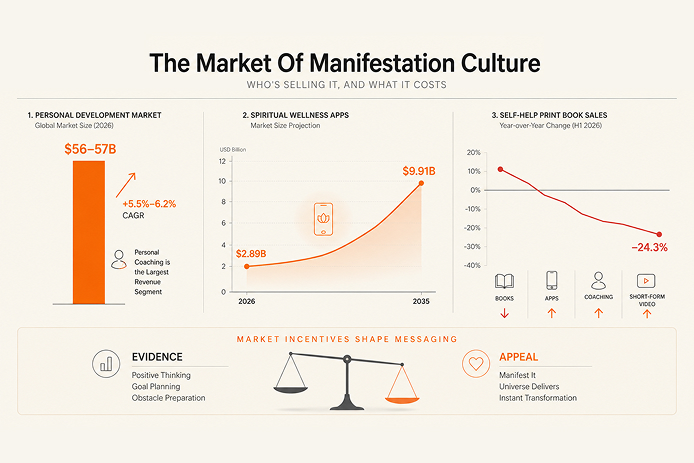
Manifestation doesn’t exist in a vacuum – it’s also a product, and the market data is worth including because it explains some of the incentive structure behind how the practice gets marketed.
The global personal development market is valued between $56-57 billion in 2026, growing at roughly 5.5-6.2% annually depending on the estimate, with personal coaching taking the largest single share of that revenue.
Spiritual wellness apps specifically – covering meditation, astrology, and manifestation-adjacent tools – are projected to grow from $2.89 billion in 2026 to $9.91 billion by 2035.
Interestingly, self-help print book sales actually fell 24.3% in the first half of 2026 even as the broader industry expanded, suggesting the format has shifted decisively toward apps, coaching, and short-form video rather than books – which tracks with how manifestation content specifically spreads now.
This matters for a simple reason: an industry growing this fast has a structural incentive to keep the promise simple and the mechanism vague.
“Think positively and plan carefully for obstacles” is a harder sell than “think positively and the universe handles the rest,” even though the former is what the actual research supports.
None of this means every manifestation coach or app is acting in bad faith – many genuinely believe in what they’re teaching.
But it’s worth naming that the economic incentives in this space favor the more seductive, less accurate version of the practice over the version backed by decades of goal-attainment research.
Coaching certifications, in particular, carry no standardized licensing requirement in most markets, meaning the credential gap between a trained clinical psychologist and a self-styled “manifestation coach” can be effectively zero from the consumer’s side, even as the advice on offer diverges sharply from what the peer-reviewed research actually supports.
Manifestation Culture In Indian Market: Old Framework, New Interface
Manifestation culture looks like a Western TikTok import when covered in most English-language wellness media, but the underlying belief structure has a much older, more localized presence in India – which changes both how the practice lands here and what the honest critique should look like.
India’s astrology app market alone was valued at roughly $0.24 billion in 2025 and is projected to reach $8.79 billion by 2034, a compound annual growth rate above 49%.
Astrology has long shaped decisions around marriage, career, and finances in Indian households; what’s changed is the interface, not the belief.
Grandparents consulted a family astrologer in person – today’s version is a subscription app or an AI birth-chart bot, and it’s disproportionately Gen Z and millennials driving the shift.
The broader wellness economy here tells a similar story: India’s spiritual and mindfulness sector has expanded steadily among millennial and Gen Z consumers, and today’s “spiritual seeker,” as one industry analysis put it, is just as likely to hold an MBA as a mala bead.
That detail matters, because it undercuts the easy assumption that manifestation belief correlates with lower education – the data suggests something closer to the opposite: educated, professionally successful people reaching for a structured belief system precisely because their careers feel less predictable than they used to.
For an Indian audience, that reframes the useful question from “why are educated women falling for magical thinking” to “what need is a centuries-old belief framework, repackaged for a smartphone, meeting that career advice and institutions currently aren’t.”
The WOOP-style corrective from Part Three doesn’t require rejecting that framework – it just asks that the obstacle-and-plan step already present in traditional astrological consultation doesn’t get dropped in the more visualization-only, Instagram-native version of the practice.
A More Honest Version Of The Practice

None of this data means the underlying impulse behind manifestation is wrong.
Wanting a sense of agency over your life, wanting a structured way to hold a goal in mind, wanting language for hope during an uncertain stretch – these are reasonable, healthy needs.
It’s also worth being clear about what manifestation borrows legitimately from established psychology: gratitude practice and cognitive reframing, both well-supported by research, overlap substantially with the affirmation and visualization components of manifestation.
The issue was never the optimism itself – it’s the specific mechanism manifestation culture assigns to that impulse, not the impulse.
A more evidence-backed version keeps almost everything practitioners already do, with one addition: name the outcome you want as vividly as you like, and then – in the same sitting, not later – name the single most likely obstacle standing between you and it, and write one specific if-then plan for handling that obstacle when it shows up.
That’s the entire WOOP protocol, and it preserves the emotional and motivational benefit of visualization while adding back the part manifestation culture tends to actively discourage.
It’s also worth holding two things as true at once, since that’s what the research actually supports: optimism measurably improves stress and health outcomes, and unmanaged optimism without obstacle-planning measurably reduces goal attainment and increases risk-taking.
The corrective isn’t cynicism. It’s specificity – trading a vague, feel-good outcome statement for one that also names, in plain language, the single thing most likely to get in the way, and what you’ll actually do the moment it shows up. That single addition is the entire difference the research points to.
My Verdict: Is Manifestation Culture All About Agency Without The Self-Blame?
Manifestation culture’s ten billion views aren’t really about magical thinking – they’re about a generation reaching for a sense of authorship over lives that have felt, in a lot of documented ways, less controllable than the ones their parents inherited. That impulse deserves respect, not ridicule.
But the specific mechanism the culture has built around that impulse – pure visualization, avoidance of “negative” obstacle-thinking, and an implicit theory that failure reflects flawed belief rather than circumstance – is not what the psychological research on goal attainment actually supports, and it carries a real cost in the form of misplaced self-blame and risk-blind decision-making.
The fix isn’t abandoning the vision board. It’s finishing the thought it starts – naming the obstacle in the way, and building the plan for it, instead of treating that step as the one thing not to think about.
Source:
- Dixon, Hornsey & Hartley, “The Secret to Success? The Psychology of Belief in Manifestation,” Personality and Social Psychology Bulletin (2025);
- Gabriele Oettingen, mental contrasting and WOOP research, NYU;
- Peter Gollwitzer, implementation intentions meta-analysis;
- Positive Psychology clinical review of manifestation (2026);
- National Geographic, “The Ancient Origins of Manifesting” (2025);
- Wikipedia, Law of Attraction (New Thought) and Manifestation (popular psychology);
- The Conversation, “Manifestation: some businesses use this new age spirituality to hold employees accountable” (2026);
- Psyche/University of Queensland Business School on toxic positivity (2025);
- Bridge Counseling, self-help red-flag analysis (2026);
- Precedence Research and The Business Research Company, Personal Development Market reports (2026);
- Towards Healthcare, Spiritual Wellness Apps Market report (2026);
- Circana BookScan self-help print sales data (2026).