
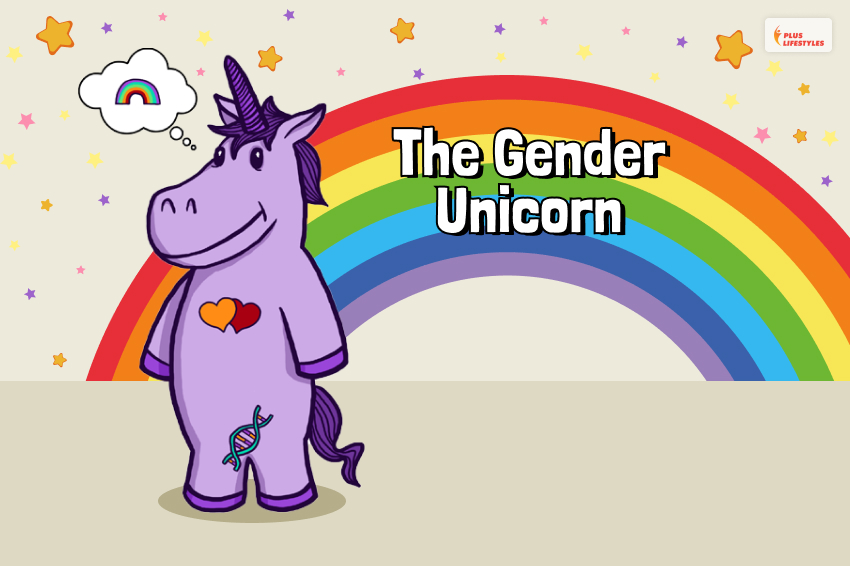
The Sunday dinner table is usually a safe zone of predictable topics.
We talk about the fluctuating price of groceries, the EMIs and SIPs, the neighbor’s overgrown lawn, estate planning in today’s world, current politics, war, and whatever sport is currently broadcasting.
But last Sunday, as my 63-year-old father reached for the salt shaker, he suddenly asked, “Ei gender unicorn bepar ta ki re? (What is this concept of gender unicorn?).”
This topic was enough to kind of disrupt our comfortable routine.
Talking About Gender Unicorn Felt Somehow Uncomfortable
Before answering what gender unicorn is, I did two things:
- Texted my younger sister (whose Gen Z brain would be rather prompt at times like these)
- Pulled up my phone, opened the famous Trans Student Educational Resources (TSER) Gender Unicorn graphic, and set it right next to his dinner plate
Looking at the educational graphic, he blinked at me. His forehead creasing into a familiar web of confusion. “Is that a new cartoon your generation is watching?” But he knew that’s not what it is about.
I don’t know about you. But as a millennial woman in my late 20s, I occupy a strange cultural middle ground.
I am 29 years old. I am old enough to remember dial-up internet. But I am young enough to deeply understand modern identity. I embrace the evolving language of equity and mental wellness. Or I try my best to do that.
However, my father belongs to a completely different generation. To him, gender roles were rigidly defined. Terms like “cisgender” or “non-binary” did not exist in his youth. They were missing from the cultural lexicon.
Lately, I’ve realized something important. Protecting our family’s emotional wellness means building bridges. We must not build walls.
Besides, the world is moving fast. And I did not want my father to be left behind.
Here is exactly how we spent our evening. A 29-year-old millennial and a 63-year-old Boomer dismantled decades of social conditioning. And we did it over a plate of very traditional Bengali daal bhaat.
Meeting The Gender Unicorn: The Initial Shock
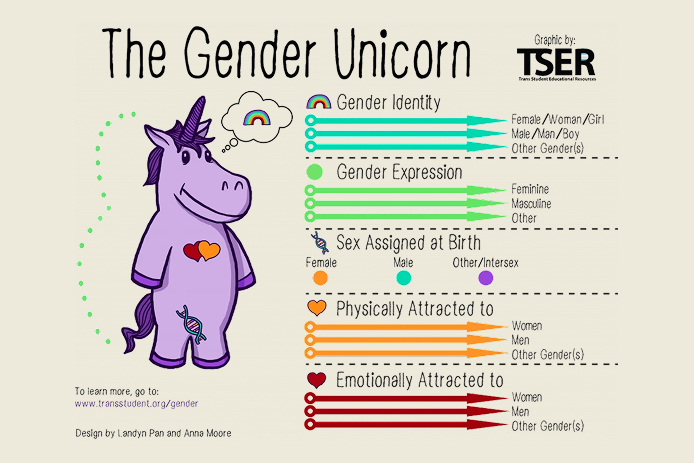
My father stared at the colorful cartoon unicorn as it rested right next to his fish fry. Specifically, the TSER Gender Unicorn graphic features five distinct arrows.
In fact, they point to different parts of the unicorn’s body. Consequently, each arrow represents a separate layer of human identity.
These layers are gender identity, gender expression, and sex assigned at birth. Furthermore, they include physical attraction and emotional attraction.
“It looks like a children’s drawing,” he muttered while adjusting his reading glasses. “So, why are people using a purple unicorn to explain real life?”
“Because, baba, society used a binary switch for a very long time,” I explained as I mixed my rice and lentils.
“Back then, you were either a boy or a girl. Ultimately, that single label decided everything. For instance, it chose how you dressed, it chose your hobbies, and it even chose who you were supposed to love. Instead, this graphic helps separate those things by creating five independent tracks.”
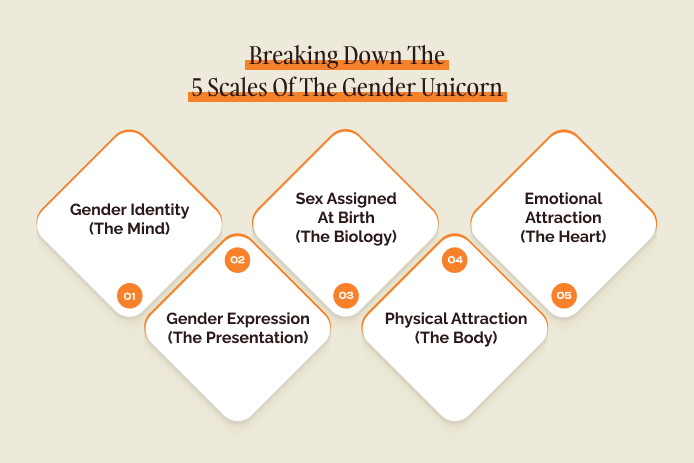
Breaking Down The 5 Scales Of The Gender Unicorn
Just then, my phone buzzed. My Gen Z sister had replied to my SOS text: “Tell him it’s like a balance sheet breakdown. But it is for human identity. Keep it simple!”
I decided to take her advice.
So, I walked him through the graphic step-by-step. I stripped away all the academic jargon.
1. Gender Identity (The Mind)
First, I pointed to the rainbow thought bubble. It hovers over the unicorn’s head.
“This is Gender Identity. Basically, it is your internal sense of who you are. It is deeply held. It is what your brain knows to be true about you.”
My father frowned slightly. “Well, I know I’m a man because that’s how I was born.”
“Right, but that recognition happens in your mind,” I clarified. “Imagine waking up tomorrow in a completely different body. However, your brain would still know your true identity. For transgender or non-binary individuals, the internal mind does not match the birth box.”
2. Gender Expression (The Presentation)
Next, I pointed to the green dotted line. And from what I understood after reading on Youth Outright, it wraps around the outside of the unicorn.
“This is Gender Expression. It is how you present yourself to the world. You do this through clothing, behavior, and grooming.”
This is where we hit our first real breakthrough.
My father is a traditional corporate professional. But he also maintains a detailed multi-step skincare routine. He takes immense pride in his gardening.
“Think of it this way, baba,” I said. “Your identity is a man. But your expression includes unique things. Older generations might have labeled them ‘feminine.’ You use skin serums. You care for delicate flowers. These hobbies don’t make you less of a man. Expression is just your personal style.”
He looked at his hands. Then he looked back at the screen.
“So, how someone dresses doesn’t change who they fundamentally are inside?”
“Exactly,” I replied.
3. Sex Assigned At Birth (The Biology)
Thirdly, I pointed to the DNA symbol on the unicorn – placed where the genitals are supposed to be.
“This is Sex Assigned at Birth. This is a biological and medical classification. A doctor gives it to a baby based on anatomy and chromosomes.”
“Okay, so that is the medical reality,” he said. He nodded. This was familiar territory for him.
“Yes. But the entire point of the unicorn is separation. This medical label is completely separate from your brain’s thought bubble. It is separate from the clothes you choose to wear,” I added.
Besides, I also explained to him how medical bodies now favor phrases like “assigned male at birth” over “biologically male.”
Critics like Alan Sokal and Richard Dawkins, in their paper Sex Assigned at Birth, call this language unscientific. However, modern frameworks use these terms to promote “equity” and “inclusivity.” (Source: New York University)
4. Physical Attraction (The Body)
I pointed to the orange heart on the graphic.
“This is Physical Attraction. It is about who you are drawn to sexually or physically.”
“This is what most people mean by a ‘type,’” I explained. I used a term he knew. ‘It is purely about physical chemistry. The Gender Unicorn separates this layer. A person’s physical desires do not dictate their mind. They do not dictate how they dress.”
5. Emotional Attraction (The Heart)
Next, I pointed to the pink heart.
“This is Emotional Attraction. It is about a romantic connection. Rather, it is who you want to hold hands with. It is who you want to go on dates with. And about building a partnership.”
My dad looked genuinely surprised. “So, people separate those two now?”
“Yes, because they do not always overlap perfectly,” I explained. I took a sip of water.
“You can have deep emotional bonds without physical attraction. And the reverse is also true. My generation and Gen Z recognize this difference. It helps people understand their relationships. As a result, it protects their mental wellness.”
Moving Beyond The “Boxes”
The conversation was not entirely seamless. My father initially struggled to separate gender identity from sexual orientation. This is common for his generation. To his demographic, an effeminate man was automatically gay.
“So if a man enjoys feminine clothes, who is he attracted to?” my father asked.
“Baba,” I smiled. “Wearing a particular outfit just means he likes the style. It tells us absolutely nothing about his dating preferences. One is expression. The other is attraction. They are on completely different lines on the unicorn.”
He sat back. He quietly studied the phone screen while finishing his meal. The silence lasted for a long moment. I worried the initial discomfort had returned.
Then, he looked up.
“When I was growing up, everything was a strict box. If you didn’t fit inside, life was very difficult. It looks like this unicorn helps people. It gives them a way to step outside those boxes without judgment.”
Believe me, I felt a profound wave of relief. I felt immense warmth.
“That’s exactly it, baba. It just gives people room to breathe.”
Why These Chats Matter For Family Wellness
We often focus on diet in lifestyle spaces. We talk about exercise and mindfulness. And I sometimes also find myself guilty of simply talking about building a skincare routine or fixing my night routine.
However, emotional wellness is deeply rooted in our relationships. Don’t get me wrong – we are well aware of this. But how many of us practice it? Consciously?
We must not avoid difficult conversations with older generations. Avoiding them builds invisible walls of disconnection.
My 63-year-old father will not become a gender studies expert overnight. And honestly, he doesn’t need to be.
In reality, the success of our dinner conversation was simple. It did not come from memorizing new vocabulary. Rather, it came from his willingness to sit at the table. He looked at a graphic from TSER. He tried to see a changing world through empathy.
We must handle these topics with patience. We should avoid frustration. This approach creates true psychological safety within our homes.
Family wellness is not about having identical viewpoints. It is about ensuring everyone feels safe enough to listen and be heard.