
My to-do list does not end. It evolves. I cross one thing off, and two more appear. By Thursday, it looks like something that needs its own project manager. And for a long time, that list was the reason I kept pushing mindfulness meditation to the bottom of it.
I thought I needed time to meditate. Long, quiet, uninterrupted time. I did not have that. So I kept waiting until I did.
Then I came across the research. And everything I assumed about meditation turned out to be wrong.
Quick Answer
Mindfulness meditation means noticing what happens right now. You focus on your breathing, body, and mind. You do not judge your experience. Research shows this practice reduces stress. It also improves focus and controls emotions. Besides, you do not need a fancy cushion. You do not need a quiet place or a whole hour. Only consistency matters. Just five minutes a day changes things.
What Does The Science Actually Say About Mindfulness Meditation?
Usually, I’m not the type of person who would blindly follow a wellness craze without knowledge of the reasoning that supports it.
So, I thought it would be best to consult the evidence before I engage myself in any of these practices.
The numbers are hard to ignore.
A staggering 9 out of 10 who meditate and practice mindfulness report that these habits assist them in becoming less stressed or more relaxed. Additionally, almost 4 out of 5 adults feel their health overall improves.
Neurological proof goes even further.
By using advanced brain imaging techniques, researchers have identified that individuals who meditate and practice mindfulness experience positive changes in the prefrontal cortex and amygdala, which are brain regions linked to controlling emotions and cognitive functions.
To put it simply: mindfulness changes how your brain is wired for stress responses.
Women who are in the workforce stand to gain quite a bit from mindfulness as well, On top of general wellness.
Studies show that mindfulness meditation can cause a 120% boost in focus and productivity for an employee.
On the other hand, consistent meditation has been found to result in a 85% decline in absenteeism. These are not lifestyle blog stats, but rather figures from workplace research.
Evidence also links mindfulness to enhanced social support and life satisfaction, as the practice increases empathy, emotional regulation, and interpersonal effectiveness. Essentially, it makes you better at your job and better with people – simultaneously.
I found that compelling enough to actually try it.
What Mindfulness Meditation Is – And What It Is Not
One of the reasons why I started practicing mindfulness meditation was because I was feeling extremely overwhelmed.
You see, if you have read my previous blog, you already know that I struggle with anxiety and burnout. Which is why my therapist told me that I absolutely HAVE to meditate – whether incorporating it in the morning, or night self care routine!
Before I started, I had to unlearn a few things.
Mindfulness meditation is not about emptying your mind. It is not about achieving some blissful, thought-free state. And it is absolutely not something reserved for people who own a yoga mat and have mornings free.
Mindfulness is defined as the awareness that emerges through paying attention on purpose, in the present moment, and non-judgmentally.
That is it.
You are not trying to stop your thoughts. You are learning to notice them without getting pulled under by them.
The difference sounds small. The effect is significant.
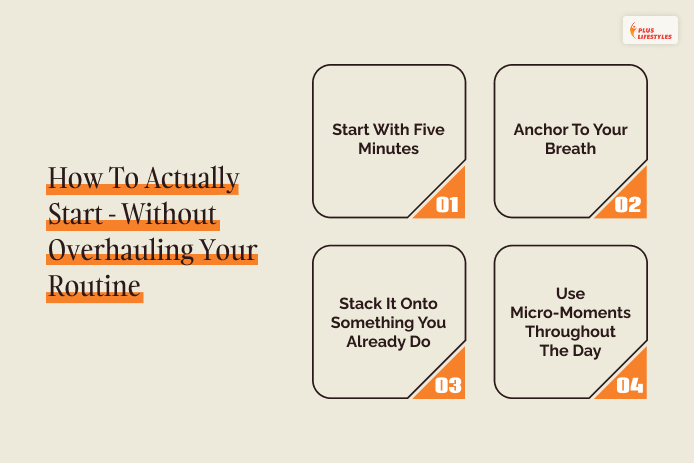
How To Actually Start – Without Overhauling Your Routine
This is the part most people skip. They tell you what mindfulness is, but not how to fit it into a life that already has no margin.
TBH, there are several ways in which you can do that. I, for instance, use tools like easymindcare. But you do you!
Here is what worked for me, and what the research supports.
Start With Five Minutes
Many people think meditation requires a lot of time. However, they forget that brief moments can greatly improve well-being.
In fact, scientific studies on dose-response effects prove that regular practice matters much more than the length of your session.
Therefore, meditating for just five minutes every day is better than meditating for thirty minutes once a week
Set a timer. Sit comfortably – on your bed, on a chair, on your office floor if you need to. Close your eyes. That is your starting point. And this is something that you can genuinely fit into your morning self care routine!
Anchor To Your Breath
Your breath is always with you. It is the most reliable anchor point in any mindfulness practice.
- Breathe in slowly for four counts.
- Hold for two.
- Breathe out for six.
- Repeat.
When your mind drifts to your inbox or your 3 pm meeting – and it will – simply notice that it has drifted, and return to the breath. No frustration needed. The noticing itself is the practice.
Stack It Onto Something You Already Do
The most effective way to build a meditation habit is to attach it to an existing one. I attached mine to my morning coffee. Before I opened my phone, I sat with my cup and did five minutes of breath-focused meditation.
It is not glamorous. But it is consistent. And consistency is what changes your brain.
Use Micro-Moments Throughout The Day
Mindfulness does not have to happen in a designated session. Short-term mindfulness interventions have shown significant neurobiological effects – which means brief, intentional moments of presence count. [Source: North Carolina State University]
Try this: the next time you feel your stress spike – before you reply to that email, before you take that call – take three conscious breaths first. Breathe in, breathe out, return to the moment. That is mindfulness. It took you twenty seconds.
Three Mindfulness Meditation Techniques Worth Knowing
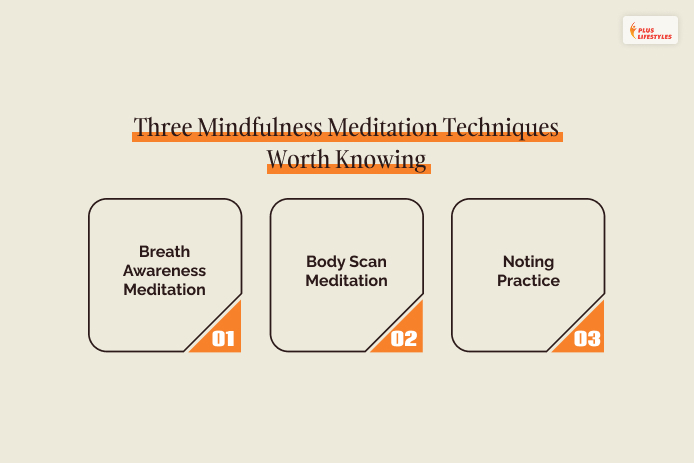
Once you have the basics down, these three approaches give you options depending on your mood and available time.
Breath Awareness Meditation
First and foremost, this is basically the simplest form. Sit, close your eyes, and focus entirely on the sensation of breathing – the air entering your nose, your chest rising, the exhale releasing. When your mind wanders, return. Repeat for five to ten minutes.
Body Scan Meditation
Start at the top of your head and slowly move your attention down through your body, noticing any tension or sensation without trying to change it.
This is particularly effective before sleep. It takes ten minutes and genuinely works for winding down after a long day.
Noting Practice
As thoughts arise during meditation, quietly label them.
- Planning.
- Worrying.
- Remembering.
Then return to your breath.
This builds remarkable self-awareness over time and helps you catch thought spirals before they pull you in – both during meditation and during your actual day.
What Changed For Me After 30 Days
I want to be honest here. I did not have a dramatic transformation. My to-do list did not shorten. My inbox did not magically manage itself.
What changed was subtler. I started noticing the moment before I felt overwhelmed – which gave me just enough space to respond rather than react.
My sleep improved in the third week. I stopped catastrophizing over small things with the same intensity.
And I became, incrementally, less terrified of stillness. Which, for someone whose nervous system had been running on deadline energy for years, was genuinely significant.
The One Thing That Makes It Work
Consistency beats perfection every time. You will miss days. Your mind will wander constantly at first. Some sessions will feel pointless. None of that means it is not working.
The number of hours that people have spent meditating has increased by 2,900% since March 2020. There was a structure shift in how working people connected to stillness.
Personally, I truly believe that we are all starting to understand something fundamental. We have started to understand that slowing down is not the opposite of productivity. Rather, it’s the foundation. Your list of tasks will be waiting for you tomorrow.
Five minutes of calm today will not set you back five minutes. It puts you five minutes closer to being able to handle your task list.
That, I promise, is worth a timer and a chair.