



| Quick Answer Indian Gen Z and millennials say sustainability matters more to them than any generation before – a majority claim they’re willing to pay a premium for it, and search interest in “sustainable fashion” has surged. But fast fashion consumption in India keeps climbing at the same time, textile waste keeps piling up, and less than 1% of discarded clothing actually gets recycled into new garments. This isn’t hypocrisy so much as a structural gap: the values are real, but the affordable, verifiable options to act on them mostly aren’t there yet – and greenwashing is making an already confusing label even harder to trust. |
Last month I stood in my room staring at a ₹399 top I’d bought during a flash sale, still in its packaging, price tag on. I genuinely couldn’t remember ordering it.
I also, in the same week, had a long conversation with a friend about supporting slow fashion and thrifting more.
Both of those things were true about me at the same time. That contradiction turns out to be the entire story of what’s actually happening with sustainable fashion in India right now, not just a personal failing I should feel guilty about.
So, my simple question: is India’s younger generation genuinely shifting toward sustainable fashion? Or is “sustainability” mostly something we say we care about while our actual buying behavior tells a different story?
The Sustainable Fashion Paradox In India
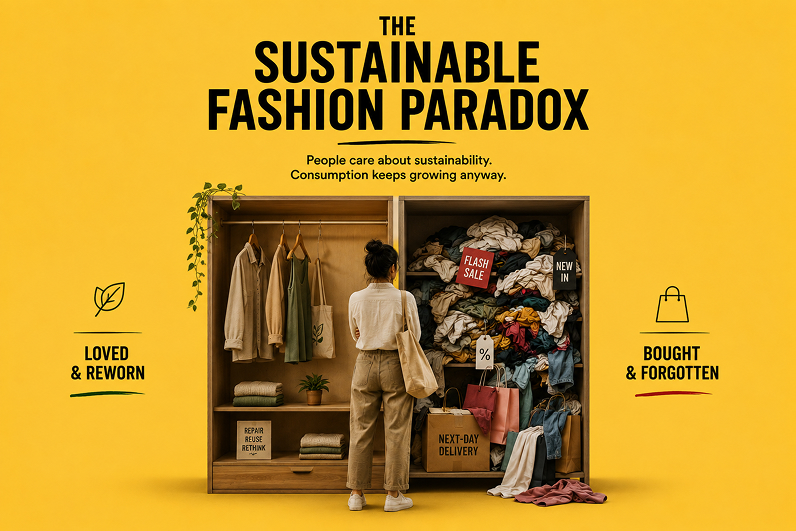
I’ll turn 30 this year, and my closet tells two completely different stories depending on which shelf you look at.
One has pieces I’ve had for years, worn until they’re soft, genuinely loved. The other is a rotating pile of things bought on impulse during a sale notification, worn twice, then forgotten.
I don’t think I’m unusual in this. And the data backs that up in a way that’s more interesting than a simple “we’ve become more conscious” narrative or a cynical “nobody actually cares” one.
The Awareness Baseline
The stated values here are genuinely strong, not just marketing spin.
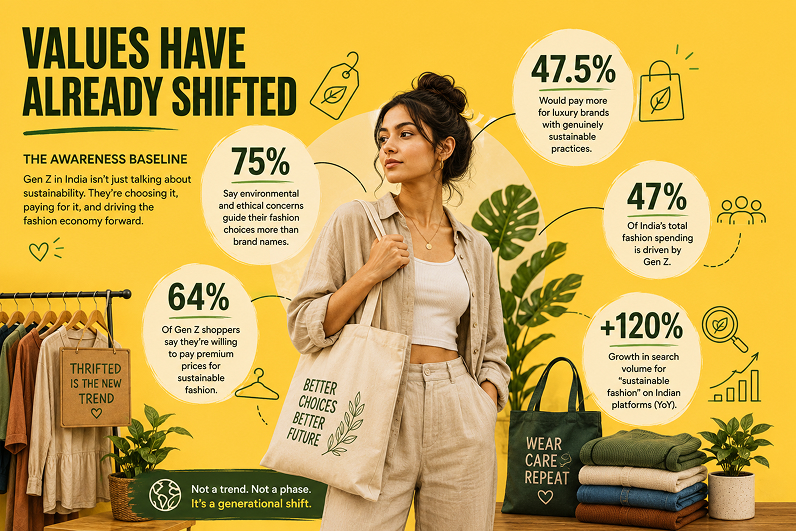
According to Vogue Institute’s 2026 India fashion trends research, 64% of Gen Z shoppers say they’re willing to pay premium prices for sustainable fashion. And 75% say environmental and ethical concerns now guide their fashion choices more than brand names alone.
Statista’s India-specific data on luxury spending puts a similar number on willingness to pay for sustainability specifically, with 47.5% of Indian Gen Z respondents saying they’d pay more for luxury brands with genuinely sustainable practices.
This isn’t a fringe sentiment.
Gen Z drives India’s fashion economy. According to First Resort’s 2026 fashion report, they account for an estimated 47% of total fashion spending.
Lifestyle spending is also heavily influenced by this group. Search volume for “sustainable fashion” is skyrocketing on Indian platforms, growing 120% year-over-year.
Thrifting has shifted into a conscious choice. It is no longer just a budget compromise. People now actively choose to thrift. They also talk about it openly.
Global Gen Z style data highlights this shift. Roughly three in four secondhand shoppers cite a specific goal. They want to reduce their overall consumption. Lower price points are no longer their only motivation.
None of this reads like performative concern. The awareness and the stated intent are real.
| What’s Actually Happening To Indian Wardrobes Here’s where the story gets more complicated. Zipdo’s 2026 Indian fashion industry report finds that only 25% of Indian consumers rank sustainability as a top priority when actually buying, even though a much larger share says it matters to them in principle. That gap between the 64-75% who say sustainability shapes their choices and the roughly 25% for whom it’s actually a top purchasing factor is the paradox in a single data point. |
The Consumption Reality Underneath The Values
While the sustainability conversation has gotten louder, actual consumption hasn’t slowed down. If anything, it’s accelerated.
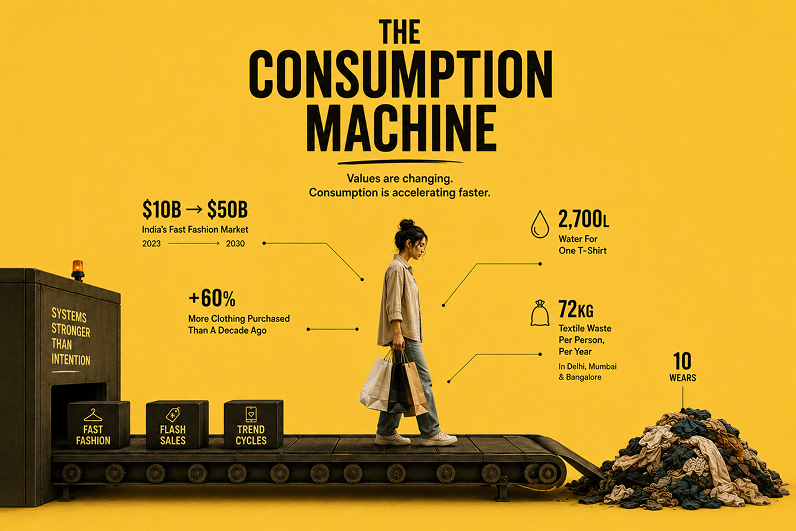
India’s fast fashion market was valued at roughly $10 billion in 2023 and is projected to hit $50 billion by 2030.
The average Indian now buys around 60% more clothing than they did a decade ago, according to sustainability research compiled by Towards Sustainability’s 2025 analysis of India’s fast fashion footprint.
What happens to those clothes afterward is the more uncomfortable part.
Mou Sengupta, programme manager at the Centre for Science and Environment, told Outlook Business that the average consumer doesn’t wear a garment more than 10 times across its entire lifecycle.
Around 41% of textiles in India are incinerated, landfilled, or discarded after just one or two uses.
The environmental cost behind that churn is significant and specific:
- A single cotton T-shirt calls for around 2,700 litres of water for its manufacture.
- Approximately 7.8 million tonnes of textile waste in India amounts to 8.5% of the total worldwide production.
- Dwellers in Delhi, Mumbai, and Bangalore each dispose of about 72 kg of textile waste per year, higher than the world average.
Worldwide, the fashion industry contributes 20% of industrial wastewater. The bulk of this pollution comes from dyeing fabric. Finishing processes also increase wastewater volumes.
Indian textile hubs rank among the most polluted areas. Facilities discharge untreated toxic runoff directly into local groundwater and rivers.
None of this is happening because people don’t know or don’t care.
It’s happening because the systems around the following are simply stronger than individual intention on any given Tuesday night scroll:
- fast, cheap, constantly-refreshed clothing, e-commerce discount cycles.
- influencer-driven trend turnover.
- flash sales timed to hit exactly when willpower is lowest.
Why “Sustainable” Is Harder To Trust Than It Sounds
Even for the share of shoppers actively trying to buy better, verifying what “sustainable” actually means has become its own problem.
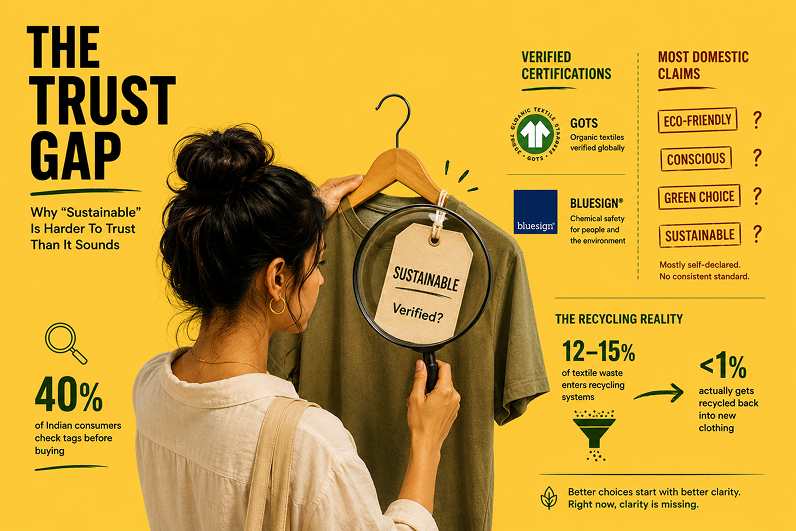
Globally, less than 1% of discarded clothing gets recycled back into new garments, even though 12-15% of textile waste technically enters recycling systems, according to research compiled by Project Statecraft’s 2025 review of India’s textile waste regulation gaps. Most of what gets labeled “recycled” in marketing never actually becomes new clothing.
Certification exists, but it’s mostly built for export markets rather than the average Indian shopper.
Global standards matter for international trade. Certifications like GOTS verify organic textiles. Bluesign checks for chemical safety. These labels matter primarily for Indian brands selling abroad. Retail partners in the US, EU, and UK require them.
Local shoppers face a different reality. A shopper browsing a domestic e-commerce app lacks access to verification. Terms like “eco-friendly” and “conscious” are widely used.
Brands also use the word “sustainable” freely. However, these are largely self-declared labels. There is no consistent standard behind them.
Many shoppers look for eco-labels. Zipdo’s research found that 40% of Indian consumers check tags before buying. They want to make sustainable choices.
There is no consistent certification standard. This is a major issue for the domestic market. Because of this, checking tags is often ineffective. Shoppers just end up reading whatever claim the brand printed. The brands choose their own labeling.
The Genuine Shift Happening Underneath The Noise
It would be inaccurate to frame this as pure greenwashing with no real movement behind it. Something genuine is happening, just smaller and slower than the awareness numbers alone would suggest.
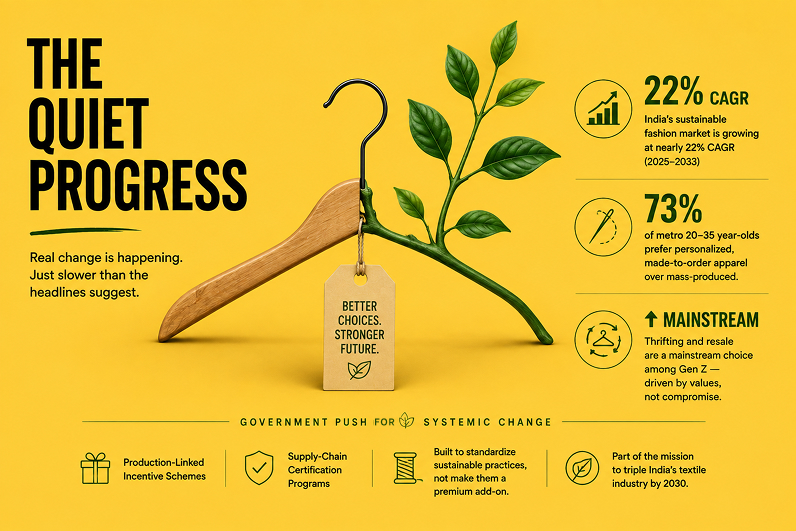
India’s sustainable fashion market is growing rapidly. It has a compound annual rate of nearly 22%. This data comes from Deep Market Insights’ 2025-2033 forecast. This pace outstrips fast fashion’s own growth rate.
Made-to-measure buying is gaining real ground. Slower, more intentional purchasing is also increasing. First Resort conducted research on this trend in 2026.
They focused on metro 20-35 year-olds and found that 73% of this group prefers personalized apparel. They choose made-to-order pieces over mass-produced garments.
Thrifting and resale have moved into the mainstream. They are no longer just niche markets. Rather, they function as a genuine alternative purchasing channel. They are not just a fallback option.
This is particularly true among Gen Z shoppers.
They describe secondhand shopping as an active choice. This choice is tied directly to their values. They do not view it as a compromise.
The Indian government has also entered the picture. Sustainability incentives are now built into a broader push. The goal is to triple the textile industry’s size by 2030. The strategy includes:
- Production-linked incentive schemes.
- Supply-chain certification programs.
These programs aim to make sustainable practices more standard. The goal is to avoid making them a premium add-on.
Sustainable Fashion: Paradox Or Progress? Reframing The Data
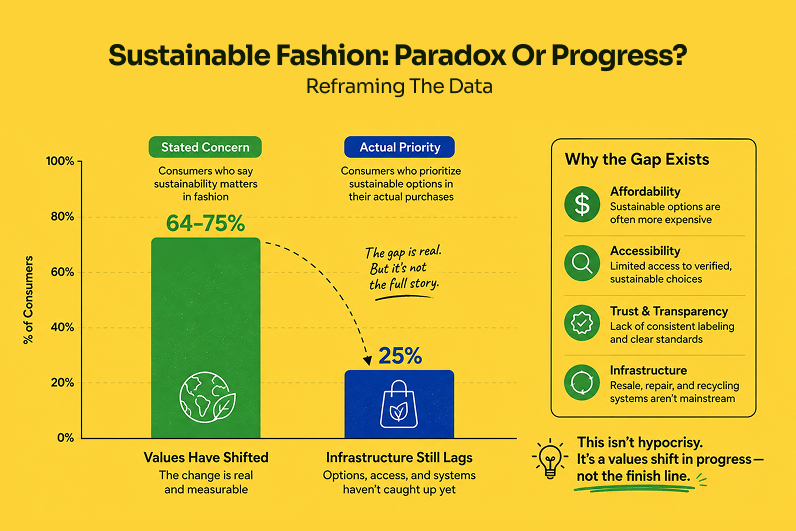
The truth lies somewhere in the middle. The honest read is not that Gen Z and millennials do not care about sustainability. It is also not true that sustainable fashion has fully arrived.
Consumer values shifted first. This change is genuine and measurable. However, the infrastructure to act on those values has not caught up. We still lack large-scale systems for affordable and verified options. Consistent labeling is missing. Accessible resale and repair systems are not yet standard.
Fast fashion fills this gap. Its convenience wins most individual purchase decisions. Its low price point also drives choices. This happens even among people who value sustainability. They would tell you honestly that the environment matters to them.
That’s not the same as hypocrisy. A 25% actual-priority rate against a 64-75% stated-concern rate is what a values shift looks like in its early, uneven stage, not proof the values were never real.
A Realistic Framework
Data doesn’t change a shopping habit by itself. Here’s a more honest way to use it.
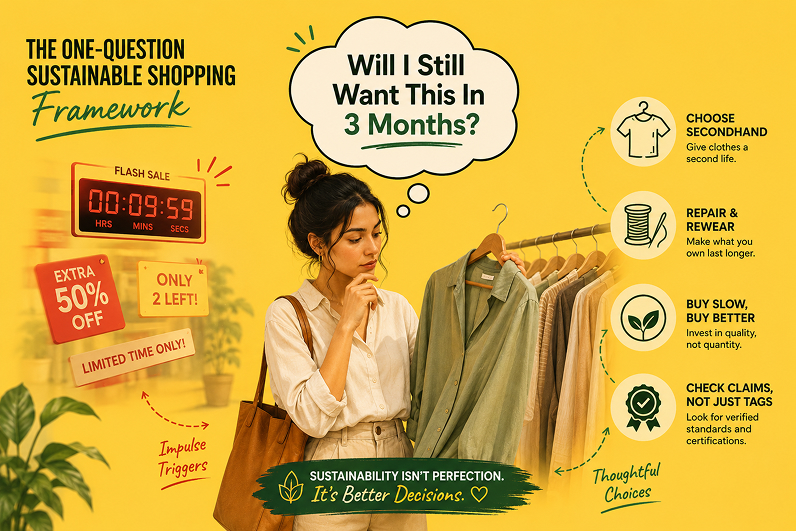
Before adding anything to your cart, ask one question rather than five: would I still want this in three months, or am I responding to a countdown timer on a sale banner?
Discount urgency is specifically engineered to bypass exactly this kind of pause.
Pick one category to buy secondhand or slow-made first, rather than overhauling your entire wardrobe at once. Trying to become fully sustainable overnight is the surest way to abandon the effort within a month.
Treat vague sustainability claims with the same skepticism you’d apply anywhere else. “Eco-friendly” printed on a tag with no certification behind it is marketing language, not a verified standard, at least in the domestic Indian market as it currently stands.
And separate the guilt from the actual decision. The gap between what this generation wants and what the market currently makes easy is structural, not a personal failure to be a good enough shopper.
Naming that clearly makes it easier to make better choices where you actually can, without the shame spiral that tends to just lead to giving up on the effort entirely.
What The Data Suggests Comes Next For Sustainable Fashion
Three things seem likely to shape where this goes from here.
The awareness-to-action gap will likely narrow, not close. As resale platforms, rental fashion, and domestic certification standards mature, the friction between wanting to buy sustainably and being able to easily do so should shrink, though probably slower than the 22% market growth rate alone suggests.
Greenwashing will get called out more aggressively. As search interest and scrutiny both rise, vague sustainability claims without real certification are likely to face more consumer pushback, particularly from a generation already primed to research brands before buying.
Price will remain the real deciding factor for most purchases, most of the time. Until sustainable options reach genuine price parity with fast fashion at scale, stated values and actual consumption will likely keep diverging, especially for shoppers outside the metro, higher-income bracket where most of this data is concentrated.
The paradox, on the evidence, is real. But it’s better understood as a generation whose values have outpaced the market’s ability to make those values easy and affordable to act on consistently, not a story about people who simply don’t mean what they say.
Sources:
- Vogue Institute, Fashion in India 2026 Trends Report
- Statista, Gen Z Willingness to Pay Premium for Sustainable Luxury (India)
- First Resort, Gen Z & Millennial Indian Fashion Spending 2026
- First Resort, Made-to-Measure & Sustainable Indian Fashion 2026
- Zipdo, Indian Fashion Industry Statistics 2026
- Outlook Business, “How India’s Fast Fashion Boom Is Fuelling A Textile Waste Crisis” (2025)
- Towards Sustainability, “The Environmental Impact of Fast Fashion in India” (2025)
- Project Statecraft, “Fast Fashion and Textile Waste in India: The Case for Regulatory Intervention” (2025)
- Deep Market Insights, India Sustainable Fashion Market Size, Trends & Forecast 2025-2033
- World Bank, industrial wastewater pollution data
Continue Reading: