
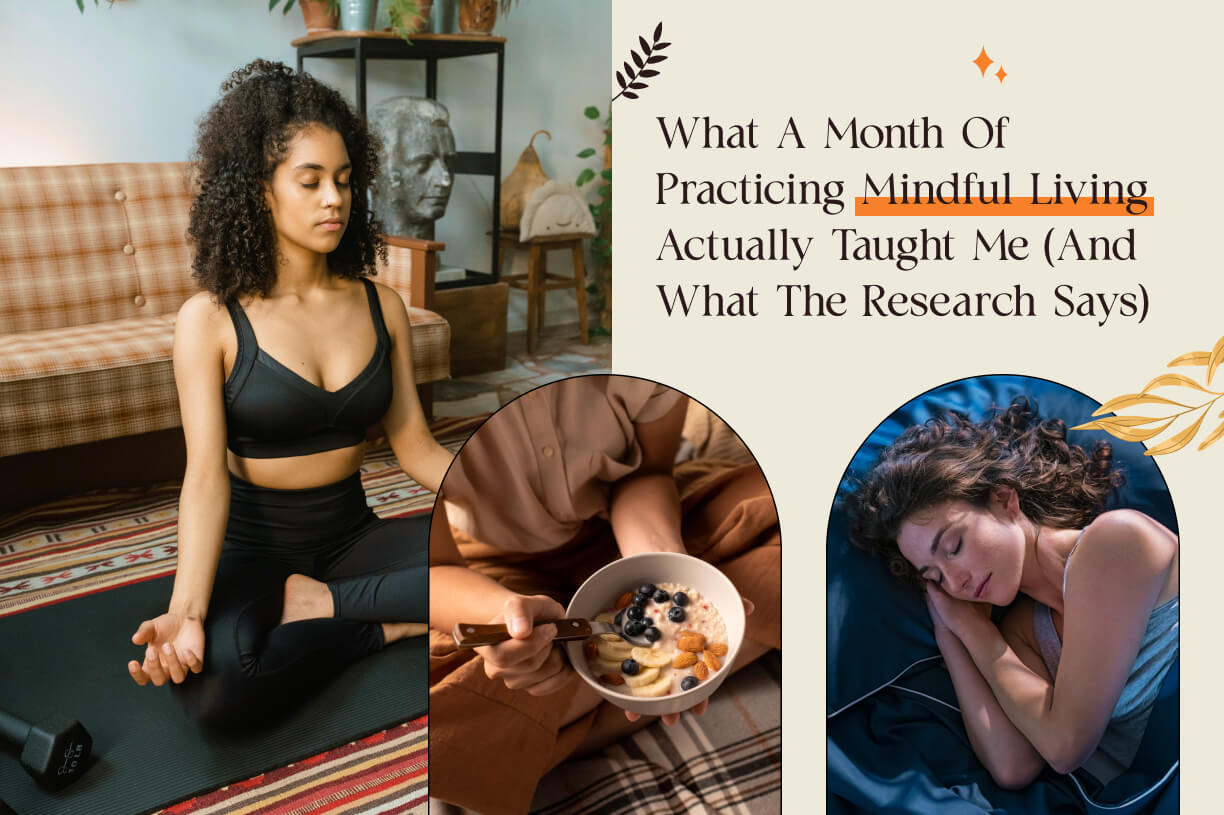
| Quick Answer: Mindful living is really about staying present and not judging whatever’s going on in your head or your life. It’s more than a meditation technique – it’s a way to stop your mind from drifting into regrets or worries. When you focus on what’s happening right now, you cut down on anxiety and stress. Plus, studies show it actually changes your brain: the part that fires up your emotions (the amygdala) gets smaller, while the areas that handle reason, decision-making, and clear thinking grow stronger. |
Mindful living always sounded a little abstract to me. Half the content I found online treated it like a personality upgrade you either had or didn’t.
I’m turning 30 this year, working full-time, and I wanted something more concrete than “just be present.”
So I turned it into an actual experiment: one month, daily tracking, and I compared what I noticed against real research instead of just vibes.
What Mindful Living Actually Means

Mindful living, at its core, is the practice of paying attention to the present moment on purpose, without judging it.
That’s a clinical-sounding definition, but the everyday version is simpler: noticing what you’re doing while you’re doing it, instead of already mentally three tasks ahead.
This matters more than it sounds.
A 2024 study in Nature Human Behaviour followed more than 2,200 people at 37 different locations and discovered something pretty striking: quick, do-it-yourself mindfulness exercises really helped cut stress, even when compared to controls.
This wasn’t just some tiny pilot project or a marketing gimmick from a wellness brand. This was one of the biggest and most rigorous trials out there.
What makes it interesting?
The researchers treated mindfulness as something everyday folks could try on their own, not as some niche practice tucked away in a long clinical program.
My Month, Tracked Like An Actual Case Study
I wanted to do more than just say, “I meditated and felt better,” so I got a bit scientific about it. For a whole month, I tracked three things every day:
- When I actually slowed down on purpose.
- How stressed I felt (just rated it from 1 to 10).
- How I slept that night.
The first week? Pretty brutal.
I was surprised by how much of my day I spent on autopilot – wolfing down lunch at my desk while mindlessly scrolling, firing off replies to texts without really reading them first. Trying to live mindfully at this point was just me realizing how unmindful I’d become.
Week two is where something shifted. I started building in small pauses: three slow breaths before opening my laptop, actually tasting my coffee instead of drinking it on the move.
My average self-rated stress dropped from a 7 to a 5.5 by the end of the week. Nothing dramatic happened externally. My job didn’t get easier. I just started reacting to it differently.
Weeks three and four were about consistency more than novelty. The daily pauses stopped feeling like a task and started feeling automatic.
My sleep log showed fewer nights of lying awake replaying the day, which tracked with what I was noticing during work hours too – less rumination, less rehearsing conversations that hadn’t happened yet.
What The Research Says About Why This Works
My month of notes lines up with what the data actually shows.
A 2026 review in npj Mental Health Research pulled together data from dozens of studies on mindfulness and stress. Basically, they looked at regular adults – not just people getting treatment – and found that mindfulness made a real dent in stress levels.
What’s interesting is the effect showed up everywhere: North America, Europe, Asia, you name it. And it wasn’t just people meditating for hours every day.
Lots of the studies focused on short, simple routines – sometimes using apps or self-guided exercises, kind of like the quick practice I do by taking three slow breaths.
This really matters if you’ve ever thought mindfulness meant rearranging your whole life. The truth is, it’s about sticking with it, not going all-in right away. Consistency beats intensity.
Five Daily Micro-Habits: What Mindful Living Actually Looks Like Day-to-Day
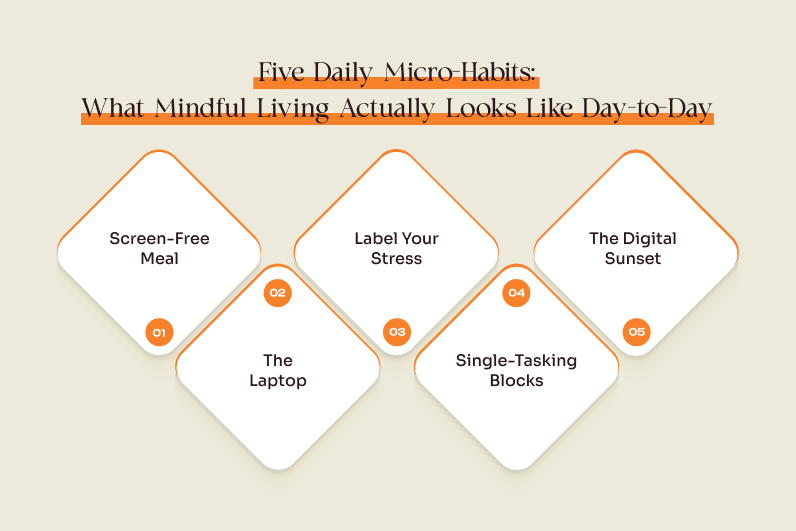
Let us strip away the wellness buzzwords. Use these five simple rules to build a sustainable routine:
Screen-Free Meal:
Eat one meal every day in total silence. Close your laptop. Put away your phone. Focus entirely on the taste and texture of your food for 15 minutes.
The Laptop:
Pause before you open your inbox or start a video call. Take three deep breaths through your nose. Exhale slowly through your mouth. Use this as a mental buffer zone.
Label Your Stress:
Do not suppress your anxiety when a task stresses you out. Name it objectively in your mind. Say: “My heart rate is high because of this deadline.” This shifts brain activity out of your emotional center and into your logical center.
Single-Tasking Blocks:
Schedule two 60-minute single-task windows daily. Close extra browser tabs. Mute your chat notifications. Work on exactly one project at a time.
The Digital Sunset:
Turn off all interactive screens 30 minutes before bed. Do not scroll in the dark. Spend five minutes sitting quietly in your room instead.
Why Brain Awareness Matters for Working Women

Modern working women face intense background noise. We manage home logistics. We navigate office politics. Society expects us to switch tasks instantly without showing exhaustion.
Mindful living cannot delete these pressures. Your career will stay demanding.
But it changes how your body reacts to stress. A solid mindfulness habit breaks the automatic stress loop. This saves your mental clarity. It preserves your physical energy.
Think of it as internal design. You optimize your project presentations. You manage your budgets carefully. Give that same high-utility attention to your nervous system.
My Verdict: Is Mindful Living Worth Trying?
Based on a month of actually tracking it, and research involving thousands of participants pointing in the same direction, I’d say yes, with a caveat: don’t expect a dramatic before-and-after.
The change is quieter than that. It shows up in fewer reactive decisions, slightly better sleep, and a stress scale that trends down instead of staying flat.
Mindful living isn’t an abstract, unreachable ideal, and it isn’t a personality trait either. It’s a practiced habit, and the research backs up what a month of tracking my own showed me directly: small, consistent moments of attention add up to something real.
I’m not a fundamentally different person than I was a month ago. I’m just noticeably less reactive, and that alone was worth the month.
Read Also: