



| Quick Answer Red Car Theory is a popular internet term describing the experience of noticing something more frequently after you have started paying attention to it. The classic example is thinking about buying a red car and then suddenly seeing red cars everywhere. The underlying ideas are related to selective attention and the frequency illusion, rather than a formally established psychological theory. |
There is a particular kind of panic that arrives somewhere between 28 and 30.
It isn’t necessarily the dramatic kind. There is no soundtrack. No one announces that your twenties are officially over.
It is quieter than that.
You are at work, answering emails, sitting in traffic, ordering your usual coffee, scrolling through Instagram before bed, and suddenly you realize that you have started measuring your life against things you never used to think about.
Should I be earning more by now?
Should I have bought a house?
Maybe I should have been further ahead in my career?
Should I know whether I want to get married?
Should I be doing something more interesting?
Or should I have figured out what I actually want?
And perhaps the most irritating question of all: What if I’ve been looking in the wrong direction this entire time?
That last question is what made me stop at Red Car Theory.
The Idea Of Red Car Theory
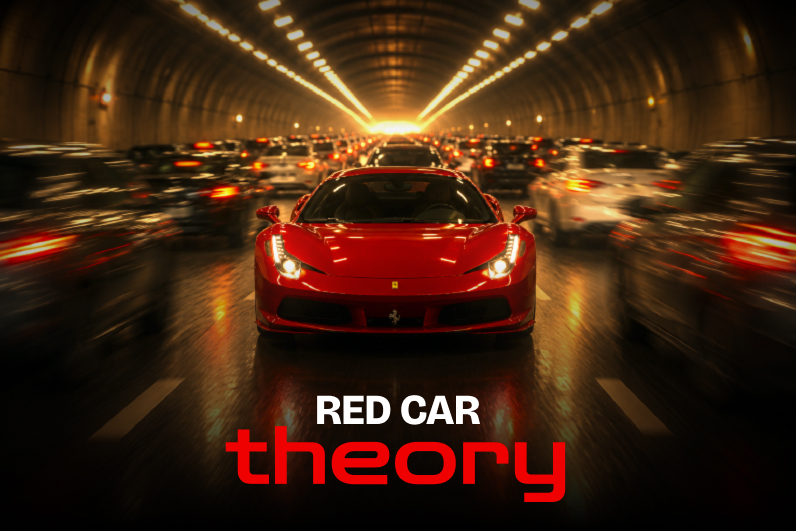
You may have seen the idea online. Think about a red car, and suddenly you start seeing red cars everywhere. It feels almost supernatural the first few times it happens. You wonder whether there really are more red cars on the road or whether the universe has decided to send you a very specific message.
The actual explanation is much less mystical.
The red cars were probably there all along.
You just weren’t looking for them.
And somewhere between the TikTok version of Red Car Theory, manifestation culture, career advice and the general anxiety of approaching 30 – with an aunty somewhere inevitably asking when you’re “settling down” – I started wondering whether this silly little idea might explain something much bigger about adulthood.
Maybe the problem isn’t always that we don’t have opportunities.
Maybe we have become very good at overlooking the ones that don’t look like opportunities.
So, What Exactly Is Red Car Theory? The Psychology Behind
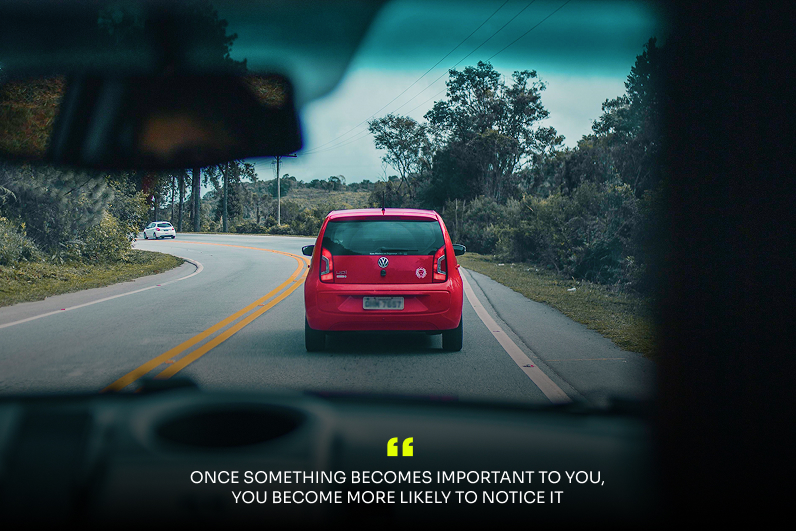
Red Car Theory is a popular internet term for a very ordinary feature of human attention: once something becomes important to you, you become more likely to notice it.
Imagine that you have decided to buy a red car.
Before that decision, you probably weren’t keeping a running inventory of red cars on the road. You might have passed twenty of them without remembering a single one.
But now you’re looking.
Suddenly there is one at the traffic signal. Another outside your office. Another parked outside the supermarket. A red hatchback is in front of you on the way home. You start wondering whether everyone has secretly bought a red car.
They haven’t.
Your attention has changed.
Psychologists have studied selective attention for decades. We are constantly surrounded by more information than we can consciously process, so attention prioritizes information that is relevant to what we’re doing or looking for.
Research on selective attention describes it as the process by which relevant information is prioritized while other information is filtered out.
There is also a related phenomenon called the frequency illusion. Stanford linguist Arnold Zwicky coined the term in 2005 to describe what happens when something you’ve recently noticed suddenly seems to be everywhere.
The Oxford English Dictionary later adopted the term. It defines it as the experience of something to which you have become newly alert suddenly seeming ubiquitous.
So when your friend tells you about a particular skincare ingredient, and you suddenly see it in every product, or you learn a new word and hear it three times that week, it doesn’t necessarily mean the world has changed.
Your filter has.
Red Car Theory In India: A Version That Has Always Existed
Here’s the part I find genuinely interesting: India has been having a version of this conversation for a lot longer than TikTok has existed.
Long before “manifestation” and “Red Car Theory” became hashtags, we had our own explanations for exactly this feeling – the family astrologer telling you Saturn is finally moving in your favor right as you notice opportunities you’d been walking past for months, or your mother saying “dekha, maine kaha tha, sab theek ho jayega” the week things quietly start clicking.
It isn’t that the pandit or the pattern was wrong about something shifting. It’s that we’ve always had a name for this experience of sudden noticing – we just used a different vocabulary for it.
That is the boring scientific explanation.
And, honestly, I think it is more interesting than the magical one – Western or desi.
Red Car Theory Has Become Something Bigger Online
The internet took this simple observation and gave it a much more ambitious interpretation. The social-media version tends to go something like this: if you focus on what you want, you start noticing opportunities related to it.
- You want a new job, you notice job openings.
- Want to meet someone, you notice people you might otherwise overlook.
- Want to travel, you suddenly see cheap flights and people talking about destinations.
- If you want to start a business, you begin noticing problems that could become businesses.
And eventually, the argument becomes: What you focus on expands.
This is where Red Car Theory starts getting mixed up with manifestation. And I think there is an important distinction here.
Thinking about a red car does not create red cars. Paying attention to career opportunities does not magically manufacture jobs.
Writing down that you want to earn more money does not make a salary increment appear in your bank account.
Personally, I think that the useful part of Red Car Theory is not that your thoughts control reality. It is that your attention influences the part of reality you actually notice. That may sound like a small distinction.
At 29, it doesn’t feel small.
I Think Turning 30 Changes What Counts As A “Red Car”

When I was younger, opportunity seemed like something that would announce itself.
A job posting. A promotion. An invitation. A scholarship. A person saying, “I have an opportunity for you.”
The older I get, the less life seems to work that way.
Most opportunities are much quieter.
Someone casually mentions that their company is hiring. A friend says she knows someone in an industry you’re interested in. A senior colleague tells you how she negotiated something you assumed was non-negotiable. Someone asks whether you’ve considered freelancing. A woman you follow online talks about changing careers at 32. A company you admire posts a role that isn’t a perfect match for your CV.
You hear about a course. You meet someone at a dinner. And you read an article that makes you realize you have been thinking about your career in the wrong way.
None of these things comes with a flashing sign saying: THIS IS YOUR OPPORTUNITY.
You have to recognize it.
And that is where I think Red Car Theory becomes unexpectedly relevant to women approaching 30, in India especially.
Because by this age, many of us aren’t short of information.
We are short of attention. And often, we are also short of the energy left over after everyone else’s expectations have taken their share of it first.
We Have Been Taught To Look For The “Right” Life: The Checklist
There is a very specific template for what being a successful woman around 30 is supposed to look like – and in an Indian household, that template usually has a few extra clauses written in by people who aren’t even you.
You are supposed to have a good job.
Ideally, a stable one – government, or at least a “settled” corporate role your relatives can explain in one sentence at a wedding.
You should be progressing.
You should be financially independent. But not so independent that it becomes a topic of concern.
You should look after yourself.
Also, you should have a social life.
You should travel – though preferably not alone. And definitely with photos to show you were “safe.”
You should have a relationship, or at least be dating. But nobody quite says that part out loud at home.
You should know whether you want marriage. And if you don’t know yet, you should have a very convincing answer ready for the next family function.
You should probably be saving, ideally toward gold, or a flat, or both. Because these are still treated as proof that you have “arrived” in a way a salary number alone never quite is.
You should have a skincare routine.
You should be emotionally mature.
And how can I forget – you should have hobbies. But not so many that people start asking if you’re “focused.”
You should somehow be ambitious without being consumed by work.
And you should do all of this while looking like you woke up naturally glowing. And while having an answer ready for “beta, koi achha ladka dekha?” that doesn’t start a whole conversation you don’t have the energy for that day.
The internet has turned adulthood into a checklist. Indian family gatherings turned it into an oral exam with follow-up questions.
Defining What Is Worth Looking For
The problem with checklists is that they tell you what to look for.
They don’t necessarily tell you what is worth looking for.
So you can spend years looking for a promotion because you think successful people get promoted.
You can look for a partner who looks good on paper – and on a biodata – because that’s what a “good match” is supposed to look like.
You can look for a bigger apartment. Because adulthood is supposed to mean upgrading your lifestyle.
You can look for a particular salary because someone your age on LinkedIn said they make it.
And while you’re looking for those things, you can completely miss something else.
A different career.
A person who challenges the way you think.
The creative project.
A business idea.
That friendship.
A city you might actually enjoy living in.
A version of adulthood that isn’t particularly impressive at a family function but happens to make you happier.
Red Car Theory made me think about how much of life is determined by what we have decided is worth noticing – and how much of that “deciding” was never really done by us in the first place.
The Career Version Of The Red Car Theory Is Probably The Most Powerful

This is where the idea becomes particularly interesting for a working woman approaching 30.
For years, I thought career opportunities were things that happened when someone finally recognized your potential.
Now I think a lot of career progression is also about becoming capable of recognizing the opportunity yourself.
There is a difference.
Imagine two women with roughly similar qualifications.
One is thinking: “I need to get promoted.”
The other is thinking: “I want to become the person people call when they need help with this particular problem.”
Those are not the same goal.
The first woman may notice job titles, promotions, and salary numbers. The second may start noticing projects, people, skills, conversations, and gaps.
She may notice that her company has a problem nobody owns. She may notice that a colleague is struggling with something she is unusually good at. Or notice an industry changing. And she may notice that people outside her organization are willing to pay for a skill she has been treating as ordinary.
The opportunities aren’t necessarily different.
Her attention is.
Why This Matters
This matters more than it might seem, given the actual numbers. India’s female labor force participation rate climbed from 23.3% in 2017-18 to 41.7% in 2023-24 — real, meaningful progress.
But the same government data shows women still spend an average of 363 minutes a day on unpaid domestic and caregiving work, compared to 123 minutes for men.
That gap doesn’t just cost time. It costs attention – the very resource this entire theory is about.
If a meaningful chunk of your daily bandwidth is already spoken for before you’ve opened your laptop, “just pay more attention to opportunities” is a much bigger ask than it sounds.
And this is one of the more useful ways of interpreting Red Car Theory. It doesn’t promise that the right opportunity will find you. It makes you more likely to recognize something when it crosses your path – assuming you have any attention left to spend.
That distinction matters because it puts some agency back into the equation without pretending that everything is within our control.
But There Is A Darker Side To This Idea

The internet loves a motivational conclusion: Focus on abundance. Raise your vibration. Look for signs. Believe it is possible.
The problem is that this can very quickly turn into: If you don’t have what you want, you’re not looking hard enough.
And I don’t believe that.
There are people who are doing everything right and still can’t find the job they want. There are women who are excellent at what they do and still get overlooked. People desperately want to leave a bad relationship but cannot immediately do so.
Some people want to move cities but cannot afford it. There are people who need a higher salary but cannot simply “change their mindset” into one.
And sometimes there really aren’t enough opportunities.
Sometimes the system is the problem. Money is the problem. Discrimination is the problem.
Sometimes family responsibilities are the problem. And in a lot of Indian households, “family responsibilities” is doing a lot more heavy lifting in a woman’s schedule than it is in a man’s.
Sometimes the job market is terrible.
Sometimes you are exhausted.
And sometimes, no amount of positive thinking will manufacture a red car where there isn’t one.
This is where I think Red Car Theory needs a disclaimer.
Attention can change what you notice. It cannot guarantee what happens next.
Your Brain Can Also Trick You
There is another reason to be careful with the theory.
Once you start looking for something, it is very easy to notice the examples that confirm your belief and forget everything else.
This is related to confirmation bias: the tendency to seek out or interpret evidence in ways that favor an existing belief or expectation.
Suppose I decide that the universe is sending me signs that I should quit my job.
- On Monday, a former colleague tells me she has started freelancing. Sign.
- On Wednesday, I see a reel about someone leaving corporate life. Sign.
- On Friday, my boss annoys me. Definitely a sign.
Except I have ignored the other thirty-seven things that happened that week.
My salary arrived. My colleague helped me. A project went well. I had a perfectly ordinary Tuesday.
Nobody would call those signs because they don’t support the story I’m telling myself.
This is how a useful psychological observation can turn into superstition – the TikTok kind and the kundli kind, honestly, if you let either one do all your thinking for you.
And I don’t think we need the superstition.
The psychology is already fascinating enough.
The “Red Car Thorey” Experiment I Would Actually Recommend

If you want to use Red Car Theory in your own life, I don’t think you need a vision board covered in pictures of luxury cars.
Try something much more boring. Pick one thing you genuinely want more of. Not ten things. One.
Maybe it’s career opportunities. Maybe it’s new friendships. Opportunities to travel. Freelance work. Or maybe it’s people who share your interests.
Then spend two weeks deliberately noticing anything connected to that goal.
But there is one rule: You have to separate noticing from acting.
If you see a job posting, that is noticing. If you save it, that is action. Or if someone mentions an interesting company, that is noticing. If you message them and ask how they got there, that is action. If someone invites you somewhere, noticing means recognizing that the invitation exists.
Action means actually going.
This sounds obvious.
It isn’t.
We are very good at collecting possibilities without doing anything with them. Our phones are full of saved posts about careers, travel, fitness, money, and relationships.
And trust me when I say this: from what I have seen, we don’t have an opportunity problem. Sometimes we have an execution problem.
The Red Car Is Only Useful If You Get In
This might be the biggest thing I have taken from the idea.
Imagine driving through a city and suddenly noticing red cars everywhere.
Wonderful.
You have proved that your attention works. But you are still sitting in your own car. The red cars don’t take you anywhere.
This is where the manifestation version of Red Car Theory loses me. It can make noticing feel like achieving.
It isn’t.
For example, noticing a job doesn’t get you hired. Noticing an attractive person doesn’t create a relationship. Noticing a business opportunity doesn’t make the business work. And noticing that your friends have started investing doesn’t mean you should invest in the same thing.
Noticing is the beginning.
Then comes judgment. Then action. Luck. Next comes timing. And then a whole collection of factors you cannot control.
That is much less glamorous than manifestation.
It is also much more useful.
What About Red Car Theory In Relationships?
Red Car Theory becomes especially interesting when you apply it to dating.
There is already a version of the theory circulating online that suggests we can miss potential partners because we are too narrowly focused on the traits we think we want.
I understand the argument.
If your definition of the perfect partner is:
six feet tall + certain profession + certain personality + certain lifestyle + perfect texting + immediate chemistry – or, in the Indian context, the version that also silently includes caste, city, family “background,” and whether your parents will actually approve
…you have created a very specific search filter.
And, very naturally, anyone outside it becomes invisible.
One of my closest friends, Namrata, had this massive checklist when we were in university. And honestly, I was worried about her. Because ticking off boxes from that checklist was a Herculean task, to say the least.
But I wouldn’t use Red Car Theory to convince yourself to settle.
That is not the point.
You shouldn’t suddenly decide that every mediocre date, or every biodata your family sends you, is your red car because you have been too picky.
Instead, perhaps the lesson is to become more specific about what actually matters.
Maybe you don’t need someone with the job title your family imagined. Maybe you do need someone who respects your ambition and doesn’t treat your career as a phase before “real life” starts.
And maybe you don’t care whether they are outgoing. Maybe you care that they make you feel safe.
Maybe you thought you wanted someone exactly like you and discover that compatibility sometimes comes from difference.
Red Car Theory isn’t telling you to lower your standards.
It is asking whether your attention is fixed on the right things – yours, not the ones you inherited without questioning.
And This Is Where Turning 30 Gets Uncomfortable
At 30, you become aware that time is real.
Not in the dramatic “your life is over” way that social media sometimes suggests. But in the sense that choices have consequences.
If I spend another five years in a career I dislike, that’s five years. If I keep postponing something because I’m waiting to feel ready, there is a cost to that. And if I keep saying I want to write but never write, eventually I have to admit that “I want to be a writer” is an identity I like more than a behavior I practice.
This is why I find Red Car Theory more interesting than manifestation.
Manifestation asks: What do you want?
Red Car Theory asks: What are you paying attention to?
And perhaps the more uncomfortable question is:
What have you trained yourself not to notice – including things about your own anxiety that you’ve been journaling around instead of actually addressing?
That last part matters more than I used to admit.
There’s a difference between noticing a pattern in yourself and knowing what to do with it. If turning 30 keeps surfacing the same knot of dread every time someone asks about your five-year plan, that’s worth more than a reframe – it might be worth an actual conversation with a therapist, not just another list in your notes app.
Noticing your own mind is the same skill as noticing red cars. It doesn’t mean you have to sit with what you find entirely on your own.
The Things We Don’t See Are Important Too
Selective attention is useful because we cannot notice everything.
But the same filtering system can create blind spots.
Research on inattentional blindness has repeatedly demonstrated how people can fail to notice unexpected objects or events when their attention is occupied elsewhere. In the famous “invisible gorilla” study, participants focused on a counting task could miss an unexpected person moving through the scene.
Obviously, a job opportunity is not a gorilla in a basketball video.
But the underlying lesson is surprisingly relevant.
Attention has a cost.
If I spend all day looking for evidence that I am behind, I will probably find it. I will see that someone:
- bought a house
- got married
- became a VP at 31
- moved abroad
- launched a company
- had a baby
- looks happier than me
And someone’s wedding reel is doing numbers and mine is just… a Tuesday.
The algorithm is exceptionally good at providing red cars for whatever insecurity I happen to be carrying.
And if I keep looking for proof that I’m behind, I will become very good at finding it.
That may be the most dangerous version of Red Car Theory.
We Can Choose The Wrong Red Car
This is something I wish more self-help content acknowledged.
Focus is powerful.
That doesn’t mean every goal deserves more focus.
For example, you can become incredibly good at chasing something you don’t actually want. You can spend years trying to become successful according to someone else’s definition – sometimes literally someone else’s, sitting across the dining table at Sunday lunch.
You can optimize your career until you realize you don’t particularly like your life. Or you can focus on getting married and forget to ask whether you actually like the person you’re marrying.
What more? You can focus on earning more and become too busy to enjoy the money. You can focus on looking younger and spend your thirties worrying about aging. And yes, you can focus on being productive until rest starts feeling like failure.
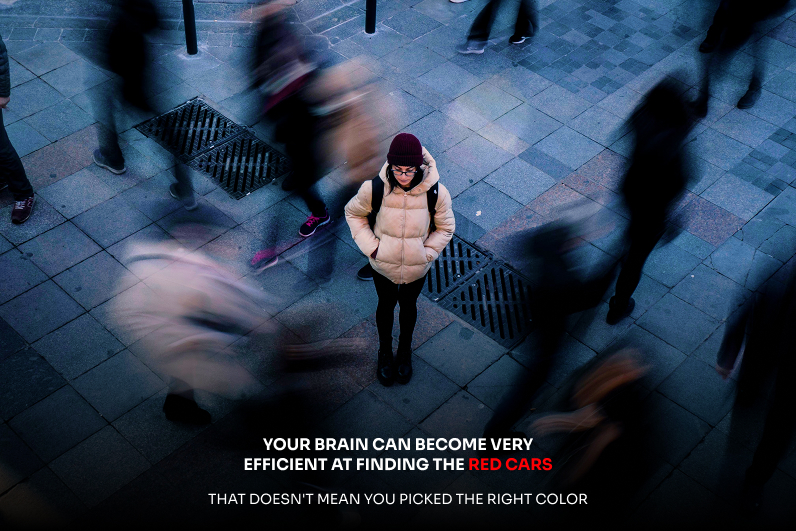
Your brain can become very efficient at finding the red cars.
That doesn’t mean you picked the right color.
So I Want To Change The Question

Instead of asking:
“What do I want to manifest?”
I’m more interested in asking:
“What do I want to become better at noticing?”
Those are subtly different questions.
If I want to grow professionally, I want to notice people I can learn from. If I want financial independence – genuinely mine, not managed by anyone else – I want to notice ways to increase my earning power, not just things to buy.
And if I want better friendships, I want to notice people who make an effort rather than people who simply look interesting online. Want to travel? Then I want to notice practical ways to make it affordable.
And if I want to write more, I want to notice ideas and opportunities to publish instead of waiting for inspiration.
Basically, if I want a different life, I need to become curious about people who are already living versions of it. And that would include the ones who had the same aunties asking the same questions and built something different anyway.
This is not manifestation.
It is attention followed by action.
What My Version Of Red Car Theory Is At 30

Perhaps this is what I actually like about the red car metaphor.
It doesn’t require me to believe that everything happens for a reason. Doesn’t require me to believe that the universe is sending coded messages. Doesn’t tell me that thinking positively will solve structural problems. And it doesn’t even require me to be particularly optimistic.
It simply asks me to notice.
And as I get closer to 30, that feels useful. Because I think a lot of adulthood is spent waiting for certainty.
We want to know whether the career change will work before we make it. We want to know whether a person is “the one” before we let ourselves care. Whether a creative project will succeed before we put it online.
Whether a new city will make us happier before we move. Or whether an opportunity is worth taking before we risk looking foolish. Or worse, before we risk having to explain a “failed” decision at the next family gathering.
But certainty rarely arrives first.
Sometimes you notice something. Then you get curious. Then you investigate. You take a small risk. And then you learn.
Maybe that is what a red car really is: It’s not a sign. Not a manifestation. Not proof that the universe wants something for you.
Just something that was already there that you finally became capable of seeing.
So, Does Red Car Theory Actually Work?

Yes, but probably not in the way TikTok wants us to believe.
If “work” means that focusing your attention on something can make you more likely to notice it, there is a solid psychological basis for that broader idea. Selective attention is a well-established area of cognitive psychology, and frequency illusion describes the tendency for newly noticed phenomena to subsequently feel unusually common.
If “work” means that thinking about a job will cause the perfect job to appear, there isn’t evidence here for that magical leap.
And that distinction matters.
Because I don’t actually need Red Car Theory to promise me that the life I want is waiting around the corner.
I just need it to remind me that I might be walking past parts of that life every day without noticing them.
For example, maybe the job isn’t there yet. Maybe the relationship isn’t there yet. Maybe the money isn’t there yet. Or, maybe the opportunity genuinely doesn’t exist.
But perhaps there is a conversation I haven’t had. A person I haven’t met. A skill I haven’t learned. Or a possibility I dismissed too quickly.
Maybe a question I haven’t asked. Including “why do I actually want this,” rather than “why does everyone expect me to want this.”
A version of myself I haven’t allowed to take seriously.
And perhaps that is enough.
Because turning 30 doesn’t mean I need to have found everything. It might just mean I should become more deliberate about what I’m looking for.
Just Know One Thing: The Red Cars Were Always There
There is something almost comforting about the fact that the red cars were never actually new.
The world didn’t suddenly change because I noticed them.
I did.
And maybe that is the part of Red Car Theory worth keeping.
Not the promise that our thoughts create our reality. Not the idea that every coincidence is a sign. And definitely not the pressure to turn every missed opportunity into a failure of mindset.
Just the reminder that attention is a choice, and choices have consequences.
If I spend my days looking for evidence that I’m behind, I will find it. If I spend my days looking for reasons to stay exactly where I am, I will find those too. But if I start looking for possibilities, I might notice a few.
That doesn’t mean I will get every opportunity.
It doesn’t mean every red car belongs to me. It doesn’t even mean I should stop when the road gets difficult.
Rather, it simply means that sometimes, before asking whether there are enough opportunities in the world, it is worth asking a smaller question:
Am I even looking for them?
Because sometimes the thing you’re waiting for isn’t suddenly going to appear. Sometimes it has been driving past you for years. You just weren’t looking in that direction.
Is Red Car Theory Scientifically Proven?
Red Car Theory itself is not a formal scientific theory with a single established mechanism. However, selective attention and related phenomena such as inattentional blindness and frequency illusion are well-established areas of psychological research.
Is Red Car Theory The Same As The Baader-Meinhof Phenomenon?
They are commonly used to describe closely related experiences. The Baader-Meinhof phenomenon is another name for the frequency illusion: once something becomes salient, it can seem to appear much more frequently than before.
Is Red Car Theory The Same As Manifestation?
Not exactly. Manifestation generally involves the belief that thoughts, intentions, or visualization can help bring desired outcomes into reality. Red Car Theory, in its most defensible psychological interpretation, is about what happens to your attention once something becomes important to you. Noticing more red cars does not mean you caused more red cars to exist.
Can Red Car Theory Help You Find Opportunities?
It can be a useful way of thinking about attention and opportunity recognition. Once you become clear about what you are looking for, you may become more likely to notice relevant people, information, conversations, and possibilities. But noticing an opportunity is only the beginning. What happens next depends on action, circumstances, and factors outside your control.
Sources:
- Annual Reviews – research establishing selective attention as the process by which relevant information is prioritized while other input is filtered out.
- Zwicky, A. (2005). “Just Between Dr. Language and I.”
- Language Log, August 7, 2005 – original coinage of “frequency illusion.”
- Oxford English Dictionary (added March 2019) – formal definition: “a quirk of perception whereby a phenomenon to which one is newly alert suddenly seems ubiquitous.”
- University of Waikato – definition of confirmation bias as the tendency to seek or interpret evidence in ways that favor an existing belief.
- PureWow – popular treatment of the theory in a relationship-attention context.
- Simons, D. J., & Chabris, C. F. (1999). “Gorillas in Our Midst: Sustained Inattentional Blindness for Dynamic Events.” Perception, 28(9), 1059-1074.
- Economic Survey 2025–26, Government of India – Female Labour Force Participation Rate rose from 23.3% (2017–18) to 41.7% (2023–24)
- Time Use Survey (Ministry of Statistics and Programme Implementation) – women spend an average of 363 minutes a day on unpaid domestic and caregiving work, compared to 123 minutes for men.