
| Quick Answer Yes, September Theory has a real psychological basis. It is a version of what researchers call the “fresh start effect.” Temporal landmarks genuinely boost motivation. Examples include a new month, season, or birthday. They let people mentally separate a “past self” from a “new self.” However, some TikTok versions add a numerology layer. This part is not backed by evidence. These versions claim September carries “divine timing” because of a “9 Year.” They also claim that endings this month are cosmically meaningful. For Indian women specifically, none of this is actually new. Navratri and the run-up to Diwali have functioned as exactly this kind of reset for generations. They involve cleaning, clearing debts, and starting fresh. This happened long before a hashtag gave it a name. |
It’s September, and my For You page already knows it. Every third video is some version of the same message: this is your reset button, your second New Year, the moment to lock in before the year runs out on you.
Someone’s doing a “September Theory explained” voiceover over b-roll of a planner and a matcha latte. Someone else is saying that if something ended for you this month, it’s “alignment.”
A third video ties it to numerology – 2025 was apparently a “9 Year,” September is the 9th month, and 9 means completion and release, so obviously the universe timed your breakup this way on purpose.
I watched about six of these back to back and had two reactions at once.
The first was mild embarrassment, because some of it worked – I did feel a small flicker of “okay, let’s get it together” watching a stranger meal-prep in a sunlit kitchen. The second reaction, slower and more useful, was: I’ve felt this exact pull before.
Not in September.
I Have Seen This Before, For Ages.

I have seen this in October, watching my mother clear out cupboards before Navratri or Durga Puja (whatever you call it depending on the state you live in), the way she does every single year, muttering that everything has to be spotless before the goddess arrives.
So the actual question isn’t whether September feels like a reset.
It clearly does, for a lot of people, myself included. The question is why – and whether “the universe timed it” is really the most useful explanation on offer, when a much older and much closer explanation has been sitting in our own homes the entire time.
What Is The September Theory?
September Theory is a 2025-2026 social media trend. It is built on a simple premise. September functions as a “second New Year.”
This month acts as a temporal landmark. It triggers genuine motivation to reset habits, relationships, and routines. It often works better than January 1st does.
Some versions focus purely on habit-building. This is sometimes called the “September Lock In.” It is framed as choosing to focus on yourself for the final four months of the year. You do this instead of waiting for the usual resolution period.
Other versions apply the theory to relationships. Summer flings fade, and daily routines return. Because of this, people start clarifying who they actually want around long-term.
A third strand is more mystical. It ties September to numerology and “divine timing.” This version treats any ending or beginning in this month as cosmically significant.
The first two versions rest on something psychologically real. The third does not.
Is September Theory Real?
The core idea has real psychological backing – it’s a version of the “fresh start effect,” where temporal landmarks like a new month or season genuinely boost motivation to pursue goals.
The numerology and “divine timing” elements some TikTok versions add are not scientifically supported.
Why Does September Feel Like A Reset Even Though The Calendar Year Doesn’t End?
The fresh-start effect does not depend on the objective significance of a date. Instead, it matters whether the date feels like a landmark.
Multiple factors combine to make September feel like a natural line. These include a new season, a return to routine after summer, and a shift in weather. This psychological shift happens automatically. It occurs even though nothing on the calendar officially resets.
Does September Theory Actually Help You Achieve Goals?
It genuinely boosts the likelihood that you will start pursuing a goal. For instance, research found people are up to 47% more likely to begin at the start of a new semester.
However, whether you follow through still depends on the usual factors. You need a specific plan. You need a way of handling obstacles. Most importantly, you need real action. Success requires more than just the reset feeling itself.
The Saying Behind September Theory In Dating: “You’ll Know by Labor Day”

Part of why September Theory spread as fast as it did is that it isn’t just a vague vibe – it collapsed into an actual, quotable line people started repeating to each other.
Vice’s coverage of the trend centered on this exact phrasing. They cited an explanation by matchmaker Susan Trombetti. The theory essentially means you know your relationship status by Labor Day. You are no longer wondering whether a summer situationship is going anywhere.
By this point, you already know.
That distinction matters more than it sounds like it should. A lot of internet “theories” stay abstract enough that anyone can bend them to fit their situation.
This one didn’t.
It gave people a specific date and a binary outcome. This is exactly the kind of framing that turns a concept into a saying. It keeps it from being just a passing trend.
The phrase “It’s giving September Theory” started changing. It functioned less as an explanation. Instead, it acted more as permission.
It became a shorthand way of telling a friend or yourself to stop leaving something ambiguous. It serves as a prompt to actually name it.
Vice’s reporting also flagged the other side of that same coin: the pull toward cuffing season.
Summer’s casual pace quickly gives way to routine. That’s why there is real pressure to lock something down. People want to have someone for the colder months.
However, experts push the “you’ll know by Labor Day” framing. These same experts were careful to separate clarity from settling.
Clarity does not mean settling. Knowing your status isn’t the same as choosing comfort over compatibility.
What makes this worth including alongside the fresh-start psychology already in the piece is that it’s a different mechanism doing similar work. The fresh-start effect explains why September feels like a turning point.
The Real Psychology Behind September Theory: The Fresh Start Effect
There’s a name for the genuine version of this phenomenon, and it predates TikTok by well over a decade.
Wharton researchers Hengchen Dai, Katy Milkman, and Jason Riis published “The Fresh Start Effect: Temporal Landmarks Motivate Aspirational Behavior” in 2014.
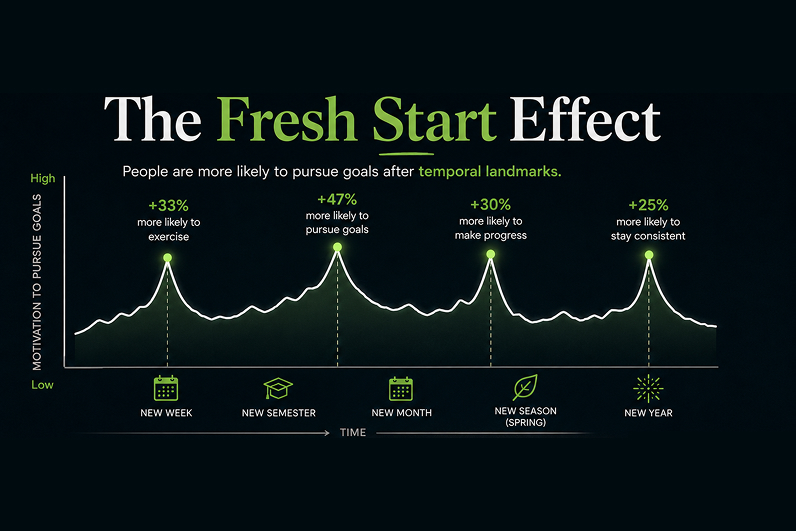
And the core finding is exactly what September Theory is (accidentally) describing: people are significantly more likely to pursue goals immediately following a temporal landmark – the start of a new week, month, season, semester, or year.
The numbers are more striking than I expected.
Their research found that people are 33% more likely to exercise at the start of a new week. They are 47% more likely at the start of a new semester.
Researcher Katy Milkman provides the explanation for this behavior. Her reasoning maps directly onto the “reset” language found all over your For You page.
Temporal landmarks create psychological distance from past failures. As she put it, they let you file your setbacks under “the old you.” As a result, the version of you standing at the start line feels genuinely new. You do not feel just chronologically further along.
There’s a detail in this research I find more interesting than the headline finding: what matters isn’t the actual date, it’s whether it feels like a landmark.
Their studies found “the first day of Spring” motivated more behavior change than “the third Thursday of March” – despite occasionally being the exact same date.
The effect lives in the perception of a fresh start, not in the calendar itself. Which means September Theory isn’t really about September specifically.
It’s about whatever date your mind has decided counts as a beginning – and that part, it turns out, is something we get to choose.
Where It Overreaches
This is where I want to apply the same test I’ve used on Red Car Theory and manifestation culture before: separate what’s genuinely psychological from what’s been dressed up as cosmic.
(Psst… This is your cue to read them if you have not already!)
The habit-reset version of September Theory holds up. The relationship-clarity version holds up reasonably well too – it’s plausible that a shift in routine and season genuinely does surface who you actually want to keep around, the same way any change in circumstance tends to clarify preferences you’d been avoiding looking at directly.
The “divine timing” and numerology version is a different animal entirely, and it’s worth naming why.
Claims like “if something ends, it’s alignment” and “if someone returns, it’s because they’re meant to” aren’t describing a psychological mechanism at all. Rather, they’re assigning cosmic intent to ordinary life events after the fact.
This is the same trap found in manifestation culture. The concept feels empowering at first. However, this changes when something painful happens in September.
The trend’s logic implies that the painful event was “meant to be.” This mindset quietly closes off a much more useful question. It stops you from asking what you might actually want to do differently.
A breakup isn’t more or less meaningful because it happened in the 9th month of a year that adds up to 9. It’s meaningful because it happened, full stop – and that meaning doesn’t need numerology to be taken seriously.
India Already Had This – We Just Called It Navratri

Here’s the part I genuinely want to talk about: the “fresh start ritual” isn’t a TikTok/Instagram invention landing on Indian audiences as something new.
It’s something Indian households have been doing, in a much more concrete and physical form, every single year for generations – we just never called it a psychological theory.
Sharad Navratri falls in late September through October (this year, October 11-20). In the eastern part of India, we call it Durga Puja (the first 9 days of which are celebrated as Navratri in the western and northern India)
And it functions as exactly the kind of temporal landmark Dai, Milkman, and Riis were describing – except with an entire cultural infrastructure built around it instead of a hashtag. Homes get deep-cleaned before the goddess arrives, not casually, but as an actual ritual obligation.
The Literal Reset
Old, unused items get cleared out. In many households, this is also when people settle pending debts, resolve arguments, and consciously try to start the season without carrying old grudges into it.
New clothes get bought. The days of the festival themselves are structured around different forms of Durga, each carrying its own symbolic focus – strength, wisdom, prosperity – giving the “reset” an actual shape instead of a vague intention to “lock in.”
Navratri does not stand alone. It is the opening act of a longer spiritual stretch.
This period runs through Dussehra and leads into Diwali roughly a month later. Diwali is the actual “naya saal” (new year) moment in a lot of Indian households. This is particularly true in Gujarati and Marwari communities. For them, the Vikram Samvat new year begins the exact day after Diwali.
Businesses close old ledgers and open new ones. Homes get lit, decorated, and cleaned again. The entire autumn stretch, in other words, is a multi-week, deeply embedded version of exactly what September Theory is describing in a single hashtag – except ours comes with recipes, rituals, and a grandmother checking that you actually did it properly.
Landmarks Of A Culture
This isn’t a coincidence, and it isn’t really a surprise either, once you sit with it.
Milkman’s own research found that what matters is whether a date feels like a landmark, not whether it’s objectively significant.
Festivals are, by design, the most deliberately manufactured “felt landmarks” a culture can build. Navratri and Diwali didn’t need modern psychology to arrive at the fresh start effect.
They arrived at it through centuries of ritual design, arguably with a better structure than a 30-second video can offer – because a festival gives you an actual sequence of actions to perform, not just a feeling to chase.
Why Autumn Actually Does Work Better Than January
There’s a reasonably good practical case, separate from the psychology, for why this season outperforms January as a genuine reset point – in India specifically.
January in India arrives in the middle of winter, sure, but it doesn’t carry the same cultural weight as it does in the West.
There’s no real “new year energy” baked into the culture the way there is around Diwali. September and October, by contrast, arrive right after the monsoon lifts, when the weather genuinely shifts and the festive season kicks off.
And – for a lot of working women specifically – mid-year appraisal conversations and festive-season hiring pushes are already reshaping how people are thinking about their careers.
The temporal landmark isn’t just psychological here. It’s stacked with actual, practical reasons the season already feels different: weather, workplace rhythms, and the festival calendar all pointing the same direction at once.
That stacking effect matters.
Milkman’s research suggests fresh starts work better when the landmark feels more significant. And few things make a date feel more significant than an entire culture agreeing, simultaneously, that it’s time to clean the house, clear the debts, and start again.
What This Actually Looks Like

I noticed my own version of this last week, before I had even seen or known about this trend. I reorganized my desk on the first of the month without really deciding to – just an old to-do list crumpled and binned, a half-finished notebook closed and put away, a new one opened.
It wasn’t dramatic. And it certainly didn’t feel like alignment or divine timing. It felt like what it actually was: a small, ordinary decision that happened to land on a day my brain had decided counted as a beginning.
That’s the useful version of this. Not “the universe cleared space for me this month.” Just: a date arrived that felt like a line, and I used it as one.
How To Use September Theory In Your Life?
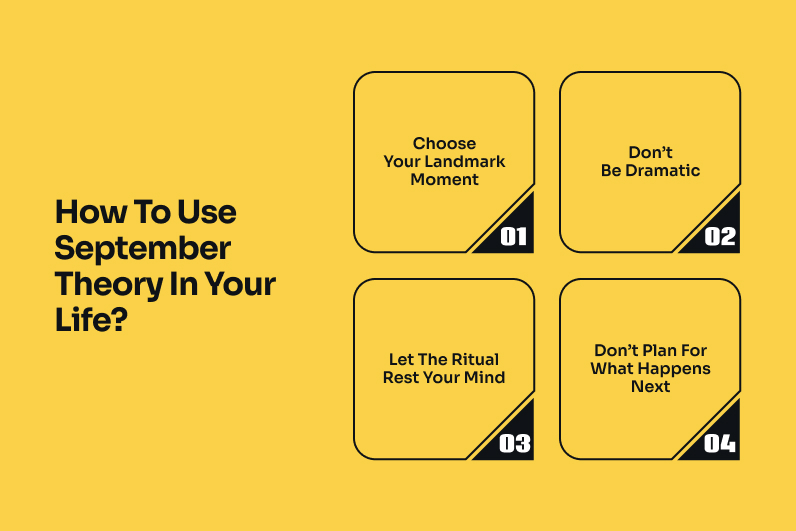
If you want to use September – or Navratri, or Diwali, or whichever landmark actually lands for you – as a genuine reset rather than a vague vibe, the research suggests a few things that make it stick.
Choose Your Landmark Moment
Pick a landmark that already feels significant to you, rather than borrowing one wholesale from a trend. For example, personally, for me that would be 10th of September since that’s my birthday.
But if Navratri has always meant something in your house, that’s a stronger fresh-start trigger for you specifically than September 1st ever will be, because the “felt” significance is doing the actual psychological work.
Don’t Be Dramatic
Attach the reset to a specific, small action, not a mood. “I’m going to lock in” is a feeling. “I’m clearing my inbox to zero before Navratri starts” is an action with a deadline attached to a landmark that already carries weight.
The fresh-start effect boosts the likelihood you’ll start something – it doesn’t guarantee you’ll finish it, and that part still depends on the same obstacle-and-plan thinking that makes any goal stick.
Let The Ritual Rest Your Mind
Let the ritual do some of the work. This is the part Indian festivals already get right. And I think this is where most of us might relate to what most people talking about September Theory miss.
A physical, repeated action (cleaning, clearing, buying something new) reinforces the mental reset far more effectively than a mindset shift alone. If you’re building your own version of this, give it a physical component, not just an intention.
Don’t Plan For What Happens Next
Don’t assign meaning to what happens next. If something ends or begins this season, let it be what it actually is. A thing that happened, on a date that happened to feel significant to you. Not proof of cosmic timing.
That distinction is the same one worth making with Red Car Theory and manifestation: the psychology of noticing and resetting is real and useful.
The story that the universe orchestrated it is not required. And it usually gets in the way of the more honest question underneath – what do you actually want to do differently now that you’ve noticed the pull to begin again?
My Verdict On September Theory: The Reset Doesn’t Need A Reason
Personally, I don’t think September Theory needs to be true in the mystical sense for it to be useful. I don’t need to believe the universe engineered my breakup or my burnout to land in a particular month for the month to still be a good moment to start again.
I just need a date that feels like a line – and it turns out my culture handed me one of those long before an app did.
Maybe that’s the actual reset worth paying attention to this season. Not the version that tells you the universe was waiting for September specifically.
The version that notices you already had a ritual for this, sitting in your own home, in your own festival calendar, in the sound of your mother clearing out a cupboard every October without ever needing a hashtag to explain why.
Sources:
- Dai, H., Milkman, K. L., & Riis, J. (2014): “The Fresh Start Effect: Temporal Landmarks Motivate Aspirational Behavior.”
- Management Science: Dai, H., Milkman, K. L., & Riis, J. (2015).
- “Put Your Imperfections Behind You: Temporal Landmarks Spur Goal Initiation When They Signal New Beginnings.”
- Psychological Science, 26(12), 1927-1936.
- Trombetti, S., quoted in “The ‘September Theory’ Says Your Summer Fling Has an Expiration Date, and Experts Agree, Vice
- Psychology Today, “Harnessing the Fresh Start Effect” (2025)
- Newsweek, “What is the ‘September Lock In’? Trend explained” (2025).
- TikTok trend analysis of #SeptemberTheory content, including numerology and relationship-framing variants.
- Wikipedia, “Navaratri” – Sharad Navratri 2026 dates (October 11-20).
- Andaaz Fashion, “Navratri 2026: Dates, Colors, Puja Vidhi & Fashion Guide” – Ghatasthapana and Dussehra dates, and the distinction between Chaitra and Sharad Navratri.