

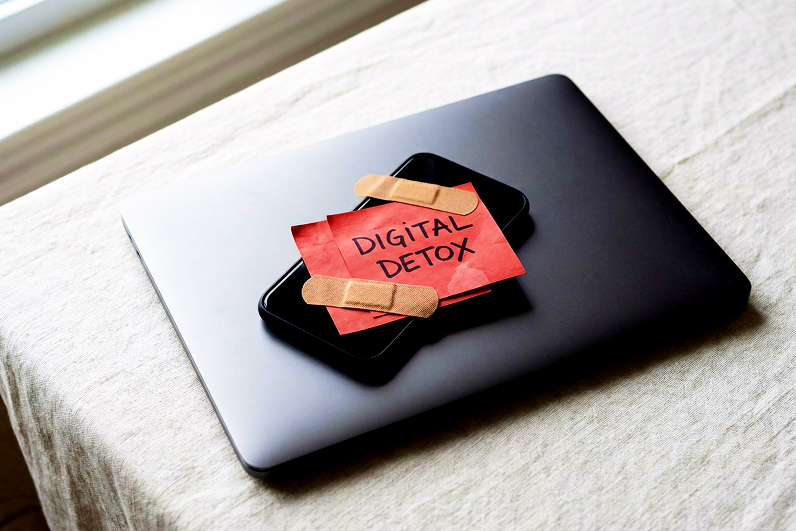
| Quick Answer A digital detox is a deliberate, time-bound break from phones, social media, or screens in general. This is not necessarily forever, just long enough to reset your relationship with them. It’s not about quitting technology; it’s about noticing how much of your day it’s quietly taken over, and taking some of that back on purpose. |
I’ll be honest about my first attempt: it lasted four hours. I turned my phone off after lunch, made it to 5 pm, and caved because I “needed to check something work-related.”
I didn’t.
TBH, I just missed the reflex of holding it. That failure taught me more about what a digital detox actually requires than any listicle did.
Why “Just Unplug” Doesn’t Work In India
Most digital detox advice assumes you can just – stop. Turn the phone off, go for a walk, done. That works fine if your phone is purely for entertainment.
It works a lot less well when it’s also your office, your bank, your family group chat. Or the only way your building’s watchman tells you a delivery has arrived.
In India, especially for working women juggling a job and a household that now runs on apps, a digital detox has to be designed around real constraints. Not wishful ones.
The Red Car Theory Of Phone Addiction
There’s a concept called the red car theory. It’s the idea that once you start noticing something, you can’t stop seeing it everywhere. Buy a red car, and suddenly every third car on the road looks red. I have written about it at length in my previous blog – check it out!
Guess what? The same thing happened to me with my phone once I started paying attention to how often I picked it up.
I wasn’t reaching for it more than usual during my detox attempt. Rather, I was just finally noticing every single time, and the number was honestly a little embarrassing.
What You’re Really Detoxing From
A digital detox isn’t really about the phone itself – it’s about what constant phone use does to you over time.
For a lot of people, that shows up as digital burnout: a bone-deep tiredness that rest doesn’t fix. For others, it shows up more as forgetfulness and a foggy head, which lines up with what’s now being called digital dementia.
Most of us are dealing with some blend of both without a name for it. Personally, I think that is part of why a proper detox, even a short one, can feel disproportionately effective. Because it’s addressing the actual cause instead of just the symptom you happened to notice first.
Touch Grass, Literally
“Touch grass” started as an internet joke aimed at people who’d clearly been online too long. However, the advice underneath it is genuinely sound.
There’s something about physically standing outside, away from a screen. Something that a walk on a treadmill scrolling Instagram simply doesn’t replicate.
I started taking my coffee outside on my balcony instead of at my desk, and it’s the single dumbest-sounding, most effective five minutes of my day.
A Realistic Screen Time Plan
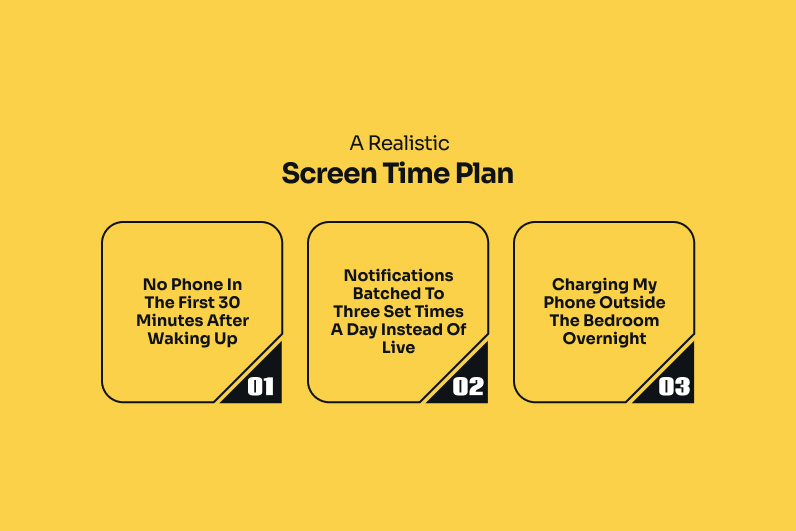
Rather than an all-or-nothing detox, what actually worked for me was a handful of specific tips on how to reduce screen time. These were the ones that I could repeat daily instead of a one-off event:
- No phone in the first 30 minutes after waking up
- Notifications batched to three set times a day instead of live
- Charging my phone outside the bedroom overnight
None of this required willpower in the moment. Because the decision was made once, in advance, rather than fought over every time.
What Happens To Your Focus
One thing nobody warns you about: the first few days of cutting back are genuinely uncomfortable, because your attention span has quietly adjusted to constant interruption.
If you’ve noticed you can’t sit through a full episode or a meeting without reaching for your phone, that’s not a personal failing – it’s a learned pattern.
And it’s exactly why so many people look up how to fix attention span separately from the detox itself. The two are connected, but rebuilding focus takes longer than the detox does.
The Body Doesn’t Lie: Cortisol And Screens

Let’s be entirely critical about the screen time report on your phone. Every single buzz, flashing notification, and reflexive check isn’t just an app vying for your attention – it is a tiny, physical stress signal your body has to respond to.
When you stay constantly connected, your adrenal glands are forced to keep your stress hormones running higher than they ever should. [Source: NetMeds]
A “cortisol detox” sounds fancy, but practically speaking, it just means removing those digital triggers so your nervous system can finally catch its breath. A digital detox is the most immediate way to pull the plug on that loop.
If you’re genuinely curious whether this screen addiction is messing with your biology, an at-home saliva cortisol test is a great way to find out rather than guessing.
But don’t waste your money on a single, one-off blood test. Cortisol spikes and drops throughout the day, so you need a multi-sample kit that tracks your entire daily rhythm.
And remember: learning how to lower cortisol cannot follow a generic template.
For women, stress isn’t just a mental state. Rather, it is tied directly to monthly hormonal shifts, estrogen balances, and a heavy default mental load that men simply don’t have to calculate.
According to the National Library of Medicine, you have to fix the actual environment, not just download another wellness app. [Source: PubMed Central]
When A Weekend Isn’t Enough

If your relationship with your phone has been off for a while, a couple of screen-free hours a day might not cut it, and that’s fine.
A short digital detox retreat – even just a weekend somewhere with genuinely poor signal – can do in two days what months of “I’ll cut back starting Monday” usually doesn’t.
The Bigger Picture Around Digital Detox
Part of why so many millennials are burnt out enough to need this in the first place ties into something bigger than screen time – what’s being called the Great Millennial Career crisis, a widespread reckoning with careers that didn’t deliver what they promised.
Constant connectivity makes that harder to sit with, because there’s always a notification available to distract from actually feeling it. A digital detox won’t fix a career crisis. But it does create the quiet you need to actually think about it instead of scrolling past it.
A digital detox was never going to be a permanent, dramatic lifestyle change for me – realistically, my job needs me online.
What it did was show me how much of my day I’d handed over on autopilot. And how much I could take back with a handful of boring, repeatable habits instead of one heroic offline week.