

| Quick Answer “Touch grass” is actually slang on the internet that means disconnecting from all electronics and digital devices. In contrast, a digital detox is a serious, healthy decision to avoid electronic devices that can distract or stress you out. The phrase “touch grass” is used informally and sarcastically to suggest someone should get away from the screen, go outdoors, and cut out online drama by reconnecting with reality. |
“Touch grass” started as a gaming insult telling someone they’d been online too long – but the science behind why it’s stuck around is real.
It’s a meme-shaped version of what wellness content calls digital detox, and the underlying idea – that stepping away from screens and into nature genuinely lowers stress and improves focus – has actual research behind it, even if the meme itself doesn’t.
For Indian millennials and Gen Z women specifically, none of this is new.
Walking barefoot at home, sitting on the floor, touching the earth before a temple visit – we’ve been doing informal versions of this for generations.
We just never called it self-care.
The Scroll That Made Me Write This

I was three replies deep into an Instagram comment thread – genuinely can’t even remember what the argument was about anymore – when someone dropped the two words that end most online arguments these days: touch grass.
It stung a little, if I’m honest. Not because it was wrong. Because it wasn’t.
I’d been on my phone for two hours by that point, most of it spent being annoyed at a stranger over something that would mean nothing to me by dinner.
And here was this ridiculous, blunt little phrase doing what several wellness apps and a very expensive planner had failed to do all year: actually making me put the phone down. That’s the thing about touch grass that I don’t think gets said enough.
It’s rude. It’s dismissive.
It was born out of toxic gaming-forum culture, not a therapist’s office. And it might be one of the more effective pieces of wellness advice currently circulating on the internet, purely because nobody experiences it as advice.
I closed the app.
I didn’t actually go outside that particular evening – old habits – but the phrase stayed with me longer than the argument did, which felt worth paying attention to.
A two-word insult had done more to interrupt my scrolling than an entire folder of saved “how to be more mindful” reels ever had.
What Does “Touch Grass” Actually Mean?
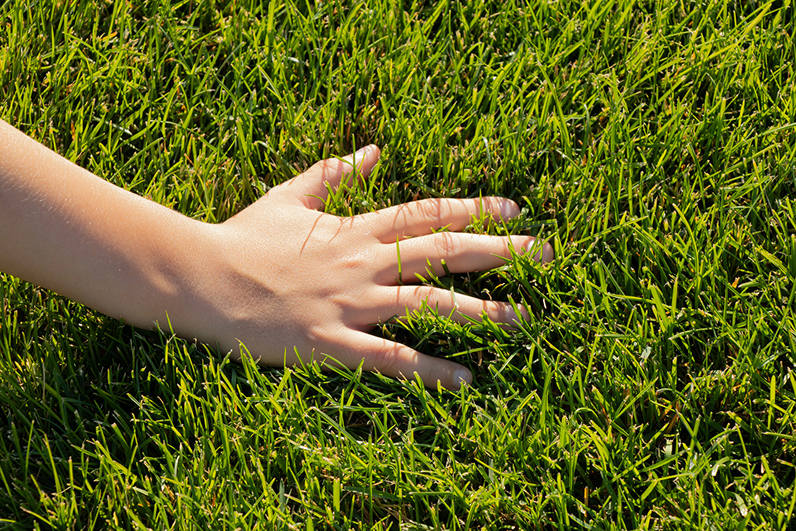
Before going further, precision about this phrase’s true nature matters. The phrase has evolved a fair bit since its arrival. Most coverage stops at the joke. It fails to ask why the joke has held on this long.
Where The Phrase Came From
“Touch grass” started circulating on Twitter around 2015, largely in gaming communities. It is basically a way of telling someone mid-argument that they’d clearly been online too long to have a reasonable perspective.
It was gaming-chat trash talk, plain and simple. The kind of line traded between people who spent hours in the same virtual space, mocking each other for exactly the behavior they were both engaged in at that moment.
It stayed fairly niche until 2020 and 2021. That is when pandemic lockdowns kept millions of people glued to screens for months at a stretch. And the phrase exploded across platforms as shorthand for exactly that specific, chronically-online exhaustion.
The timing wasn’t a coincidence.
A phrase built to mock excessive screen time landed at a specific moment. An entire generation had no choice but to live on their screens. This gave the phrase a second, more sincere layer of meaning. It had not originally carried this meaning.
How It Turned From Insult To Advice
What’s interesting is the tone shift.
It started as pure insult – a way to end an argument by implying the other person had lost touch with reality.
Over time, it’s picked up a second, more sincere use. People say “I need to touch grass” about themselves. They are half-joking and half-meaning it. This usually happens after catching themselves doomscrolling for the third hour in a row.
It’s become one of the only wellness-adjacent phrases that works equally well as a joke and as genuine advice. This is probably why it’s had so much more staying power than most internet slang.
Most memes either stay jokes forever or get sanitized into something earnest and lose their edge in the process. This one somehow does both at once.
You can say it to mock someone. You can mean it sincerely in the same breath. The person hearing it usually understands exactly which version you intend.
The Data Behind the Meme
This isn’t just a vibe.
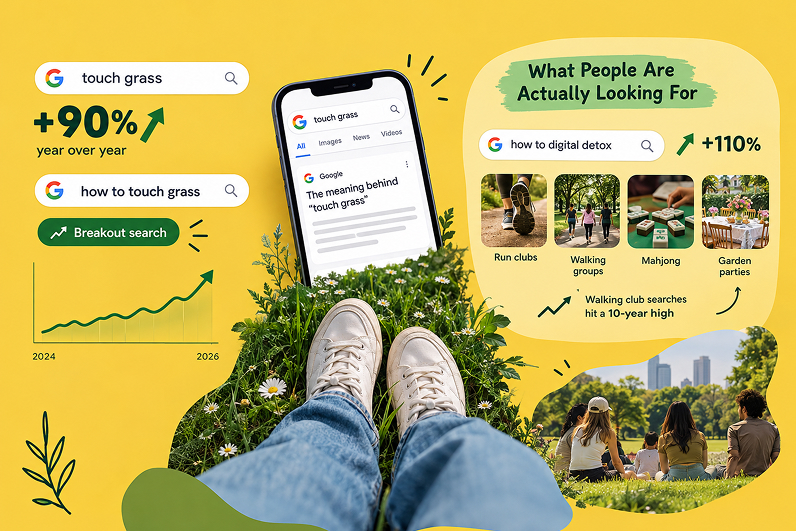
Google’s own trends data shows something genuinely happening underneath the joke. This data was published in mid-2026. It is a much bigger shift than a single phrase trending for a season.
A search engine’s own team writing about a meme is usually a sign. The underlying behavior has moved well past the joke stage.
Search Interest Is Exploding
Searches for “meaning of touch grass” are up 90% year over year. “How to touch grass” registered as a full breakout search in the month the report was published.
That’s not just people learning a new phrase. That’s people actively looking for the follow-through. This is a meaningfully different search intent than curiosity about slang.
Most viral phrases generate a spike in “what does X mean” searches and then fade once the definition circulates.
This one kept climbing well past that point. People actually asked how to do the thing the phrase describes. This suggests the meme tapped into something more durable than novelty.
What People Are Actually Looking For
The same report found “how to digital detox” up 110% since the start of the year. This is a much bigger surge than the meme itself. It rose alongside breakout interest in run clubs, walking groups, mahjong, and garden parties. Searches for “walking club” hit a ten-year high in the same period.
The throughline across all of it is obvious once you see it laid out. People aren’t just discovering a funny phrase.
They’re actively, measurably looking for ways to get offline and reconnect with something physical, structured, and offline. These are activities with a built-in format, a group, and a reason to show up in person.
They provide more than a vague intention to “be more present.” That vague intention tends to fade the moment the notification pings again.
We Already Had A Word for This
Here’s the part I think gets missed every time this trend gets covered by a site that isn’t writing for an Indian audience. It’s the part I actually think matters most about this whole piece.
Bare Feet At Home Were Never A Trend
I grew up in a house where shoes came off at the door, always, no negotiation. Where sitting on the floor for a meal wasn’t a wellness choice, it was just how meals happened sometimes.
Where my grandmother would tell me to go stand on the cool floor if I’d been sitting hunched over a book too long, not because she’d read a study, but because that’s what you did. None of this had a name.
It was never marketed to us. It was just how a home worked, passed down without anyone ever calling it a practice or a ritual.
Grounding, Rebranded
The internet now sells a repackaged, monetized version of a practice as “grounding” or “earthing”. This practice involves walking barefoot on grass or soil to reconnect with the body. However, this practice never left a lot of Indian households in the first place.
There’s a mat you can buy for it now, shipped internationally, marketed with testimonials about better sleep and reduced inflammation. There’s a $30-a-day retreat built entirely around the same idea, complete with a curated schedule and a hashtag.
We had a doormat, bare feet on a stone floor, and a mother telling us to go outside – no product, no subscription, no influencer partnership.
Just a habit nobody thought to sell back to us until someone else did first, packaged and priced as though it had never existed anywhere before.
The Science, Without the Overselling

I don’t want to overclaim here. That’s exactly the trap this kind of content usually falls into. It either dismisses the whole idea as nonsense or sells it as a cure-all. The honest answer sits somewhere less dramatic in between.
What Research Actually Shows
There’s genuine science behind why stepping outside helps, separate from any grounding-specific claims.
Time in nature is linked to measurable improvements in cardiovascular health, cognitive function, sleep quality, and overall mental health.
The Japanese practice of shinrin-yoku, or forest bathing, has specifically been shown to lower cortisol levels in controlled research. This happens alongside shifts toward parasympathetic dominance in the nervous system.
This dominance represents the “rest and digest” state. Your body struggles to access this state when it’s stuck fielding notifications all day.
Even listening to recorded nature sounds, with no outdoor exposure at all, has been shown to reduce pain perception and improve mood in some studies.
Where The Claims Go Too Far
The specific “earthing” claim – that direct skin contact with the ground transfers beneficial electrons into the body – is a lot shakier.
Some preliminary studies report interesting physiological signals. These signals include changes in inflammation markers and sleep quality. However, the research base is still small and mixed. In a fair number of cases, companies that sell grounding products fund the research.
The honest version of this section is: nature exposure helps, reasonably reliably, across a fairly wide body of research.
Whether it needs to be literal skin-to-soil contact to work, rather than simply being outside, is still an open question, not a settled one – and any source claiming certainty on that specific point is worth reading with a skeptical eye.
Why This Hits Different for Indian Millennials and Gen Z
This isn’t an abstract wellness trend for this audience. The numbers make that fairly concrete, and they’re worth sitting with rather than skimming past.
Why?
Because they explain why a two-word insult landed as hard as it did for so many people here specifically.
Screen Time Numbers
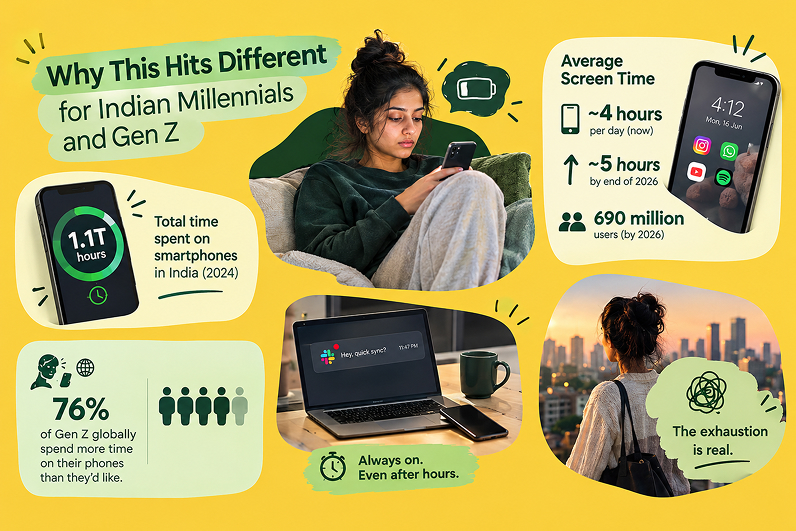
Indian smartphone users currently average close to four hours a day on their phones. Projections put that average closer to five hours by the end of 2026, with 690 million users.
In 2024 alone, Indian users collectively spent an estimated 1.1 trillion hours on smartphones. This number is too large to hold onto meaningfully. However, it is worth registering anyway.
Separately, roughly 76% of Gen Z respondents globally admit they spend more time on their phones than they’d actually like to.
This is a noticeably higher rate than older generations report. It represents a gap between behavior and preference. Most wellness content skips right past this gap.
The Always-On Culture At Work
Layer that onto a work culture where being reachable after hours is often treated as a given rather than an exception – where a late-night Slack ping gets answered on reflex.
Not because it’s urgent, but because not answering feels riskier than it should. And “touch grass” stops sounding like a joke and starts sounding like a genuine, if blunt, diagnosis.
The exhaustion isn’t imagined. It’s measurable, and for a lot of working women specifically, it’s compounding on top of everything else already competing for the same limited attention.
The Retreat Economy Catching Up
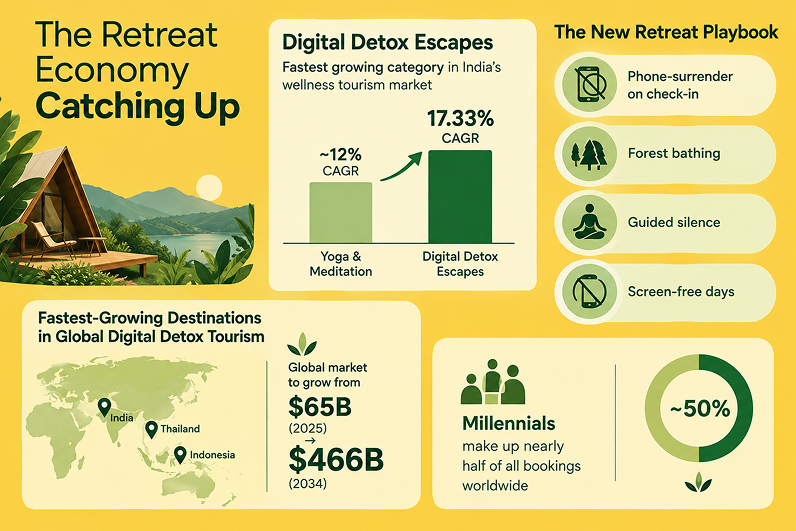
The market has clearly noticed the same thing the memes are pointing at. It’s worth registering just how fast this particular corner of wellness tourism has grown compared to categories that have existed far longer.
Digital-detox escapes are now the fastest-growing category in India’s wellness tourism market. They have a projected 17.33% compound annual growth rate through 2031. This outpaces even yoga and meditation retreats, which have long been the dominant category in Indian wellness travel.
Resorts across the country have started formalizing phone-surrender-on-check-in policies. They are building entire itineraries around forest bathing, guided silence, and screen-free days. They treat disconnection itself as the product being sold rather than an afterthought to a spa menu.
India also sits alongside Thailand and Indonesia among the fastest-growing destinations in the broader global digital detox tourism market. This is on track to grow from roughly $65 billion in 2025 to $466 billion by 2034, with millennials making up nearly half of all bookings worldwide.
We’ve actually covered this specific shift in a lot more depth in our piece on Digital Detox Retreats in India. If you’re curious what that looks like in practice – pricing, what a typical itinerary involves, and how to pick one that’s actually structured well rather than just marketed well – check that out!
What This Looks Like for Different People
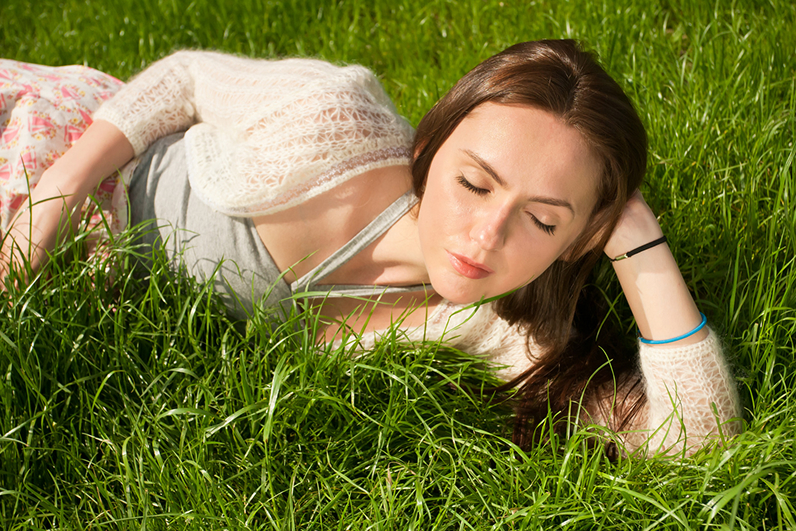
The scenarios below are composites, drawn from patterns commonly described around digital fatigue – not real, named individuals.
The Marketing Manager Who Couldn’t Sit Still
She’s 27, works in Bangalore, and describes her day as “back-to-back until it isn’t, and then I’m too tired to do anything except scroll.”
Her experiment wasn’t dramatic – she started eating lunch on her building’s terrace instead of at her desk, phone left behind on purpose.
Nothing about her workload changed.
She noticed a change after about ten days – she stopped reaching for her phone the second a meeting ended. She had built one small pocket of the day where that reflex didn’t automatically fire.
The Student Who Used It To End Arguments
He’s 21, in his final year of college, and first heard “touch grass” as an insult aimed at him during an online gaming argument. He didn’t take it as wellness advice at first – he took it as a challenge, then almost accidentally as a habit.
He started walking to a nearby park after particularly heated online exchanges instead of typing a reply.
Later he told a friend that he wasn’t sure if he was calmer because of the walk or because he’d simply removed himself from the argument long enough to lose interest in finishing it. Both, probably. That’s rather the point.
Who’s Actually Selling This
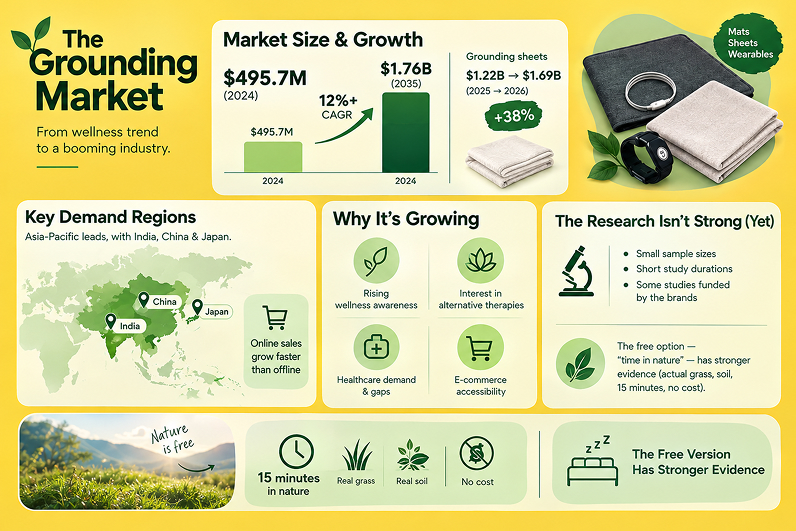
Once an idea like this gets big enough, an industry follows – and this one is a useful case study in how quickly that happens.
The Product Side
The global grounding products market was valued at roughly $495.7 million in 2024. This market includes mats, bed sheets, and wearables. It is projected to grow to $1.76 billion by 2035. This growth represents a compound annual growth rate above 12%.
Grounding sheets alone are forecast to jump from $1.22 billion in 2025 to $1.69 billion in 2026. This represents a striking 38% single-year growth rate.
Rising awareness of holistic wellness largely drives this growth. Expanding interest in alternative therapies also drives it. This happens as mainstream healthcare struggles to keep pace with demand.
India appears repeatedly in these market reports as one of the Asia-Pacific regions driving demand. It appears alongside China and Japan. Online sales specifically grow faster than offline retail. E-commerce makes these products more accessible than ever before.
Why This Still Isn’t The Same As Free
None of this is inherently dishonest. Some people do report better sleep using these products. The placebo effect alone is a legitimate mechanism worth taking seriously rather than dismissing.
But it’s worth naming plainly. The research base behind grounding mats specifically remains thin. It is built on small sample sizes and short study durations. A meaningful share of the existing research is funded by the same companies selling the product.
The free version has a comparatively stronger research base behind the broader “time in nature” mechanism than the specific product marketed to replicate it indoors. This version involves actual grass, actual soil, fifteen minutes, and no purchase required.
What Actually Happens When You Touch Grass
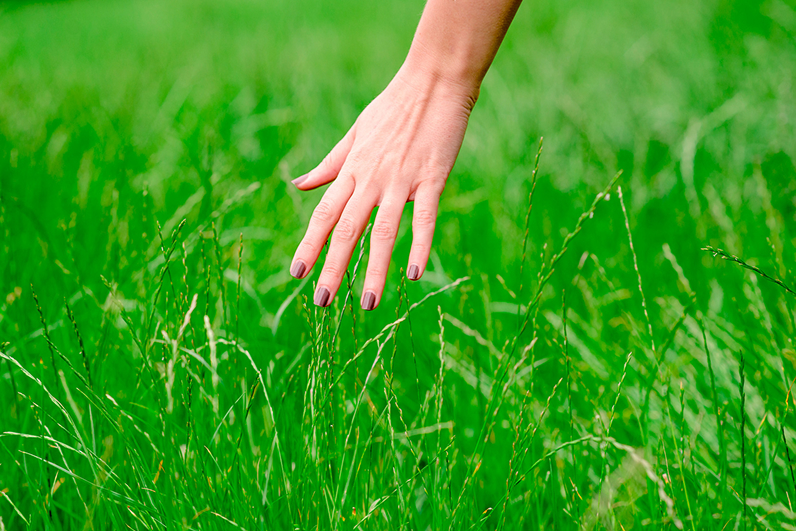
Setting the meme aside for a second, specificity about the actual mechanism matters. Vague advice like “go outside” loses its utility. This vagueness causes people to nod at and then ignore most wellness content.
The Nervous System Angle
Stepping outside, especially somewhere with natural light and greenery, appears to shift the body out of the low-grade sympathetic “on” state that hours of scrolling and notification-checking keep it stuck in.
This is closely related to why research on digital burnout ties chronic screen exposure to elevated stress markers. This exposure also disrupts sleep. The nervous system doesn’t fully distinguish between an actual threat and the low-level vigilance of constant notifications.
Removing that input, even briefly, gives it room to downshift, which is a large part of why fifteen minutes outside can feel disproportionately restorative compared to how little time it actually takes.
My Own Experiment
I tried the blunt version of this for a week – fifteen minutes outside, phone left indoors, no goal beyond being there. I didn’t feel transformed.
Rather, I felt, on most days, mildly annoyed for the first five minutes and noticeably calmer by the end of it. That’s a far less dramatic outcome than the wellness industry usually promises.
It’s also, I think, a far more honest one – and easier to actually sustain past the first week, because it never asked more of me than fifteen ordinary minutes.
How to Actually Use This
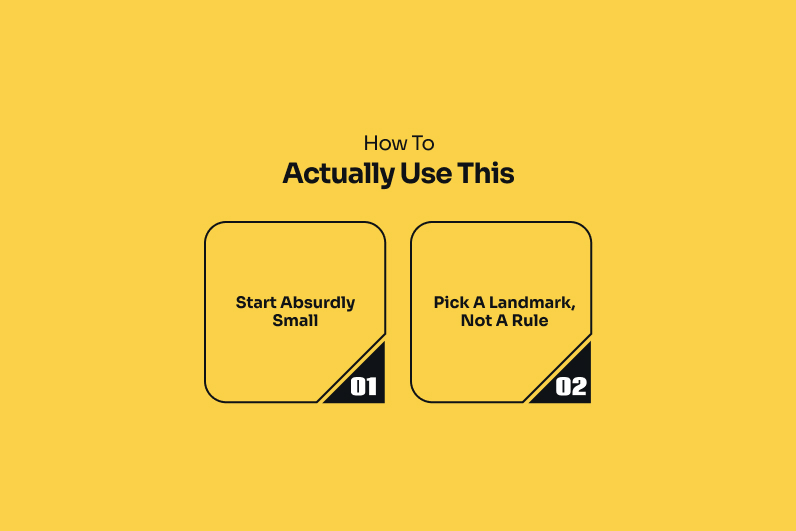
If you want to take the meme seriously without turning it into another task on a to-do list that’s already too long, a few things seem to actually matter, based on both the research above and what I noticed trying this myself.
Start Absurdly Small
Fifteen minutes, not an hour. A balcony, not a retreat.
The research on nature exposure doesn’t require a dramatic commitment to show a benefit – it requires consistency. And consistency is much easier to maintain when the bar is low enough that skipping it feels like a bigger effort than doing it.
Most people abandon wellness habits not because the habit doesn’t work, but because the starting version of it was too ambitious to survive a genuinely busy week.
Pick A Landmark, Not A Rule
“Every day” creates a rule. You break rules and then abandon them entirely the first time you miss one.
A landmark – after your last work notification of the day, before you open Instagram in the morning – gives the habit something to attach to, rather than asking your willpower to show up cold every single time.
This is the same logic behind why a fresh start on a specific date works better than a vague intention to “do better” starting whenever you get around to it.
How This Compares to the Internet’s Other “Theories”
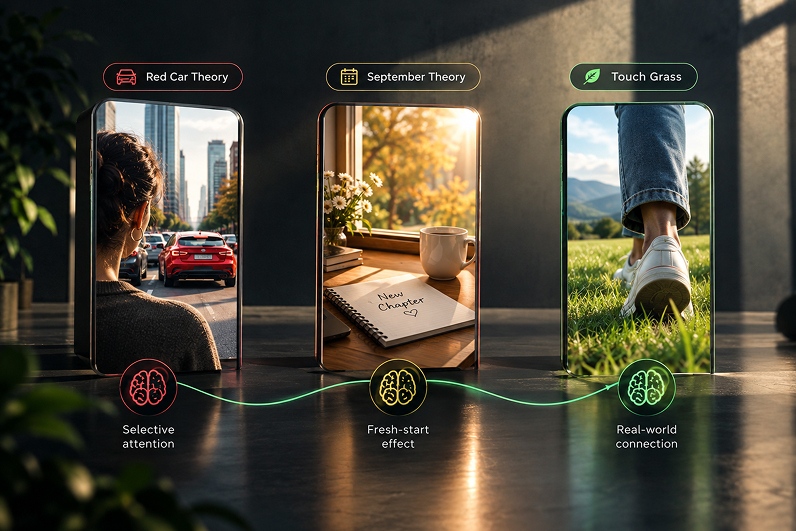
If you’ve read anything else on this site, you’ll notice touch grass fits a pattern rather than standing alone – and once you see the pattern, it’s hard to unsee it in the next trend that comes along.
The Same Shape, Different Packaging
Red Car Theory turned out to be selective attention wearing a catchier name. September Theory turned out to be the fresh-start effect wearing a seasonal one.
Touch grass is the same move again – a real, defensible psychological mechanism, repackaged into something short and shareable enough to survive a five-second scroll. None of these trends invented anything new about how the mind works.
They just found better marketing for ideas psychologists and, frankly, our own grandmothers already understood.
Why That Pattern Matters
I don’t think that repetition is a coincidence, and I don’t think it’s a criticism either.
It says something about what a generation raised entirely online actually wants: not new information, but old wisdom translated into a format that fits how we already communicate.
The lesson isn’t “ignore the meme because it’s not original.” It’s that the meme is usually pointing at something worth taking seriously, dressed up in a costume that makes it easier to swallow than the original advice ever was.
The Grass Was Always There
I keep coming back to this thought: the internet didn’t invent the idea that stepping outside helps. It just found a way to say it in two words rude enough to actually get through to people who’d ignore a wellness article completely.
Maybe that’s fine. Maybe the delivery mechanism doesn’t matter as much as whether it works. And for a lot of us, apparently, it does.
Not because the universe timed a meme perfectly, but because our bodies have been asking for this the entire time, in a language a lot older than TikTok.
I think about the marketing manager on her terrace, the student mid-argument choosing a walk instead of a reply, my own grandmother telling me to go stand on the cool floor without ever once calling it self-care.
None of them needed a market report or a peer-reviewed study to know something was true.
They just knew it. A lot of ordinary wisdom gets known this way. Generations quietly repeat it. Nobody markets or monetizes it. Eventually, someone online gets rude enough about it that the rest of us finally listen.
We just needed someone rude enough online to finally translate it.
Sources:
On the origin and spread of “touch grass”:
Know Your Meme, “Touch Grass” and “What Does ‘Touch Grass’ Mean? The Slang Term Explained” – documented origin circa 2015, widespread adoption 2020–2021.
On search trend data:
Google, “These Google Trends show people really want to touch grass” (The Keyword, 2026) – searches for “meaning of touch grass” up 90% year over year; “how to touch grass” and “how to digital detox” (+110%) as breakout searches.
On nature exposure and health outcomes:
Systematic review of nature exposure and health research (cited via Meme Wiki, 2026) – links to improved cardiovascular health, cognitive function, sleep quality, and mental health; shinrin-yoku research on cortisol reduction.
On grounding/earthing research and its limitations:
Cleveland Clinic, “Is Earthing Actually Good for You?” – evidence remains preliminary; Factually.co, “Is Earthing (Grounding) Real?” – mixed findings, funding-bias concerns, need for larger controlled trials.
On India’s digital detox retreat and wellness tourism market:
Mordor Intelligence, “Wellness Tourism Market in India” – Digital-Detox Escapes as fastest-growing category, 17.33% CAGR (2026–2031); Akbar Travels, “Digital Detox Retreats: Why People Are Traveling Just to Log Off” – global digital detox tourism market growth ($52B in 2024 to $466B by 2034), India among fastest-growing Asia-Pacific destinations, millennial booking share.
On India smartphone and screen time statistics:
GrabOn, “Smartphone Users In India (2026 Data)” – 690 million Indian smartphone users; Dailyhunt, “Which Countries Spend the Most Time on Smartphones? Here’s Where India Ranks” – Indian average daily smartphone usage near 4 hours, projected toward 5 hours by end of 2026, 1.1 trillion collective hours in 2024.